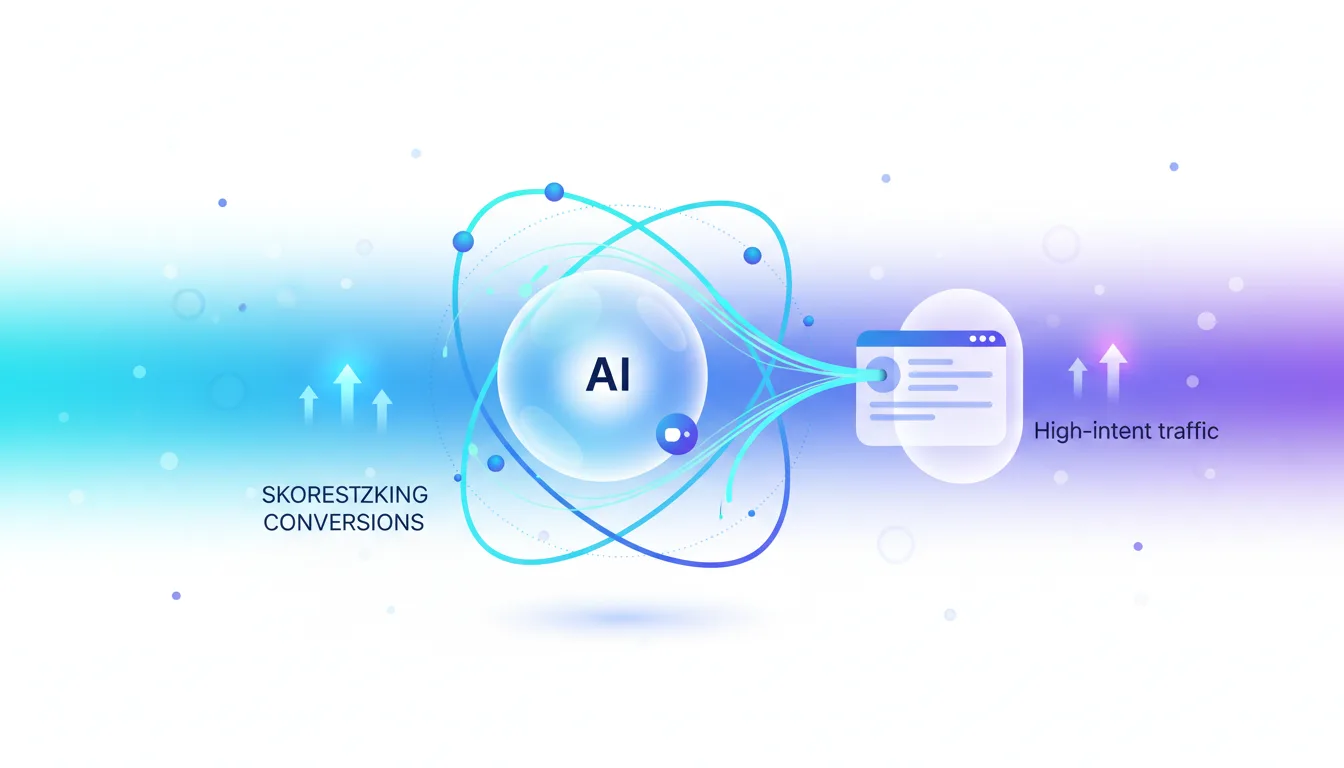
AI-Referred Traffic Converts 3–6x — The Rise of Answers Engine Optimization (AEO)
⚡ Quick Take
Have you ever wondered if the way people find your site is about to change overnight? Recent research claims traffic referred from AI assistants like ChatGPT and Gemini converts at 3-6x the rate of traditional sources, signaling a seismic shift for digital marketing and the beginning of a new discipline: Answers Engine Optimization (AEO). As the online starting point moves from the search bar to the AI prompt, the playbook for acquiring high-intent customers is being rewritten in real-time—right before our eyes, really.
Summary
A new report indicates that users clicking links from AI assistants are converting into leads and customers at a rate 3 to 6 times higher than visitors from channels like traditional search or social media. This is forcing an immediate re-evaluation of digital acquisition strategies, as the nature of user intent and the path to purchase are fundamentally changing, and it’s happening faster than most of us expected.
What happened
Analysis of website traffic has begun to distinguish visitors arriving from AI chatbot sessions. Early data suggests these visitors, having already refined their needs through a conversation with an AI, land on sites with a much stronger intent to act, leading to unprecedented conversion rates. From what I’ve seen in similar trends, it’s like they’ve done the heavy lifting upfront.
Why it matters now
The era of “ask an AI” is creating a new, highly-qualified traffic stream that most analytics tools are currently blind to. This isn’t just another referral source; it represents a new top-of-funnel controlled by AI platforms like OpenAI, Google, and Anthropic. Mastery of this channel offers a significant competitive advantage, one that could tip the scales in a crowded market.
Who is most affected
CMOs, growth marketers, CRO specialists, and SEO professionals are on the front line. Their existing strategies, built around keyword optimization for search engine results pages (SERPs), must now evolve to focus on getting their content, products, and data cited by AI models. It’s a pivot that feels inevitable, doesn’t it?
The under-reported angle
While the 3-6x conversion metric makes headlines, the more critical story is the attribution black hole. Much of this traffic appears as “dark” or “direct” due to lost referrer data, meaning most companies can’t see their biggest opportunity. The real challenge is building the measurement infrastructure for what’s being dubbed Answers Engine Optimization (AEO)—and getting ahead of it before it becomes the norm.
🧠 Deep Dive
What if the next big battle for your audience isn’t on a search page, but in a simple chat with an AI? A new front has opened in the war for customer attention, and it’s not on Google’s SERP or a social media feed—it’s inside the chat window of an AI assistant. The bombshell claim that AI-referred traffic converts up to 6x higher than traditional channels is forcing a total rethink of digital strategy. This traffic originates when a user, after a detailed query-and-answer session with an LLM like ChatGPT, Gemini, or Perplexity, clicks a source link to visit a website. They arrive not as browsers, but as pre-qualified prospects who have already used an AI to narrow down their options and define their needs—arriving with purpose, in other words.
The immediate-term crisis for marketers is one of measurement, plain and simple. This high-value traffic is largely invisible, often miscategorized as “direct traffic” because of inconsistent referrer-passing protocols from the AI platforms. This “dark traffic” phenomenon means most marketing teams are flying blind, unable to quantify, segment, or optimize for their most promising visitors. The emerging solution is a technical trifecta: deploying assistant-specific UTM tagging conventions, using server-log analysis to identify chatbot user-agents, and building AI-specific landing pages that can be tracked as distinct entry points. It’s a bit of a scramble, but one that’s worth the effort.
This measurement gap is accelerating the pivot from Search Engine Optimization (SEO) to Answers Engine Optimization (AEO). AEO is not about gaming keyword density; it’s about making your content the most citable, authoritative source for an LLM to reference. Succeeding in this new paradigm requires a focus on structured data, clear FAQ formats, verifiable statistics, and content that directly and accurately answers the questions your audience is asking the AI. The goal is no longer just to rank, but to be the definitive answer an AI trusts enough to cite—trust being the currency here.
This shift also demands a new CRO (Conversion Rate Optimization) playbook. Visitors arriving from an AI assistant have different expectations. They’ve been primed by a summary and are looking for quick validation and a clear path to action. Assistant-optimized landing pages must prioritize speed, scannability, prominent trust signals (like citations or expert validation), and frictionless calls-to-action. The user has already done their research with the AI; the landing page is for execution, not exploration. As competition for AI citations intensifies, the performance of these post-click experiences will be a critical differentiator, and I’ve noticed how overlooking that can make all the difference.
📊 Stakeholders & Impact
| Stakeholder / Aspect | Impact | Insight |
|---|---|---|
| Marketers & Brands | High | A powerful new acquisition channel has emerged, demanding new skills in AEO, attribution, and CRO—skills that could redefine how we grow. |
| AI/LLM Providers | High | The ability to drive high-converting traffic becomes a key value proposition and a future monetization vector (e.g., sponsored citations), opening doors we haven’t fully explored yet. |
| SEO Professionals | Significant | Roles will evolve from keyword-centric SEO to answer-centric AEO, focusing on content structure, authority, and data accuracy—it’s an exciting evolution, really. |
| Analytics & MarTech | High | A new market is opening for tools that can solve the AI attribution problem and provide AEO analytics, with plenty of room for innovation. |
✍️ About the analysis
Researched and written with AI assistance under the editorial responsibility of the i10X News team. The title image is an AI-generated illustration. Read our AI Use Policy. Spotted an error? Request a correction.
This analysis is based on synthesizing early-stage research reports on AI-referred traffic with an assessment of current marketing attribution challenges. It is written for marketing leaders, ecommerce managers, and digital strategists who need to understand and prepare for the shift from search-first to answers-first customer acquisition—because staying ahead means adapting thoughtfully.
🔭 i10x Perspective
Ever felt like the ground is shifting under the digital world you know? The rise of AI-referred traffic marks a fundamental redistribution of power at the front door of the internet. For two decades, Google’s search index was the undisputed starting point for digital discovery. Now, AI models from OpenAI, Google, Anthropic, and a growing list of competitors are becoming the primary aggregators of user intent—taking the reins, so to speak.
The future of digital acquisition will be fought on two battlegrounds: the ability to be cited by these intelligence platforms (AEO) and the race to monetize the resulting high-value traffic. The key unresolved tension is the attribution gap. Until a standard emerges for tracking visitors from AI sessions, the market will operate on anecdotal data and guesswork, creating a high-risk, high-reward environment for first-movers. The companies that solve the “dark traffic” problem won’t just optimize a new channel; they’ll be mapping the economic fabric of the AI-native internet—and that mapping could unlock opportunities we can only imagine now.