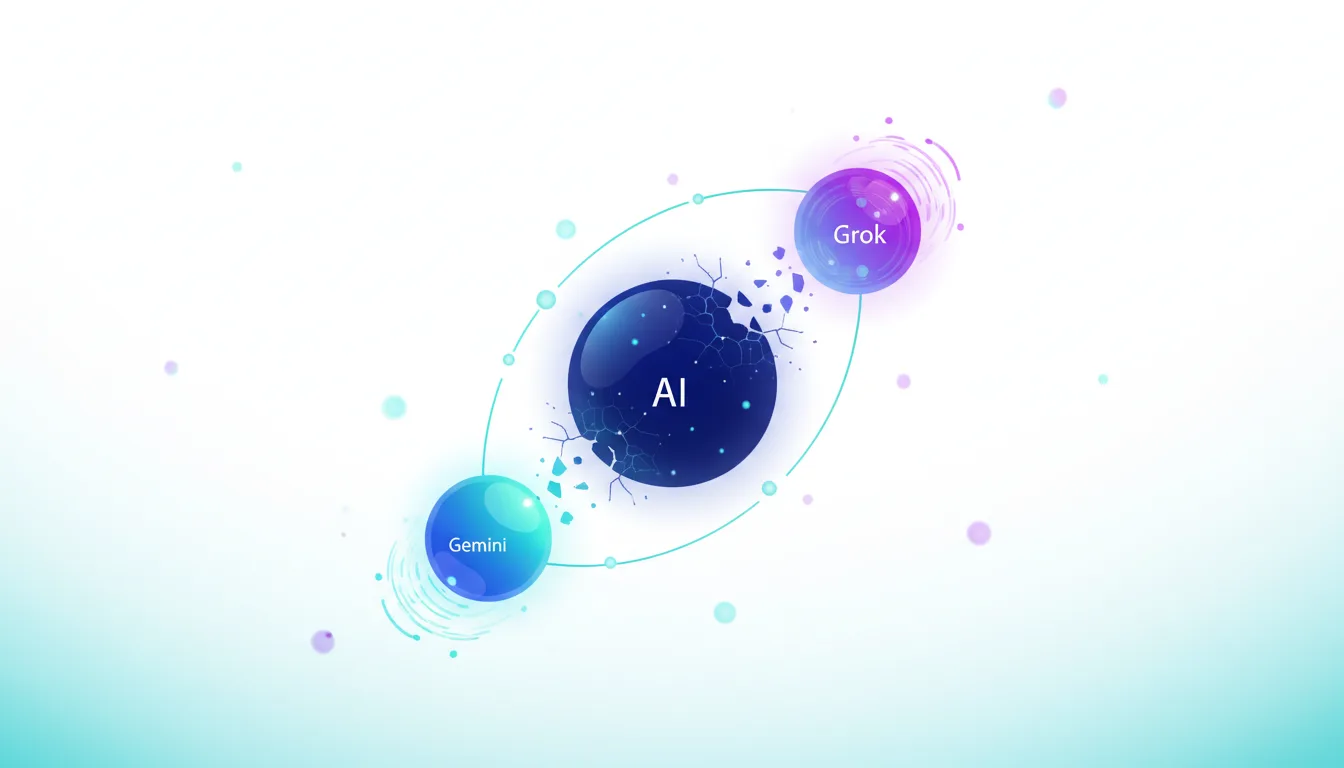
Gemini’s capturing search engine mindshare and Elon Musk’s Grok is winning the social buzz war, fracturing the AI landscape once dominated by ChatGPT. New 2025 search data reveals a critical divergence between public curiosity and embedded daily use, signaling the next phase of the AI platform wars is being fought not just on model capabilities, but on distribution and integration.
Quick Take
- Summary: According to Google’s 2025 “Year in Search” report for India, Gemini has become the most-searched AI topic, while xAI‘s Grok has also broken into the top 10 overall search terms. This surge in public interest indicates that ChatGPT‘s default position as the top-of-mind generative AI is being seriously challenged, heralding a multi-polar AI market. It’s one of those moments where you can almost feel the ground shifting underfoot.
- What happened: In a significant market signal, Gemini outranked all other AI models in search interest within India, a key global tech market. Both Gemini and Grok penetrated the mainstream consciousness, competing for attention alongside cultural giants like the Indian Premier League (IPL), which has historically dominated search rankings. From what I’ve observed in similar trends, that’s no small feat in a place where cricket fever runs so deep.
- Why it matters now: The era of a single, default AI chatbot is ending. Mindshare is fragmenting, driven by the distinct distribution strategies of major players. This forces enterprises and developers to look beyond a single provider and evaluate a more complex ecosystem of models, each with unique strengths tied to their native platforms (Google Search/Workspace vs. X). But here’s the thing – it puts a new spin on how we think about building with AI.
- Who is most affected: Enterprises and developers now face a more nuanced decision-making process for AI adoption, weighing the benefits of different integrated ecosystems. For AI providers, the battleground is shifting from pure model performance to the effectiveness of their distribution channels in converting curiosity into daily active users. Plenty of reasons, really, to start rethinking those partnerships.
- The under-reported angle: The biggest story isn’t just about rising search popularity; it’s the growing chasm between “search interest” (curiosity) and “market share” (daily productivity). While Gemini and Grok are winning search queries and social media buzz, data on active usage and web traffic suggests ChatGPT still holds a powerful incumbency advantage in day-to-day workflows. The key question is how effectively Google and X can convert their newfound attention into sticky, embedded usage – and whether that gap will close anytime soon.
Deep Dive
Have you ever watched a market tip from one clear leader to a crowded field, where everyone’s vying for their slice? Google’s 2025 search report from India acts as a bellwether for a global shift in the AI power dynamic. For the first time, models from Google (Gemini) and xAI (Grok) are not just niche topics for tech enthusiasts; they are mainstream cultural phenomena commanding search volume on par with massive sporting events. This marks the end of the market’s initial phase, where OpenAI’s ChatGPT was the singular, default entry point for generative AI. We’re now entering a multi-front war for user attention, where different models are winning on different battlefields. It’s fascinating, isn’t it, how quickly that monopoly feel has faded.
The core tension, however, lies in the data – and it’s worth pausing on that. While news outlets covering the Google report rightly highlight Gemini‘s dominance in search, market analysis firms focusing on web traffic and market share paint a more complex picture. Reports from sources like FirstPageSage and ExplodingTopics often still place ChatGPT at the top for monthly active users and overall web visits. This discrepancy reveals the crucial difference between “buzz” and “business,” or as I like to think of it, the spark versus the steady flame. Gemini is winning the battle for initial curiosity, but OpenAI is still deeply embedded in existing workflows. That said, it’s the kind of split that keeps strategists up at night.
This divergence is rooted in fundamentally different distribution strategies, each with its own clever angle. Gemini’s rise is intrinsically linked to its deep integration within the Google ecosystem. It is being woven into Android, Chrome, and, most critically, Google Workspace. This strategy aims to make Gemini the default intelligence layer for billions of users, turning search interest into ambient, daily utility. For Gemini, the path to market share runs through the enterprise and consumer products Google already dominates – a smart play on what they know best.
Grok’s popularity follows a different playbook entirely: “The X Effect.” Its primary advantage is its native integration with X, giving it access to a real-time, conversational firehose of data and a platform built for viral discourse. Grok’s personality – often provocative and unfiltered – is engineered for social media buzz, making it the leader in capturing topical, in-the-moment conversations. Its popularity is less about workplace productivity and more about being the fastest, most culturally-attuned AI, creating a unique moat based on speed and relevance. The AI landscape is no longer a simple race for the “best” model, but a strategic competition between deeply integrated ecosystems, each pulling users in their own direction.
Stakeholders & Impact
| Stakeholder / Aspect | Impact | Insight |
|---|---|---|
| AI / LLM Providers | High | The fragmentation of mindshare forces a shift in strategy – it’s not just about building the smartest model anymore. Success now depends on converting platform-specific attention (from Search or X) into loyal, high-retention users. The race is about ecosystem lock-in, not just public benchmarks, and that’s where things get really interesting. |
| Enterprises & Devs | High | The choice of a foundation model is no longer straightforward; it’s a bit like picking the right tool for a job that keeps evolving. It’s now a strategic decision based on workflow integration. Do you need the collaborative productivity of Workspace (Gemini), the real-time social insight of X (Grok), or the broad, established API ecosystem of OpenAI? Weighing those options takes some thought. |
| Platform Owners (Google/X) | Significant | This trend validates their core strategy of leveraging massive existing user bases as a distribution channel for their AI models. Their primary metric for success will be converting initial “search interest” or “social buzz” into measurable daily active usage within their platforms – easier said than done, but they’re off to a strong start. |
| End Users | Medium | Users benefit from increased choice and competition, but also face the potential for ecosystem fragmentation where different tasks require different AI assistants. The “one AI to rule them all” future seems less likely, which could mean more flexibility – or just a bit more hassle in switching between tools. |
About the analysis
Researched and written with AI assistance under the editorial responsibility of the i10X News team. The title image is an AI-generated illustration. Read our AI Use Policy. Spotted an error? Request a correction.
This i10x analysis is an independent synthesis based on a review of Google’s 2025 search trend reports, third-party market share data, and comparative analyses of AI assistant features. It’s written for product strategists, developers, and CTOs seeking to understand the strategic drivers behind shifts in AI model popularity and make informed technology choices. I’ve pulled together these threads to highlight what’s practical amid the noise.
i10x Perspective
The AI landscape is rapidly evolving from a model-centric to a distribution-centric battleground – you can sense the pivot happening right now. The era of a single hegemonic AI is over, and that’s both exciting and a touch daunting. The future of intelligence infrastructure is not just about who builds the most capable model, but who owns the most effective “on-ramp” for users – be it a search bar, a social feed, or an operating system. The most significant unresolved tension is whether this battle of integrated ecosystems will lead to innovative, specialized AI services or create powerful, walled gardens that limit user choice and stifle the next wave of independent AI startups. Either way, it’s a landscape worth watching closely.