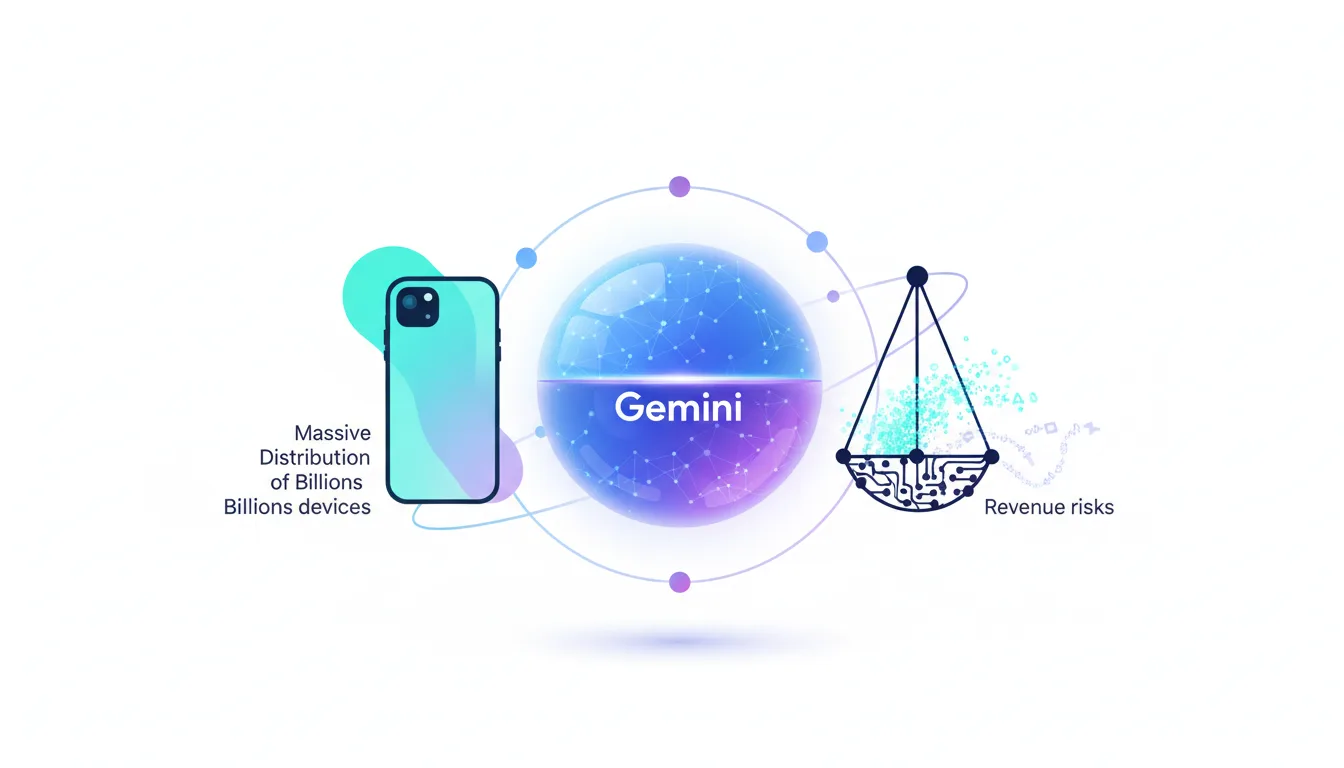
Have you ever watched a market shift its gaze so quickly? The market is suddenly seeing Google not just as a search giant with an AI hobby, but as a contender for the premier public AI stock. The catalyst is its potential Gemini deal with Apple, which offers a path to put its flagship models on over a billion iPhones. Yet the real story isn’t the distribution—it’s whether Google’s internal economics and core business model can survive the victory.
Quick Take
- Summary: Alphabet (GOOGL) is being re-evaluated as a top AI investment, largely driven by negotiations to integrate its Gemini AI models into Apple’s iOS. This potential partnership grants Google unparalleled distribution, positioning it as a powerful alternative to OpenAI on the world’s most valuable mobile platform and forcing a showdown over the future of AI monetization. From what I’ve seen in these kinds of tech pivots, it’s the kind of move that could redefine who’s leading the pack.
- What happened: Reports have confirmed that Apple is in active discussions to license Google’s Gemini models to power new generative AI features in upcoming versions of iOS. This move would embed Google’s AI directly into the iPhone ecosystem, potentially alongside Apple’s own models and other partners like OpenAI. It’s straightforward enough on the surface – but that’s where things get interesting.
- Why it matters now: For a decade, Google paid Apple to be the default search engine. This potential evolution of the partnership—from search provider to intelligence provider—marks a critical inflection point in the AI platform wars. It gives Google a direct channel to a massive, high-value user base outside its Android ecosystem and allows Apple to instantly close its perceived generative AI gap. But here’s the thing: in an industry moving this fast, timing like this isn’t just lucky – it’s a game-changer.
- Who is most affected: This directly impacts Google, Apple, and their chief rival, OpenAI/Microsoft. For Google, it’s a test of its AI monetization strategy. For Apple, it’s a strategic choice between building, buying, or partnering for core AI capabilities. For OpenAI, it threatens its early lead as the go-to AI partner for enterprises and platforms. Plenty of reasons to keep an eye on all sides, really.
- The under-reported angle: Most analysis focuses on the potential revenue from a licensing deal. The real, and far more critical, story is twofold:
- the unit economics of serving AI answers at iPhone scale, a test of Google’s custom Tensor Processing Units (TPUs) versus the industry’s reliance on costly NVIDIA GPUs, and
- the existential risk of Google’s own AI-powered Search (SGE) cannibalizing its fabulously profitable ad business. It’s the quieter pressures – those internal ones – that often trip up even the biggest players.
Deep Dive
Ever wonder what happens when a tech narrative does a complete 180? The narrative around Google’s AI ambitions has flipped. Once seen as a sleeping giant caught off guard by OpenAI, the company is now being framed as a strategic powerhouse, with the potential Apple partnership serving as the ultimate validation. Where news outlets reported the “what”—the talks themselves—and investment blogs debated valuation, the critical underlying machinery of this potential deal remains unexplored. The core question isn’t if Google can get its AI onto iPhones, but whether it can afford the victory. I’ve noticed how these overlooked details tend to surface later, shaping the real outcomes.
The first hidden challenge is the brutal unit economics of AI at scale – you know, the kind that keeps CFOs up at night. Every generative AI query costs money to serve—a process called inference. While most of the AI world runs on expensive, general-purpose NVIDIA GPUs, Google has a secret weapon: its decade-long investment in custom Tensor Processing Units (TPUs). The latest generations (TPU v5e/v5p) are specifically optimized for efficient inference of its own models. The Apple deal would be the ultimate stress test of this hardware advantage. If Google can serve a billion users’ AI requests at a lower cost than competitors, it isn’t just winning a deal; it’s revealing a deep, structural moat in the AI infrastructure race. That said, scaling like that – it’s a high-wire act, balancing efficiency with reliability.
The second, more dangerous test is internal, and honestly, a bit trickier to pin down. While the world watches Gemini on the iPhone, an even bigger transformation is happening within Google’s core product: Search Generative Experience (SGE). The SGE replaces a simple list of ten blue links—a high-margin ad delivery system perfected over two decades—with a computationally expensive, AI-generated paragraph. This introduces a massive paradox. Does SGE create new, better advertising opportunities, or does it simply answer the user’s question directly, eliminating their need to click on profitable ads? This risk of margin compression and ad revenue cannibalization is the single biggest variable in Alphabet’s future, and one that the current bull thesis often glosses over. It’s like weighing the upsides of innovation against the quiet erosion of what built the empire.
Ultimately, the Apple deal is not an isolated event but a key component of Google’s full-stack AI strategy. It leverages Gemini models that are already being integrated across its portfolio—from enhancing YouTube with AI dubbing to powering enterprise workflows in Google Cloud’s Vertex AI. Securing a spot on iOS would serve as external proof that its models are competitive with the best, driving a flywheel effect that benefits its cloud and enterprise businesses. The battle for AI stock supremacy is no longer just about who has the smartest model, but who has the most efficient infrastructure and the most viable business model to deliver intelligence at a global scale. And that, in the end, might be what tips the scales.
Stakeholders & Impact
| Stakeholder / Aspect | Impact | Insight |
|---|---|---|
| Google / Alphabet | High | Secures massive distribution for Gemini, validating its model quality against OpenAI. Puts enormous pressure on its TPU-based infrastructure and AI cost structure. It’s a win that demands they tread carefully on the economics side. |
| Apple | High | Fills its immediate generative AI gap with a proven model, but creates a strategic dependency on a major competitor for core “intelligence” features. A smart shortcut – or a vulnerability in the making? |
| OpenAI / Microsoft | Significant | Loses the chance for exclusive or primary AI integration on iOS, establishing Gemini as a formidable platform competitor. Increases pressure on Azure’s AI economics, forcing quicker adaptations. |
| Investors & Markets | High | Forces a re-rating of GOOGL based on AI monetization potential beyond advertising. The narrative shifts from “catching up” to “leading on profitable scale.” Eyes will be glued to how this plays out. |
About the analysis
Researched and written with AI assistance under the editorial responsibility of the i10X News team. The title image is an AI-generated illustration. Read our AI Use Policy. Spotted an error? Request a correction.
This is an independent i10x analysis based on a synthesis of market reporting, investment research, and technical documentation. It is designed to provide developers, product managers, and technology leaders with a deeper understanding of the strategic forces shaping the AI infrastructure landscape beyond the daily headlines. Think of it as notes from someone who’s tracked these trends for years – practical, not flashy.
i10x Perspective
What if the real turning point in AI isn’t the flashiest benchmark, but something more grounded? The potential Apple-Google deal signals a pivotal maturation in the AI race. The war is no longer just about model benchmarks; it’s about distribution, unit economics, and business model integration. Google is making a calculated bet that it can leverage its custom silicon (TPUs) to make AI inference a profitable, horizontal platform service, much like it did with search. From my vantage point, it’s a bold evolution – one that’s equal parts opportunity and tightrope.
This forces a fundamental choice: does Google remain a vertically integrated advertising machine, or does it evolve into a horizontal intelligence provider, selling its AI like a utility? The unresolved tension is whether these two business models can coexist. Can the new, expensive AI inference engine be grafted onto the old, high-margin advertising engine without the entire structure collapsing? How Alphabet answers that question over the next five years will determine whether it truly becomes the definitive AI stock of this decade. It’s the kind of crossroads that lingers in your mind, isn’t it?