Apple is officially integrating Google’s Gemini models to supercharge a long-overdue Siri overhaul, a landmark partnership that signals a new era of AI co-opetition. The move pits Apple’s urgent need for state-of-the-art AI capabilities against its ironclad brand of user privacy, creating a complex new dynamic in the platform wars.
Quick Take
- Summary: Apple has confirmed a partnership with Google to use Gemini models to power advanced features within “Apple Intelligence,” its new AI system. This will manifest as a significantly more capable Siri, able to handle complex, context-aware queries that go beyond the scope of Apple’s on-device models.
- What happened: Instead of building or acquiring a top-tier large language model in time for its next OS update, Apple has opted to license one from its biggest competitor. The integration will be presented to users as an optional, opt-in feature, routing certain complex requests from Siri to Google’s cloud-based Gemini AI.
- Why it matters now: This is a tacit admission from Apple that its in-house LLM development lags behind the market leaders. In the race to embed generative AI into every user experience, even the world’s most valuable company has to pick its battles. This move prioritizes feature velocity over vertical integration, fundamentally altering the competitive landscape.
- Who is most affected: iPhone users, who will finally get a competitive AI assistant; Google, which gains unprecedented access to the world’s most valuable user base; and rival model providers like OpenAI, who have been temporarily sidelined in the battle for iOS integration.
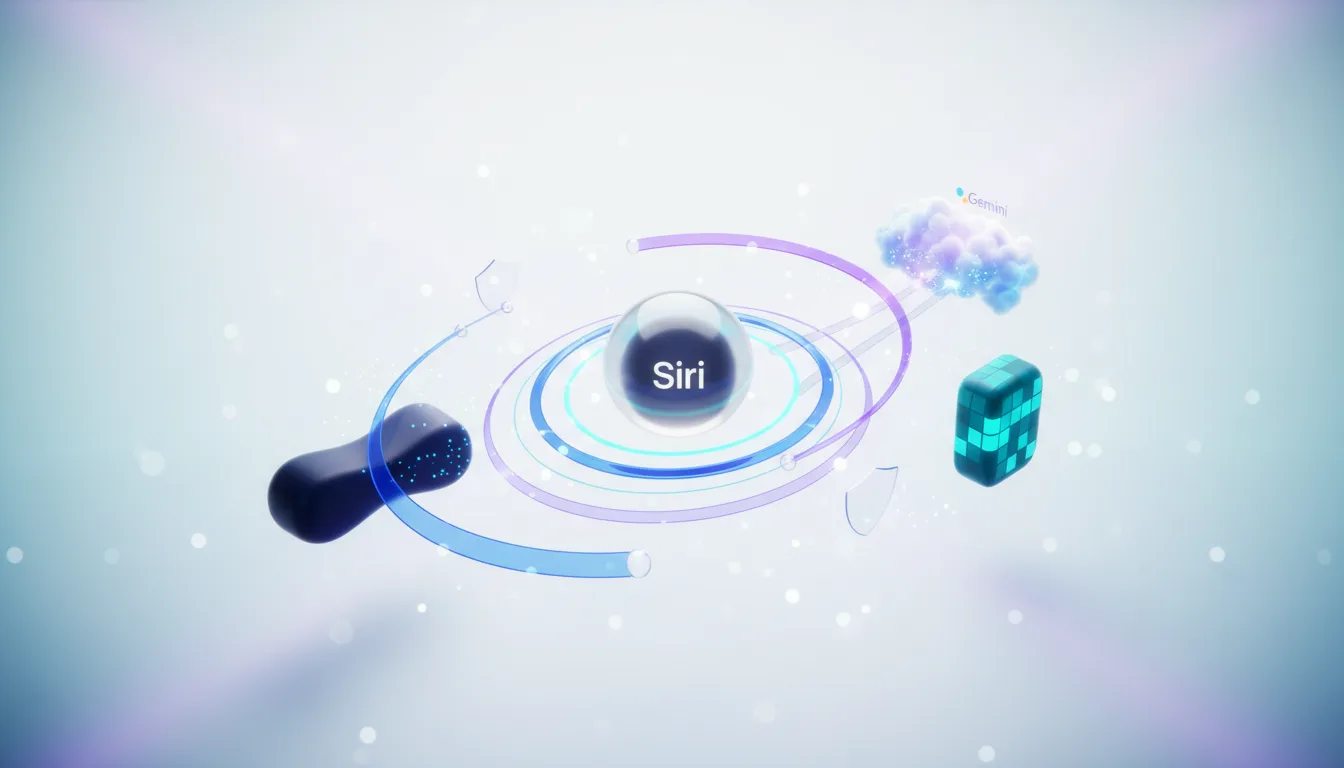
- The under-reported angle: The real story isn’t just “Siri gets smarter.” It’s the sophisticated, multi-tiered architecture Apple has engineered to make this partnership palatable. The system is designed to handle requests on-device first, then escalate to Apple’s “Private Cloud Compute,” and only then, with explicit user consent, hand off queries to Google’s Gemini. This privacy-centric brokerage is the core innovation.
Deep Dive
Have you ever wondered why Siri, for all its charm, often feels a step behind the competition in handling those tricky, everyday conversations? For years, Siri has been the Achilles’ heel of the iOS ecosystem – a digital assistant left behind by the rapid advances in conversational AI. Apple’s answer, dubbed “Apple Intelligence,” finally addresses this by striking a pragmatic, if surprising, alliance with Google. This partnership isn’t a simple API call; it represents a major strategic pivot, acknowledging that in the generative AI era, not even Apple can build everything in its own walled garden.
The core of this strategy lies in a three-tiered processing hierarchy designed to balance power with privacy. Simple tasks will remain on-device, leveraging Apple’s own, smaller models for speed and security. More complex queries will be sent to Private Cloud Compute, a new infrastructure built with Apple silicon that processes user data in a secure, stateless environment. Only when a request exceeds the capabilities of both tiers will Siri ask for permission to tap into Google’s Gemini. This tiered system is a massive technical and marketing effort to reassure users that Apple remains the final arbiter of their data, even when using a rival’s service – or at least, that’s how it feels from what I’ve seen in similar tech rollouts.
This deep integration is poised to transform core Apple apps. Reports suggest Gemini-powered Siri will enable contextual actions across Photos, Mail, Messages, and Music. Imagine asking Siri to “summarize all emails from my manager this week and draft a reply,” or “find photos from my trip to Lisbon and create a shared album.” These are tasks current Siri is incapable of, and they rely on the kind of cross-app context awareness that a powerful foundational model like Gemini can provide. It’s the sort of seamless help that could make your day a little smoother, really.
The decision to partner with Google over others, like OpenAI, is a calculated strategic move. It leverages an existing, multi-billion-dollar search relationship and potentially boxes out a fast-moving competitor. However, it also raises significant antitrust questions, as it further concentrates the power of AI development and distribution in the hands of two of tech’s largest players. The AI race is no longer just about who builds the best model, but who controls the endpoints – and Apple just handed Google a key to over a billion of them.
Stakeholders & Impact
| Stakeholder | Impact | Insight |
|---|---|---|
| Apple | High | Fills a critical LLM capability gap to stay competitive in AI, but at the cost of strategic dependence on a primary rival and a complex privacy narrative. |
| High | A massive distribution victory. Gemini becomes a core service on the world’s most lucrative mobile platform, entrenching its AI models as a foundational utility. | |
| iPhone Users | High | Gain a vastly more capable and useful digital assistant. However, they must now navigate a new set of privacy choices and understand when their data leaves the Apple ecosystem. |
| App Developers | Significant | The new Siri’s potential integration with Shortcuts and app intents could unlock powerful, voice-driven workflows, but may also increase reliance on Apple’s specific AI framework. |
| Regulators | Medium-High | The deal will face intense scrutiny from antitrust authorities in the US and EU, who are already concerned about the consolidation of power in the AI market. |
About the analysis
Researched and written with AI assistance under the editorial responsibility of the i10X News team. The title image is an AI-generated illustration. Read our AI Use Policy. Spotted an error? Request a correction.
This is an independent i10x analysis based on official company statements, specialized industry reporting, and an evaluation of the proposed technical architecture. It synthesizes publicly available information to provide a strategic perspective for developers, product leaders, and CTOs navigating the rapidly evolving AI ecosystem.
i10x Perspective
Ever feel like the tech giants are rewriting the rules right under our noses? This partnership signals the end of the pure “walled garden” strategy in the age of foundation models. AI is becoming a utility, like electricity, and even the most self-sufficient companies must plug into the grid. Apple’s move isn’t a failure, but a recognition that the future of intelligence infrastructure is collaborative, distributed, and brokered.
The critical long-term tension to watch is not whether Siri gets better, but which layer of the new intelligence stack – on-device, private cloud, or public LLM – captures the most valuable user interactions. Apple has built the plumbing to control the flow, but it has also conceded that the most powerful source of intelligence currently lies outside its walls. This redefines the platform wars from a battle over hardware to a sophisticated struggle for control over AI’s cognitive supply chain, and I’ve got to say, it’s fascinating to watch unfold.