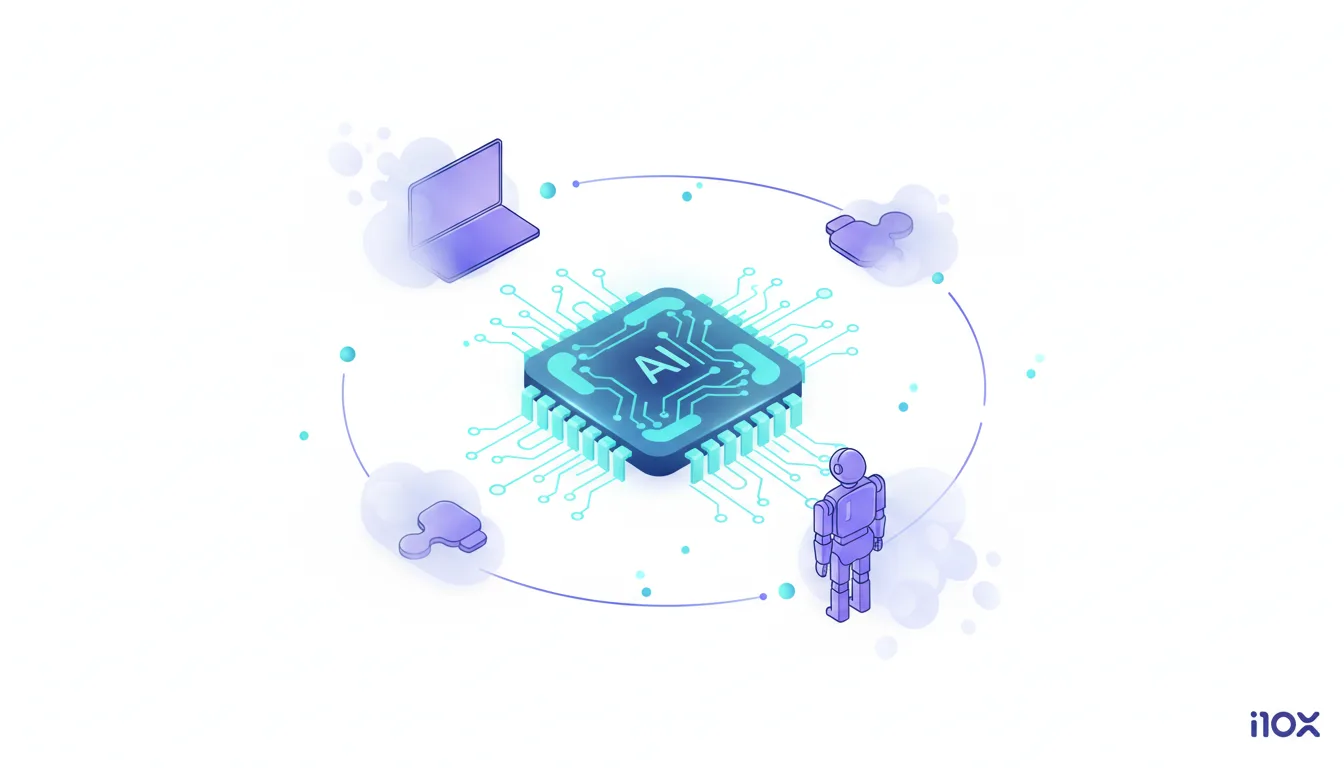
CES 2026 marks a pivotal moment for artificial intelligence, as the industry’s focus shifts decisively from the ethereal world of cloud-based LLMs to the tangible reality of on-device AI. The show floor in Las Vegas has become a physical battleground where the race for AI dominance is being waged in silicon, with fierce competition over the chips, laptops, robots, and home assistants that will run next-generation intelligence locally.
Quick Take
- Summary: Have you ever wondered when AI might finally feel more like a personal companion than a distant server? At CES 2026, the AI revolution has moved from the cloud to the edge. Major announcements from Nvidia, AMD, Amazon, and others reveal a market-wide push to embed powerful generative AI capabilities directly into consumer and enterprise hardware, transforming laptops, smart homes, and robots into independent intelligent agents – something that’s starting to feel, well, a bit more real.
- What happened: Nvidia and AMD have escalated their “chip wars” with new hardware platforms like Nvidia’s “Rubin” and updated Ryzen AI chips, both designed to power on-device generative AI. This silicon arms race is fueling a new category of “AI PCs” and enabling more sophisticated robotics and agentic assistants like Amazon’s Alexa+, which now integrates with third-party services to perform complex tasks. It’s all happening faster than I expected, really.
- Why it matters now: But here’s the thing – this transition from cloud-dependent to edge-native AI is the most significant architectural shift in computing since mobile. It signals that the next phase of AI innovation will be defined not just by model size, but by hardware efficiency, power consumption, and the developer ecosystems built around new Neural Processing Units (NPUs). From what I’ve seen in these announcements, it’s like the industry’s finally weighing the upsides against the practical limits.
- Who is most affected: Hardware manufacturers (Nvidia, AMD, PC makers), software developers who must now target on-device NPUs, and enterprises evaluating the total cost of ownership (TCO) and security of edge AI devices. Consumers will benefit from more responsive, privacy-preserving AI but face a confusing landscape of competing ecosystems – a mix of excitement and, yeah, a little frustration if you’re trying to keep up.
- The under-reported angle: While the industry celebrates the “democratization” of AI through on-device processing, it largely ignores the new bottlenecks: battery life, thermal management, and the lack of standardized benchmarks (TOPS/TFLOPS) to verify performance claims. Furthermore, the promise of enhanced privacy through local processing remains an unproven claim that demands deeper technical scrutiny. It’s one of those details that keeps nagging at me, you know?
Deep Dive
Ever caught yourself thinking CES is just a parade of gadgets, but really it’s where the future gets a sneak peek? CES 2026 isn’t just another tech showcase; it’s the physical manifestation of the AI industry’s second act. After years of focusing on massive, cloud-hosted models, the frontier has moved to the edge. The key narrative emerging from Las Vegas is the mass physicalization of intelligence, where the abstract power of AI is being packed into the silicon, plastic, and metal of the devices we use every day. This shift introduces a new set of rules and a new competitive arena focused on efficiency, privacy, and real-world utility over raw scale – not a small change, by any stretch.
The epicenter of this shift is the renewed “chip war” between Nvidia and AMD. Nvidia’s unveiling of its “Rubin” platform and AMD’s counter-offensive with new Ryzen AI chips go far beyond incremental upgrades. This is a strategic battle for the soul of the emerging “AI PC.” The focus has expanded from pure GPU horsepower to the efficiency of integrated Neural Processing Units (NPUs), measured in Terra Operations Per Second (TOPS). The winner won’t just be who delivers the most raw power, but who can do so within the thermal and battery constraints of a laptop, providing a stable and compelling platform for developers to build the next generation of AI-native applications. I’ve noticed how this emphasis on balance is quietly reshaping priorities, almost like treading carefully on a tightrope.
This hardware arms race directly enables the move from simple “smart” assistants to truly agentic AI. Amazon’s announcements for Alexa+ serve as a prime example. By integrating directly with web services from Expedia, Yelp, and Square, Alexa is evolving from a reactive voice command system into a proactive agent capable of booking trips, ordering services, and managing commerce. This demonstrates a crucial trend: AI is no longer just about answering questions; it’s about executing multi-step tasks in the real world, a capability that relies on the low-latency processing that on-device hardware provides. That said, it’s impressive – but only if those integrations hold up day to day.
While AI PCs and smart agents are grabbing headlines, the progress in robotics reveals a more pragmatic, enterprise-focused dimension of the edge AI trend. Companies like Siemens are showcasing robots not as flashy humanoid novelties but as practical solutions for logistics and manufacturing. This grounds the AI hype in the language of business: total cost of ownership (TCO), operational efficiency, and workplace safety. The key challenge, as highlighted by gaps in current coverage, is moving beyond impressive demos to address the mundane but critical questions of manageability, integration with existing enterprise systems, and long-term reliability. Plenty of reasons to stay skeptical there, plenty.
Finally, this migration to the edge forces a conversation the industry has been avoiding: the real-world trade-offs. On-device AI is being marketed as inherently more private, but without clear standards or third-party audits, these are just marketing claims. Every watt of power an NPU consumes to run a local language model is a watt drawn from a finite battery. The silence from vendors on standardized power efficiency benchmarks, thermal design power (TDP) under AI load, and verifiable privacy controls is the most significant story at CES – a story of unresolved technical and ethical challenges that will define the success or failure of the on-device AI revolution. And honestly, it’s the kind of oversight that could trip things up down the line.
Stakeholders & Impact
| Stakeholder / Aspect | Impact | Insight |
|---|---|---|
| AI Model Providers (OpenAI, Google, etc.) | Medium | Their dominance is challenged by on-device models. They must now create smaller, efficient models and partner with hardware makers, shifting focus from pure scale to deployment flexibility. |
| Hardware & Chip Makers (Nvidia, AMD, Intel) | High | This is their new primary battleground. Success depends on winning the AI PC market through a superior balance of NPU performance, power efficiency, and developer toolchains (SDKs, APIs). |
| Consumers & End-Users | High | Gain faster, more private AI experiences but face a fragmented market with competing hardware ecosystems, confusing performance metrics (TOPS), and uncertain long-term support. |
| Developers & Enterprises | Significant | A new development paradigm emerges, requiring apps to target local NPUs. Enterprises must evaluate the TCO and security of deploying and managing thousands of AI-enabled edge devices. |
About the analysis
Researched and written with AI assistance under the editorial responsibility of the i10X News team. The title image is an AI-generated illustration. Read our AI Use Policy. Spotted an error? Request a correction.
What if I told you this isn’t just pulled from press releases, but pieced together with a critical eye? This is an independent i10x analysis based on a synthesis of official company announcements, mainstream news coverage, and identified content gaps from CES 2026. This piece is written for developers, product leaders, and strategists seeking to understand the architectural shifts and market dynamics driving the next phase of AI infrastructure – the kind of insights that stick with you.
i10x Perspective
Isn’t it fascinating how CES 2026 is flipping the script on what we thought AI would be? CES 2026 signals that AI is no longer just software; it is now inseparable from the hardware that runs it. The cloud, once the undisputed center of AI, is becoming a hub in a powerful new distributed network that extends to every device. The competitive landscape will be redrawn around the companies that master the physics of intelligence – managing power, heat, and silicon to deliver performance at the edge. The great, unresolved tension for the next decade is whether this decentralization will truly empower users with privacy and control, or simply create new, more powerful forms of hardware-based ecosystem lock-in. It’s a tension worth pondering, if you ask me.