Quick Take
China is executing a pragmatic pivot in the global AI race, sidestepping a direct-frontal assault on Western frontier models. Instead, it’s building a resilient, state-backed AI ecosystem by weaponizing open-source models, optimizing for compute efficiency under sanctions, and driving rapid deployment into the physical economy—a strategy focused on ubiquity and industrial value over raw scale.
Summary
Have you ever wondered why the U.S. AI story seems fixated on bigger and bigger models? China, on the other hand, is taking a different route—one that’s more about getting things done. They’re unleashing a series of strong, affordable open-source LLMs, paired with a nationwide push for their own compute setup. From what I’ve seen in the reports, this approach puts practical use, keeping costs down, and standing firm against outside pressures right at the center.
What happened
Lately, a bunch of Chinese tech heavyweights and newcomers—like Alibaba with Qwen, Zhipu AI’s GLM, Baichuan, and DeepSeek—have gone all-in on open-sourcing entire lines of impressive models. That’s unfolding right alongside a huge government-backed rollout of “intelligent computing centers” in cities all over the country, laying down a solid homegrown hardware foundation for AI work.
Why it matters now
This dual-track plan hits back hard at those U.S. restrictions on high-end GPUs. By sharpening their focus on software tricks for better efficiency—think Mixture-of-Experts or quantization—and weaving together a spread-out, government-supported compute web, China is growing an AI world that’s quick to adapt and roll out. That could give them the edge in real-world spots like factories, supply chains, and robots, maybe even leaving the West a step behind.
Who is most affected
Big Western players such as OpenAI and Google now have to grapple with rivals who compete on bang for the buck and easy access, not just topping charts. Companies worldwide get a real option—tricky as it might be—outside the usual U.S.-dominated tools. And for chip giants like NVIDIA, it’s a wake-up call: the very limits they pushed for might spark a fully independent Chinese AI chain that leaves them on the sidelines.
The under-reported angle
It’s easy to frame this as China just trying to catch up, but that’s missing the bigger picture. They’re deliberately crafting a whole separate AI realm. Forget leaderboard wins; this is about a seamless setup where tuned open-source code hums along on homegrown hardware, shaped by their own rules, and zeroed in on real gains in the economy and everyday automation.
Deep Dive
What if the real AI winners aren’t the ones chasing endless growth, but those who make it work everywhere, right away? The worldwide conversation around AI has been all about one thing—scaling up to massive, do-everything models—and that’s been the playbook for labs in the West. China, though, hit a wall with U.S. hardware curbs, so they’ve switched gears to something smarter: not trying to outgrow everyone, but outsmarting them through open-source smarts and government muscle. It’s a path they’re probably built to excel at, if you ask me.
You see this shift clearest in the surge of top-notch open-source models coming from outfits like Alibaba’s Qwen, Zhipu AI’s GLM, and fresh faces such as 01.AI, DeepSeek, and Moonshot AI. These aren’t locked away behind APIs like so much of what’s out West; they’re out there with open licenses that invite tinkering. That sparks a huge wave of builders at home—lowering the hurdles so countless firms can tweak and launch their own AI tools. It’s like handing out the keys to the kingdom and watching the crowd build the rest; plenty of reasons why that drives real momentum.
That software flexibility? It’s born from tough hardware limits. Without access to NVIDIA’s bleeding-edge chips, Chinese teams are turning necessity into strength, leading the pack in squeezing more from less. They’re diving deep into methods like Mixture-of-Experts, quantization, even sparsity, to speed things up and cut costs on whatever gear they’ve got—homegrown or otherwise. Sure, their models might not claim every top spot on paper, but they shine where it counts: lower costs per use, snappier responses. That makes them a no-brainer for businesses looking to scale up without breaking the bank.
On the hardware front, it’s all part of a calculated push. Digging into the policy papers, you find this methodical rollout—city after city—of “intelligent computing centers” (智算中心). These aren’t your basic server farms; they’re tailored AI hubs, the backbone for that open-source surge. With the state steering the ship, China’s AI efforts get a sturdy, self-reliant base—safe from global supply hiccups or political shakes. It’s grounding their tech in something solid, you know?
In the end, though – or maybe at the heart of it all – this is about reshaping the real world, not just pixels. As the West wrestles with chat safeguards, China’s eyes are on AI that moves and builds: think cutting-edge robots from Unitree or Fourier Intelligence, or weaving multimodal smarts into factories and self-driving rigs. They’re after intelligence that’s everywhere, automating the gritty stuff in production lines, warehouses, even streets. That hands-on, economy-driven focus? It turns big ideas into everyday wins, while others chase the next big number jump.
Stakeholders & Impact
| Stakeholder / Aspect | Impact | Insight |
|---|---|---|
| Western AI Leaders (OpenAI, Google, Anthropic) | High | They’re up against a fresh kind of rivalry—centered on value for money and getting into industry workflows, beyond just raw power. With China throwing open-source options into the mix, those walled-off models might lose ground in spots where cost really bites. |
| Chinese AI Companies (Alibaba, Zhipu, Baichuan) | High | These firms are scooping up home turf and beyond with models that do the job well enough—at lower prices, easier to fit local needs, and aligned with rules there. It’s speeding up how businesses jump on board, really. |
| Global Enterprises & Developers | Medium-High | Now there’s a solid lineup of cheap, tweakable open-source tools as an alternative to the usual U.S. lineup—handy, but tangled up in data rules and cross-border headaches that come with it. |
| Chipmakers (NVIDIA, AMD) | Significant | Those export walls? They’ve oddly sped up China’s tweaks in software and their own chips, risking a future where they get cut out of a fully homegrown setup – one that thrives without them. |
| Regulators & Policy Makers (Global) | High | AI’s splitting along national lines, with locked-in stacks in places like the U.S., China, and EU. That makes it tougher – way tougher – to hash out worldwide rules on safety, morals, and oversight. |
About the analysis
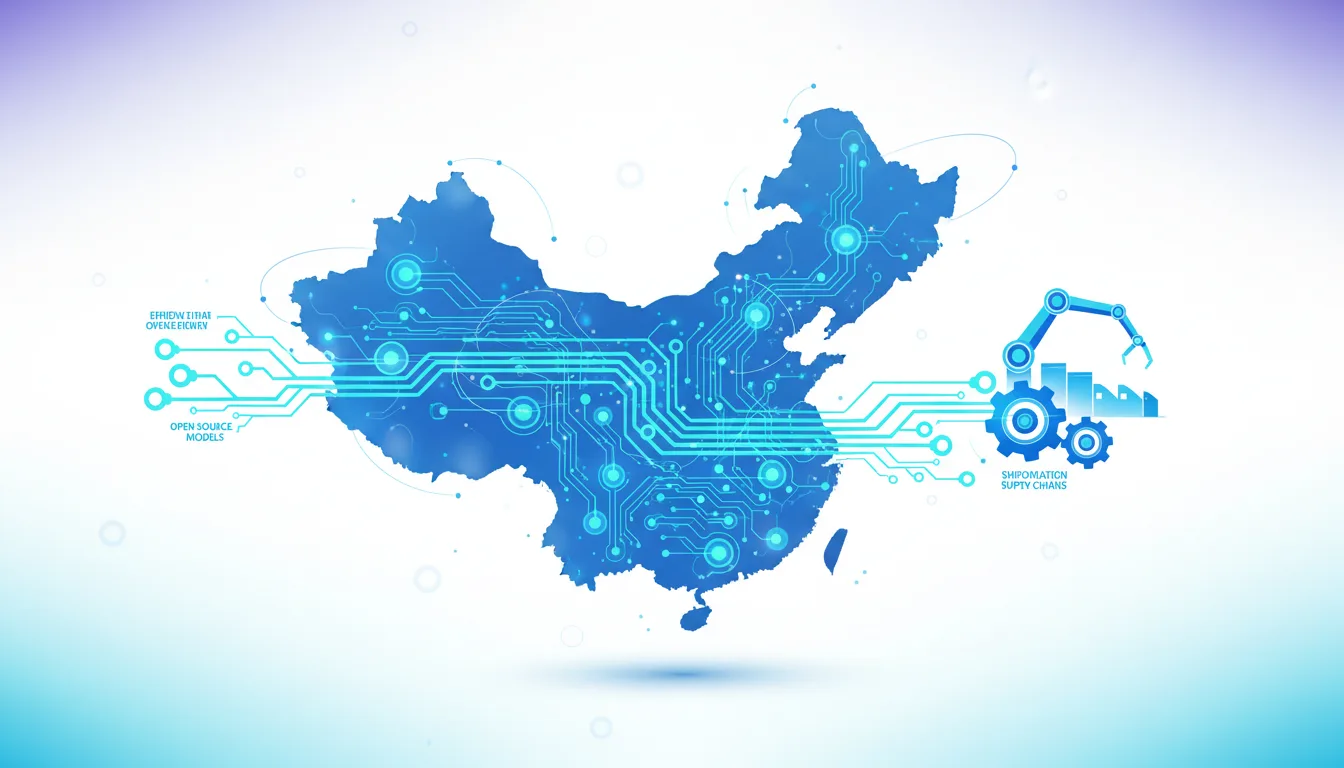
Researched and written with AI assistance under the editorial responsibility of the i10X News team. The title image is an AI-generated illustration. Read our AI Use Policy. Spotted an error? Request a correction.
This comes from my own take at i10x, pulling together the latest on Chinese model drops, benchmark numbers, infrastructure breakdowns, and policy blueprints. I put it together for tech execs, coders, and planners who want the real undercurrents in global AI – beyond the flashier news bites.
i10x Perspective
Ever catch yourself thinking the U.S.-China AI split is just a rivalry? It’s more like two roads forking off, each leading to its own kind of future. The West’s after that ultimate, all-knowing mind in a server—powerful and contained. China, meanwhile, is wiring up a widespread “digital nervous system,” efficient AI woven into factories, systems, and machines like nerves in a body.
But here’s the thing that keeps me up at night: it’s not about some Chinese model topping GPT-5 on a test. The real test is if their setup can produce more, automate smarter, and move faster in the actual world. This showdown – scale from the top down versus spread-out and everywhere – it’s set to shape the next ten years of tech and money, maybe making all the fuss over super-models feel like yesterday’s worry.