GM and Google: Gemini in Four Million Vehicles
⚡ Quick Take
Google’s Gemini is hitting the road in a landmark deal with General Motors, transforming over four million vehicles into rolling AI edge nodes. This move marks one of the largest-ever deployments of a large language model into a physical, mobile hardware ecosystem, setting the stage for a new battleground in AI platform dominance and data governance beyond the browser and smartphone.
Summary
Have you ever wondered what it would be like if your car could truly understand you, not just respond to commands? General Motors is deploying Google’s Gemini AI to over four million U.S. vehicles via an over-the-air (OTA) software update, replacing the existing Google Assistant. This upgrade brings more conversational and context-aware voice capabilities for navigation, communication, and in-car controls – moving beyond those simple, back-and-forth interactions that we’ve all grown used to.
What happened
But here’s the thing: this isn’t merely a feature patch to spruce things up. It’s a full platform replacement within GM’s “Google built-in” infotainment system. The rollout leverages the Android Automotive OS, pushing a foundational AI model directly into the vehicle’s core operating system – a far deeper integration than what we see with phone-based systems like Apple CarPlay or Android Auto, which feel a bit more tacked-on, if you ask me.
Why it matters now
From what I’ve seen in the tech world lately, this initiative stands out as a massive, real-world stress test for consumer-facing LLMs operating in variable connectivity environments. Plenty of reasons why it’s timely, really – it escalates the platform war between Google, Apple, and Amazon for control over that lucrative in-car digital experience, turning the vehicle into a critical frontier for AI services, data collection, and developer ecosystems.
Who is most affected
While GM drivers are the immediate ones feeling the change – and likely excited about it – the strategic shockwaves hit Google’s competitors hardest, particularly Apple and Amazon, who’ll need to counter with deeper, more intelligent in-car integrations. That said, it also creates a new paradigm for automotive and AI developers, who can now target a large, standardized vehicle fleet with advanced AI capabilities, opening up all sorts of possibilities.
The under-reported angle
Most coverage out there zeros in on the shiny user-facing features, but the real story – the one that keeps me up at night pondering – lies in the underlying infrastructure and data architecture. Key questions linger: how will Gemini balance on-device processing (potentially using Gemini Nano) with cloud-based power in those low-connectivity zones, and how will the torrent of new data – voice queries, location history, vehicle telemetry – be governed between Google and GM? It’s the kind of detail that could shape everything down the line.
🧠 Deep Dive
Ever feel like the tech in your car is playing catch-up to the smarts in your pocket? The announcement that Google’s Gemini will replace Google Assistant in four million GM vehicles is more than just a software update; it’s the formal beginning of the ambient AI era in mobility – something I’ve been watching unfold with real interest. While outlets like The Verge and TechCrunch have correctly framed this as a strategic partnership and a shot across the bow at Apple’s CarPlay, the deeper technical and ethical questions about infrastructure and data are only just beginning to surface. This move transforms the car from a simple transport tool into a sensor-rich, mobile AI platform, one that could redefine how we move through our days.
The central tension – largely unaddressed in official communications, mind you – is the split between on-device and cloud-based AI. A car is the ultimate edge case for connectivity, moving seamlessly between 5G hotspots, patchy rural networks, and offline environments like parking garages (you know, those spots where signals just vanish). For Gemini to be more than a frustratingly inconsistent gimmick, it must intelligently manage this reality – weighing the upsides of quick responses against the need for heavier processing. This implies a hybrid model where a smaller, on-device model (like Gemini Nano) handles essential, low-latency tasks such as “turn up the heat” or basic navigation commands, while more complex, generative queries (“Find me a highly-rated Italian restaurant on my route that has a kids’ menu and EV charging”) are offloaded to the cloud. This architecture doesn’t just shape the user experience; it also affects the load on cellular networks and even the driver’s data plan, in ways that could catch people off guard.
This deployment also creates one of the richest, most complex data streams in the consumer world – a flood of information that’s both thrilling and a little daunting. Competitor analysis shows that while official PR from Google and GM emphasizes safety and user benefits, the missing piece is a transparent data-flow model, which feels like an oversight amid all the hype. An LLM integrated at the OS level has access to not just your media preferences and contacts, but your driving patterns, location history, vehicle health, and in-cabin conversations. This raises critical governance questions: Is this data used to train future versions of Gemini? How is it shared between GM and Google? And what new controls will users have to manage the privacy trade-offs of an AI that is always listening and knows where they are going? It’s these quieter concerns that might echo longest.
By embedding Gemini directly into the Android Automotive OS, Google is building a powerful moat against its rivals – one that’s tougher to breach than it seems. Unlike Apple CarPlay or Amazon’s Alexa Auto, which are largely parasitic applications running on top of a car’s native system, this is a native, foundational layer. It gives Google a direct pipeline to a captive audience and a fleet of rolling laboratories for testing and refining its AI. For GM, it’s a calculated gamble: they gain a best-in-class AI experience but cede significant control over the digital soul of their vehicles to a tech giant – a decision that will likely force other automakers to pick a side in the escalating AI platform wars, treading carefully as they go.
📊 Stakeholders & Impact
| Stakeholder / Aspect | Impact | Insight |
|---|---|---|
| AI / LLM Providers (Google) | High | Establishes a massive, real-world deployment for Gemini, providing invaluable data for model training and a powerful beachhead against Apple and Amazon in the automotive sector – the kind of foothold that could pay off big in the long run. |
| Infrastructure (Telcos & Cloud) | Medium | Increases demand for consistent, high-bandwidth cellular connectivity to support cloud-based LLM features. May drive new “connected car” data plan offerings, which feels like a natural next step for these providers. |
| Drivers / Vehicle Owners | High | Gain powerful conversational AI features for navigation, media, and vehicle control but face a new and complex set of data privacy considerations and potential dependency on connectivity – exciting upgrades, but with strings attached. |
| Automakers (GM & Rivals) | Significant | GM gets a competitive AI advantage but deepens its dependency on Google’s ecosystem. Competitors are now under immense pressure to match this level of native AI integration, forcing some tough choices. |
| Regulators & Policy Makers | Medium | The scale of this data collection in a safety-critical environment will likely trigger new scrutiny around driver distraction, data privacy (especially location data), and AI liability – issues that have been simmering for a while now. |
✍️ About the analysis
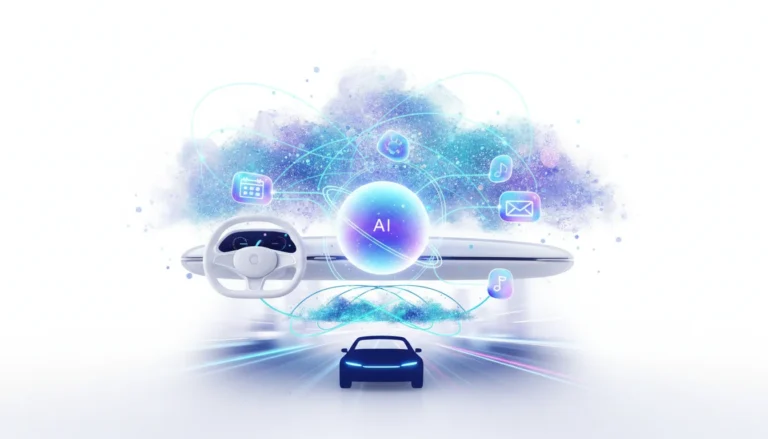
Researched and written with AI assistance under the editorial responsibility of the i10X News team. The title image is an AI-generated illustration. Read our AI Use Policy. Spotted an error? Request a correction.
This is an i10x independent analysis, synthesizing data from official company announcements, major tech news outlets, and specialized automotive tech publications. This report is written for product strategists, platform engineers, and technology leaders seeking to understand the infrastructural and ecosystem implications of embedding large language models into physical hardware – the sort of insights that can guide real decisions amid all the buzz.
🔭 i10x Perspective
What if the car becomes our next constant companion, smarter than we ever imagined? The GM-Google deal is a blueprint for the future of ambient computing, where AI is no longer confined to a screen but is woven into the fabric of our physical environments. The car is merely the first mass-market AI “container” – a sensor-rich, mobile, and power-abundant edge device that opens doors we haven’t fully stepped through yet.
This signals a fundamental shift in how intelligence infrastructure will be architected, forcing a resolution to the ongoing tension between powerful, centralized cloud AI and responsive, private on-device models. The ultimate prize isn’t just selling more cars or software; it’s owning the ambient OS for human life – that seamless layer humming in the background. The key risk to watch, though, is whether consumers will embrace this integrated intelligence or push back against the inevitable privacy trade-offs that come with a car that’s always listening, always aware.