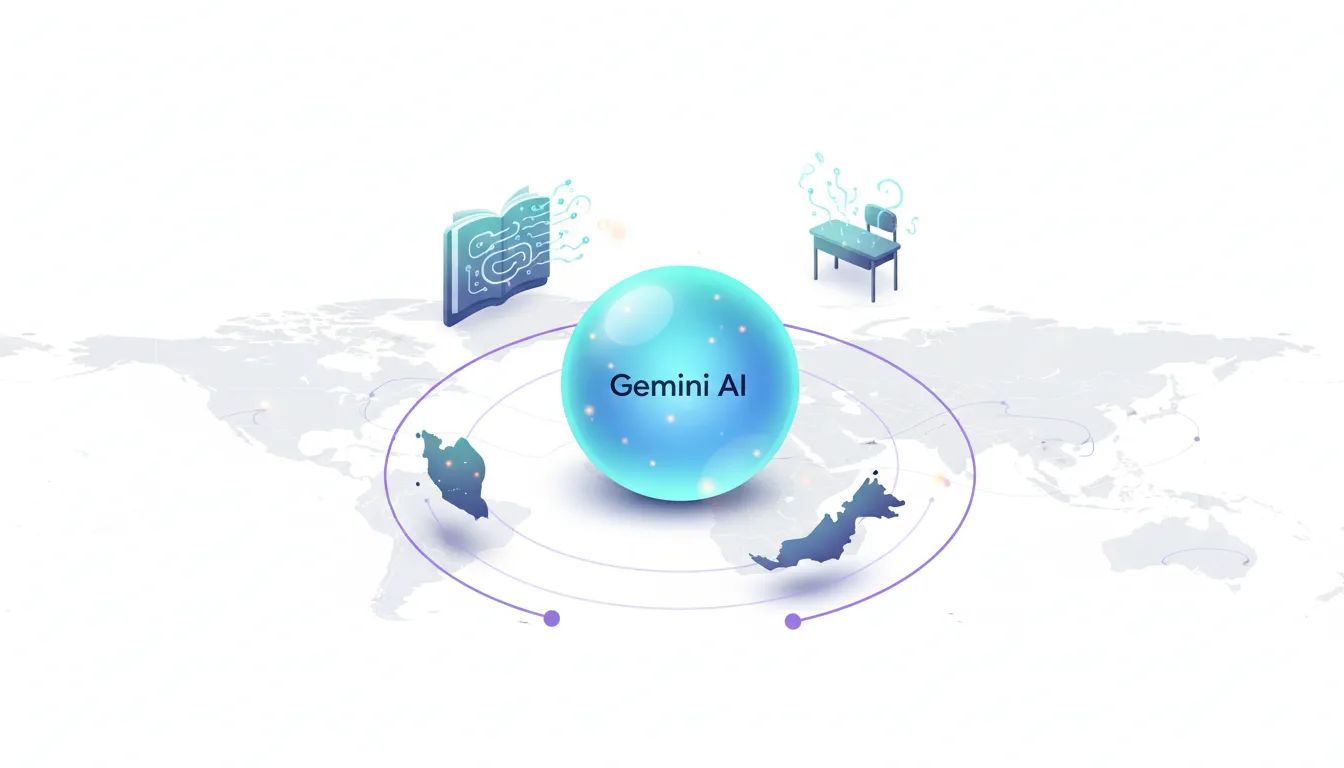
Google is aggressively embedding its Gemini AI across the global education sector through Google Workspace, turning classrooms and universities into the next major battleground for AI platform dominance. This isn’t just a feature update; it’s a strategic move to lock in the next generation of knowledge workers, forcing institutions to navigate a complex maze of opaque pricing, data privacy, and academic integrity policies. The recent rollout to public universities in Malaysia signals the start of a global push where practical deployment challenges will define success far more than marketing promises.
Quick Take
- What happened: : Ever wonder how a tech giant slips right into the heart of learning? Google has officially launched “Gemini for Google Workspace for Education,” integrating its flagship AI model into core tools like Docs, Gmail, and Slides for schools and universities. The offering comes in multiple paid add-on tiers (e.g., Gemini Education, Gemini Education Premium) on top of existing Workspace for Education editions – a setup that’s got everyone talking about the fine print.
- Why it matters now: : From what I’ve seen in these kinds of rollouts, timing can make all the difference. With this move, Google is leveraging its near-ubiquitous presence in education to scale its AI ecosystem. As students and educators become accustomed to Gemini-powered workflows, it creates a powerful lock-in effect, making Google’s AI the default intelligence layer for future professionals and challenging competitors like Microsoft’s Copilot to gain a foothold. That said, it’s not without its ripples.
- Who is most affected: : Picture yourself in the thick of it, balancing budgets and big decisions. Institutional leaders, IT administrators, and faculty are on the front lines. They must now evaluate the ROI of new licensing costs, establish governance and responsible-use policies from scratch, and manage the significant change management required to train staff and students, all while safeguarding student data – plenty of reasons to tread carefully, really.
- The under-reported angle: : But here’s the thing that often gets glossed over in the hype. While Google touts productivity gains, the real story is the governance nightmare facing institutions. The tiered pricing is confusing, the burden of creating academic integrity policies falls entirely on schools, and rollouts in regions like Southeast Asia raise immediate questions about compliance with local data protection laws (like Malaysia’s PDPA) that Google’s boilerplate privacy statements don’t fully resolve. It’s a puzzle worth pondering as things unfold.
Deep Dive
Have you ever felt the weight of a tool that’s promising to change everything, yet leaves you figuring out the rules? Google’s introduction of Gemini into its Workspace for Education suite is being framed as a revolution in teaching and learning. The official narrative focuses on an AI assistant that helps educators draft lesson plans in minutes, gives students a creative partner for assignments, and automates tedious administrative tasks. By embedding generative AI directly into the Docs, Slides, and Sheets that millions already use daily, Google is removing nearly all friction to adoption. From a product perspective, it’s a masterclass in distribution – smooth, almost too easy.
However, for the institutions tasked with deploying it, the reality is far more complex, as I’ve noticed in similar tech shifts. The first obstacle is the deliberately opaque pricing and feature matrix. School districts and universities must now decipher the value proposition between their existing Workspace edition (e.g., Teaching & Learning Upgrade) and new, costly Gemini-specific add-ons. The key pain point isn’t just budget, but a lack of clarity on which tier provides which specific capabilities, making procurement and ROI calculation a significant challenge for leadership – one that drags on longer than you’d expect.
Beyond cost, the core tension is one of control versus capability, weighing the upsides against what you might lose. Google’s admin console provides the technical levers to enable or restrict Gemini by organizational unit – for instance, turning it on for faculty but not for students under 18. But these technical controls are a small part of the solution. The much larger, unaddressed gap is the policy and ethical framework. Institutions are now solely responsible for defining what constitutes academic dishonesty in the age of AI, creating responsible-use guidelines, and training a diverse faculty with varying levels of AI literacy. Google provides resources, but the heavy lifting of institutional change management, curriculum redesign, and risk assessment is left to the schools – and that’s where the real work begins.
This global strategy is meeting its first major test in regions like Southeast Asia. As highlighted by the recent rollout to public universities in Malaysia, these institutions are not just adopting a new tool; they are beta-testing a new paradigm of education infrastructure. They must reconcile Google’s global data processing policies with national laws like the Personal Data Protection Act (PDPA), a task requiring deep legal and technical expertise that many institutions lack. This makes the Malaysia rollout a critical case study for how the ideals of AI-powered education will collide with the realities of regional governance, data sovereignty, and institutional readiness – a reminder that not every promise lands as neatly as planned.
Stakeholders & Impact
| Stakeholder / Aspect | Impact | Insight |
|---|---|---|
| AI / LLM Providers (Google) | High | Secures a foundational user base for the Gemini ecosystem, generating vast amounts of training data (on non-personal data) and normalizing AI integration for the future workforce. Creates a powerful competitive moat against Microsoft. |
| Educational Institutions | High | Face a tripartite challenge: navigating complex procurement and licensing, developing urgent AI governance and academic integrity policies, and funding large-scale change management and faculty training initiatives. |
| Educators & Students | Medium–High | Educators gain powerful productivity tools but face pressure to redesign pedagogy and assessments. Students gain an AI “co-pilot,” but the line between assistance and cheating becomes dangerously blurred without clear institutional guardrails. |
| Regulators & Policy Makers | Significant | The large-scale deployment of a single AI ecosystem in education will trigger increased scrutiny around data privacy (especially for minors), algorithmic bias, and market concentration. The Malaysia case will be a bellwether. |
About the analysis
Researched and written with AI assistance under the editorial responsibility of the i10X News team. The title image is an AI-generated illustration. Read our AI Use Policy. Spotted an error? Request a correction.
This i10x analysis is based on a structured review of Google’s official product documentation, admin guides, public announcements, and regional news coverage. It is written for technology leaders, university administrators, and policy stakeholders to help them understand the strategic implications of deploying large-scale AI platforms within educational infrastructure – insights drawn from piecing together the details, much like you’d do in a real strategy session.
i10x Perspective
Isn’t it striking how something designed to empower can quietly reshape dependencies? Google’s Gemini for Education is more than a product; it’s a Trojan horse for AI platform dependency. By integrating AI at the foundational layer of education, Google isn’t just selling a feature – it’s shaping how the next generation thinks, writes, and solves problems, all within its own ecosystem. This move forces every competitor to respond in kind, transforming schools and universities into the primary battleground for AI supremacy. The unresolved tension is whether this top-down integration will ultimately foster critical thinking and creativity, or simply train a generation of users to be highly proficient operators of a single company’s intelligence engine. The future of open academic inquiry may depend on it.