Google repurposes bird-call AI to monitor marine life
⚡ Quick Take
Google Research has unveiled a novel application of transfer learning, adapting an AI model originally trained to identify bird songs to now detect underwater marine life from hydrophone recordings. This cross-domain leap from terrestrial to marine bioacoustics could dramatically lower the cost and scale of ocean monitoring, a critical bottleneck for tracking biodiversity and climate change. However, the announcement currently lacks the open benchmarks, deployment blueprints, and ethical frameworks necessary to bridge the gap from a compelling research blog to a scalable, verifiable conservation tool.
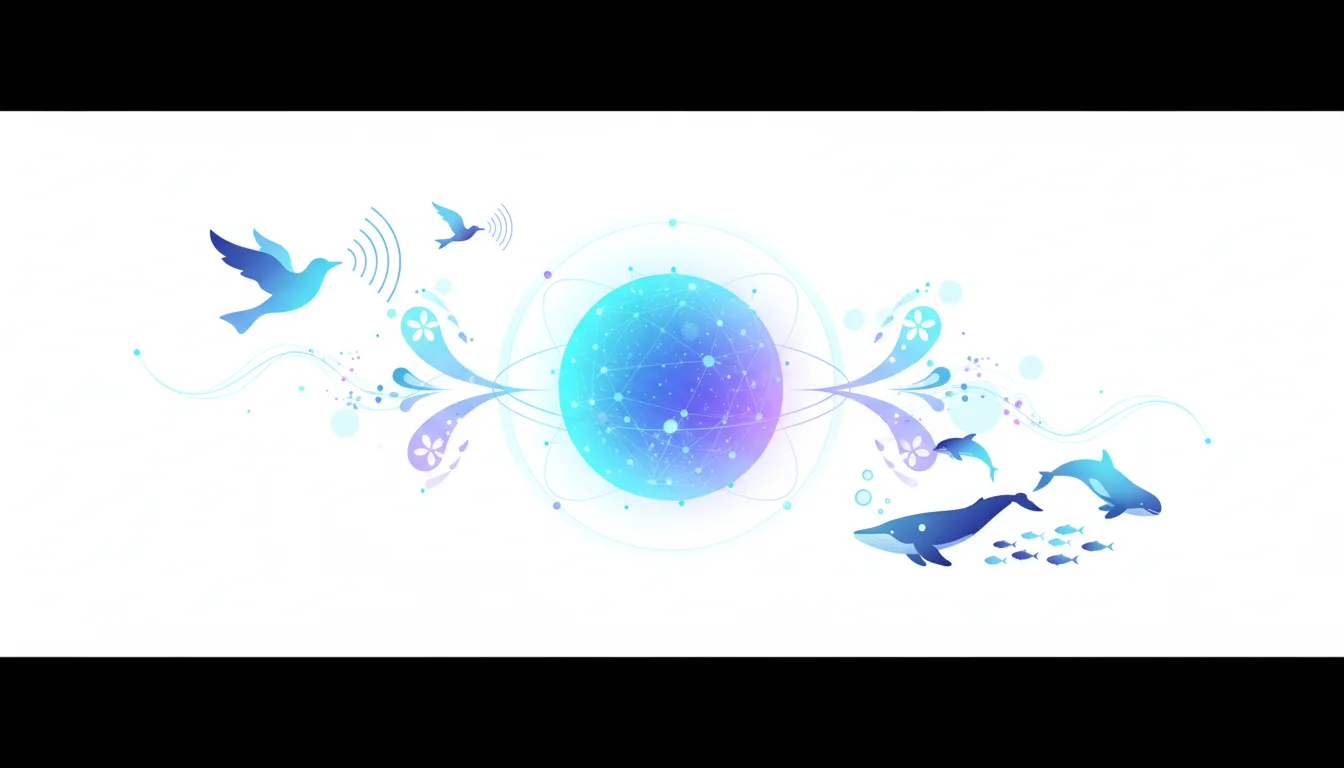
Have you ever wondered how AI could listen to the ocean’s hidden conversations? Summary: Google researchers are repurposing AI models trained on vast bird-audio datasets to identify the sounds of whales, dolphins, and fish choruses in noisy underwater environments. This “transfer learning” approach aims to overcome the chronic shortage of labeled audio data from the world’s oceans, which has long hampered automated biodiversity monitoring. From what I’ve seen in similar projects, it’s a smart way to sidestep the usual headaches of starting from zero.
What happened: Instead of building a marine bioacoustics model from scratch – which would require massive amounts of hard-to-collect labeled data – the team fine-tuned a pre-existing, powerful bird-call detection model. The underlying assumption? That the core features of acoustic events (like calls and songs) are similar enough across air and water for the model’s foundational knowledge to be reusable. It’s almost like borrowing a well-worn toolbox from one job site and tweaking it for another.
Why it matters now: Monitoring ocean health feels more urgent by the day – but traditional methods, like visual surveys or tagging, are pricey and hit a wall in terms of coverage. Passive Acoustic Monitoring (PAM) with AI offers a scalable alternative, one that could deliver near-real-time data streams. If it proves robust, this could shape conservation policy, manage Marine Protected Areas (MPAs), and track the fallout from climate change or human noise like shipping. Plenty of reasons to pay attention, really.
Who is most affected: Marine biologists, conservation NGOs, and environmental policymakers stand to gain a powerful new tool, provided it becomes accessible and verifiable. For the AI community, it’s a compelling case study on the power of transfer learning for scientific discovery in data-scarce domains. I’ve noticed how these kinds of breakthroughs can shift entire fields, even if they start small.
The under-reported angle: While the technological leap is impressive, the research is presented without quantitative performance benchmarks (e.g., precision, recall, F1 scores) or comparisons to marine-native models. The lack of open-source code, deployment guides for edge hardware (like buoys), and a clear data governance model means the project remains a “walled-garden” proof-of-concept, not a community-ready solution. That said, it’s a reminder of how far the ideas still need to travel to make a real dent.
🧠 Deep Dive
What if we could teach an AI to hear the whispers of the deep sea by starting with the songs of birds? Google’s latest experiment in bioacoustics represents a clever shortcut around one of AI’s most persistent problems: the data bottleneck. By leveraging a model pre-trained on a massive corpus of bird sounds, researchers are essentially giving their marine AI a head start – the model already understands the fundamental structure of an “acoustic event” from a spectrogram. The task is then to fine-tune this knowledge to recognize the specific signatures of a humpback whale instead of a European robin. This approach, known as transfer learning, is a cornerstone of modern AI, but its application across such different physical domains – air and water – is a significant test of its power. It’s the kind of cross-pollination that gets me thinking about AI’s broader potential.
The primary challenge is “domain shift,” and boy, does it make things tricky. Underwater audio is plagued by unique and variable noise profiles from shipping, seismic activity, and even weather – all of which are absent in terrestrial recordings. The sound also propagates differently, bending rules that don’t apply on land. Google’s work focuses on adapting the model to be robust against this noise and domain gap. While the initial announcement highlights the potential, it’s thin on the specific domain adaptation techniques used, leaving the AI community to speculate on the methods – whether through data augmentation, source separation, or other advanced denoising strategies. But here’s the thing: without those details, it’s hard to build on.
This is where the story pivots from a scientific success to a deployment challenge – for a conservation group to actually use this, they need answers that aren’t in the blog post. What are the model’s true precision and recall rates for different species in various ocean environments? How does it perform compared to a model trained exclusively on a smaller, marine-only dataset? Without public benchmarks and a labeled evaluation set, the research is impossible to validate externally or build upon, limiting its immediate impact. It showcases what’s possible but doesn’t provide the blueprint for others to replicate it – a common frustration in these early stages.
Furthermore, real-world conservation isn’t run in a cloud data center; it happens on low-power edge devices mounted on buoys, autonomous gliders, and AUVs. A truly impactful solution requires a “Deployment Cookbook” detailing the hardware bill-of-materials, power budget calculations, and inference code optimized for platforms like NVIDIA Jetson or Raspberry Pi. The total cost of ownership (CAPEX/OPEX) for a fleet of these acoustic sensors is a critical data point for any cash-strapped NGO or government agency – weighing the upsides against the practical hurdles. Moving from a research paper to a field-ready system is the unglamorous but essential “last mile” of AI for Good, and it often decides if these ideas stick.
Finally, deploying a network of underwater microphones raises serious governance questions that can’t be ignored. How will data on the location of endangered species be protected from poachers? How will indigenous data sovereignty be respected? A complete model release today requires a model card detailing its limitations and potential biases, alongside an ethical framework for data handling. By omitting these elements, the project leaves the hardest questions of operationalizing responsible AI unanswered – questions that linger long after the excitement fades.
📊 Stakeholders & Impact
| Stakeholder / Aspect | Impact | Insight |
|---|---|---|
| AI / ML Researchers | High | It demonstrates the extreme effectiveness of transfer learning across surprisingly distant domains (air to water) – sets a precedent for using large, unrelated datasets to bootstrap models for niche scientific applications. I’ve seen this kind of adaptability spark a wave of follow-up work in tight-knit communities. |
| Conservation Orgs & Marine Biologists | Potential | Offers a tantalizing glimpse of a future with cheap, scalable, and automated ocean monitoring – but its current status as closed research prevents immediate adoption and validation. That gap between promise and practice? It’s what keeps folks up at night. |
| Edge AI & Hardware Vendors | Medium | Success in this area will drive demand for low-power, ruggedized chips and hardware for long-term deployment on autonomous buoys, gliders, and AUVs – creating a new market for environmental sensing infrastructure. Opportunities like this don’t come around often. |
| Regulators & Policymakers | Future | If deployed at scale, data from these systems could provide the evidence needed to create, monitor, and enforce Marine Protected Areas (MPAs) and new regulations on shipping noise pollution. Trust in the data will be paramount – and building that trust takes time, plenty of it. |
✍️ About the analysis
Researched and written with AI assistance under the editorial responsibility of the i10X News team. The title image is an AI-generated illustration. Read our AI Use Policy. Spotted an error? Request a correction.
This is an independent i10x analysis based on a review of primary research announcements and data from the AI deployment landscape. It’s written for technology leaders, AI practitioners, and strategists working at the intersection of machine learning, environmental science, and infrastructure – folks navigating those overlapping worlds every day.
🔭 i10x Perspective
Ever imagine an AI eavesdropping on whales by first tuning into sparrows? The journey of an audio AI from the forest canopy to the ocean floor is more than a clever technical demo; it’s a signal of how planetary-scale intelligence infrastructure might be built. The future of environmental monitoring lies in leveraging massive, foundational models and adapting them to niche, data-scarce domains – a path that feels both exciting and overdue.
However, this work also exposes the critical tension in today’s “AI for Good” movement. The most innovative work often emerges from corporate labs that have little incentive to release the open benchmarks, deployment code, and ethical frameworks needed for real-world adoption. The true impact of AI on science hinges on this shift from closed novelty to open, verifiable infrastructure – one that could redefine how we safeguard the planet.