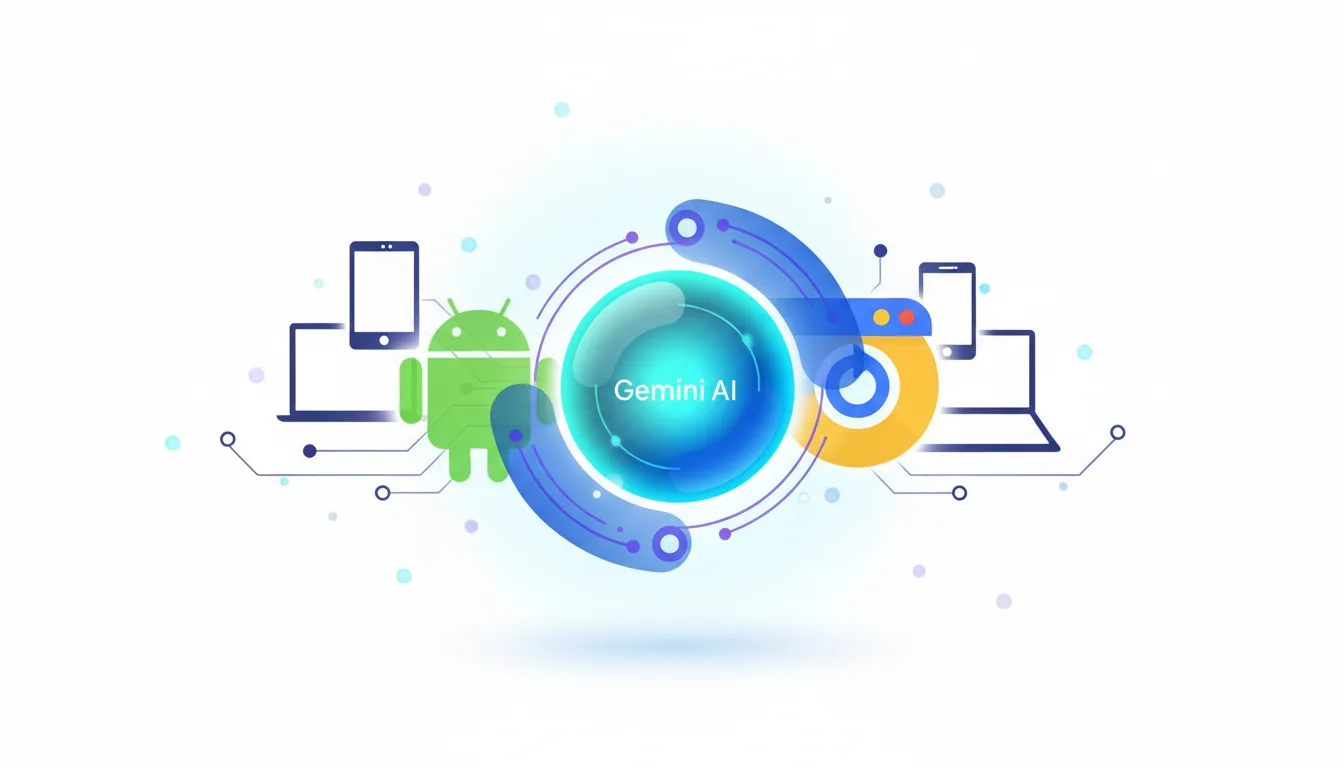
Leaked code suggests Google is developing “Aluminium OS,” a new operating system designed to merge Android and ChromeOS with native Gemini AI integration at its core. This signals a strategic pivot from adding AI features to existing platforms towards building an entirely new, AI-native user experience from the ground up.
Quick Take
- Summary: An APK teardown has uncovered explicit code references to “Aluminium OS,” a long-rumored project to unify Google’s operating systems. Crucially, the code points to deep integration with Google’s Gemini AI, suggesting the model will be used to trigger system-level features and orchestrate user experiences, rather than acting as a simple add-on application.
- What happened: Ever wonder what it takes to spot the next big shift in tech? Code strings and feature flags discovered within a recent APK teardown directly link the “Aluminium” codename with Gemini services. This provides the first concrete evidence that Google’s OS convergence strategy is not just about running Android apps on ChromeOS, but about architecting a new platform where its flagship AI model is a fundamental component of the system’s logic – a real game-changer, if you ask me.
- Why it matters now: As the AI race shifts from cloud-based chatbots to on-device intelligence, the underlying operating system becomes the critical battleground. This move represents Google’s answer to Apple’s tightly integrated hardware and software ecosystem, aiming to create a seamless, AI-powered experience across a wide range of devices – from tablets to Chromebooks – that is more than the sum of its parts. It’s like weighing the upsides of a more connected world against the complexities it brings.
- Who is most affected: Developers, who will face a new paradigm of building “Gemini-aware” applications; device OEMs, who will need to meet new hardware requirements for on-device AI (e.g., powerful NPUs and more RAM); and enterprise/education IT admins, who may soon evaluate a new, unified platform for their device fleets. Plenty of reasons for them to pay close attention, really.
- The under-reported angle: This is not just a merger of two existing OSes. It’s the blueprint for an “AI-first” operating system, where the user interface may become secondary to the AI’s ability to proactively manage tasks and information. The central question is no longer “How do we put AI in an OS?” but “How do we build an OS around an AI?” That said, it’s the kind of pivot that could redefine how we interact with our devices every day.
Deep Dive
Have you ever felt the frustration of juggling two similar but separate systems on your devices? Google’s long-standing ambition to resolve the fragmentation between Android and ChromeOS appears to be entering a new, AI-driven phase. The discovery of “Aluminium OS” in recent code teardowns is significant, but the real story lies in its native hooks to the Gemini AI model. This suggests a fundamental architectural shift: instead of bolting AI features onto a legacy framework, Google is positioning Gemini as the central nervous system of a next-generation platform. From what I’ve seen in similar tech evolutions, this strategy moves beyond simply running Android apps in a Chrome environment and points toward a system where Gemini can orchestrate actions and context across applications and hardware functions – smoothly, almost intuitively.
The key challenge – and opportunity – lies in how this integration is implemented. The code hints at Gemini triggering system-level features, which implies a deep awareness of user context and intent. This will demand a new class of hardware. The success of Aluminium OS will likely depend on the widespread availability of devices with powerful Neural Processing Units (NPUs) capable of handling sophisticated on-device inference. This creates a new hardware baseline, pushing OEMs to compete not just on screens and processors, but on AI-readiness, potentially creating a new wave of device-tiering based on AI capabilities. It’s a push that could spark innovation, though it’ll take some treading carefully to get it right.
For developers, Aluminium OS represents both a threat and a massive opportunity. The old rules of building for either Android or ChromeOS may become obsolete. Instead, they will likely need to engage with new APIs and intents that allow their apps to be “seen” and “controlled” by Gemini. An application that is not “Gemini-aware” might feel inert and disconnected in this new ecosystem. This forces developers to think about their apps not as standalone silos, but as services that the master AI can call upon to fulfill a user’s request – a shift that’s exciting, if a bit daunting at first glance.
This move also intensifies the privacy and data governance debate. An OS-level AI with deep context awareness requires a transparent and robust framework for managing data flows. The critical distinction will be between on-device and cloud-based inference. An Aluminium OS that heavily relies on the cloud for its “intelligence” will face scrutiny over data privacy and will be less useful offline. Conversely, a system that maximizes on-device processing will be seen as more secure and responsive, but this again puts immense pressure on hardware capabilities. Google’s ability to message and deliver on a privacy-first, on-device-centric model will be crucial for both consumer and enterprise adoption – and honestly, it’s one area where trust will make all the difference.
Stakeholders & Impact
| Stakeholder / Aspect | Impact | Insight |
|---|---|---|
| Google (AI & OS Divisions) | High | Creates a unified platform to distribute Gemini as the native intelligence layer, directly countering Apple’s integrated ecosystem and creating a powerful data flywheel for future model improvements. |
| Hardware OEMs (Samsung, HP, Dell) | High | Establishes new, non-negotiable hardware requirements (NPUs, RAM, sensors) for “AI-Ready” devices. OEMs must adapt or risk their products being relegated to a lower tier. |
| Developers (Android & Chrome) | Significant | A paradigm shift is coming. Developers will need to learn new APIs to make their apps available to Gemini’s orchestration layer, moving from building UIs to providing services for the AI. |
| Enterprise & Education | Medium | Presents a potential unified solution to replace fragmented Android/ChromeOS fleets. However, it also introduces new security, data governance, and device management (MDM) challenges to be solved. |
About the analysis
Researched and written with AI assistance under the editorial responsibility of the i10X News team. The title image is an AI-generated illustration. Read our AI Use Policy. Spotted an error? Request a correction.
This analysis is an independent interpretation of publicly available APK teardown data, contextualized with market signals around AI hardware and operating system strategy. It is written for developers, product managers, and technology strategists seeking to understand the implications of Google’s next major platform evolution – drawing from patterns I’ve observed in the tech landscape over the years.
i10x Perspective
What if the future of your devices wasn’t about tapping icons, but about an AI that anticipates your needs? Aluminium OS is more than an OS merger; it’s a bet on the future of computing as an ambient, AI-mediated experience. This signals Google’s attempt to build a platform where the “interface” is not a screen of icons, but the conversational and predictive power of Gemini itself. This is Google’s strategic response to Apple’s cohesive ecosystem, but with a uniquely Google-flavored, open-hardware twist. The primary unresolved tension is whether Google can convince its vast but fragmented ecosystem of developers and OEMs to rally around this singular, AI-first vision. Aluminium OS is the crucible where that ambition will be tested – and it could either unify or further divide the landscape, depending on how it unfolds.