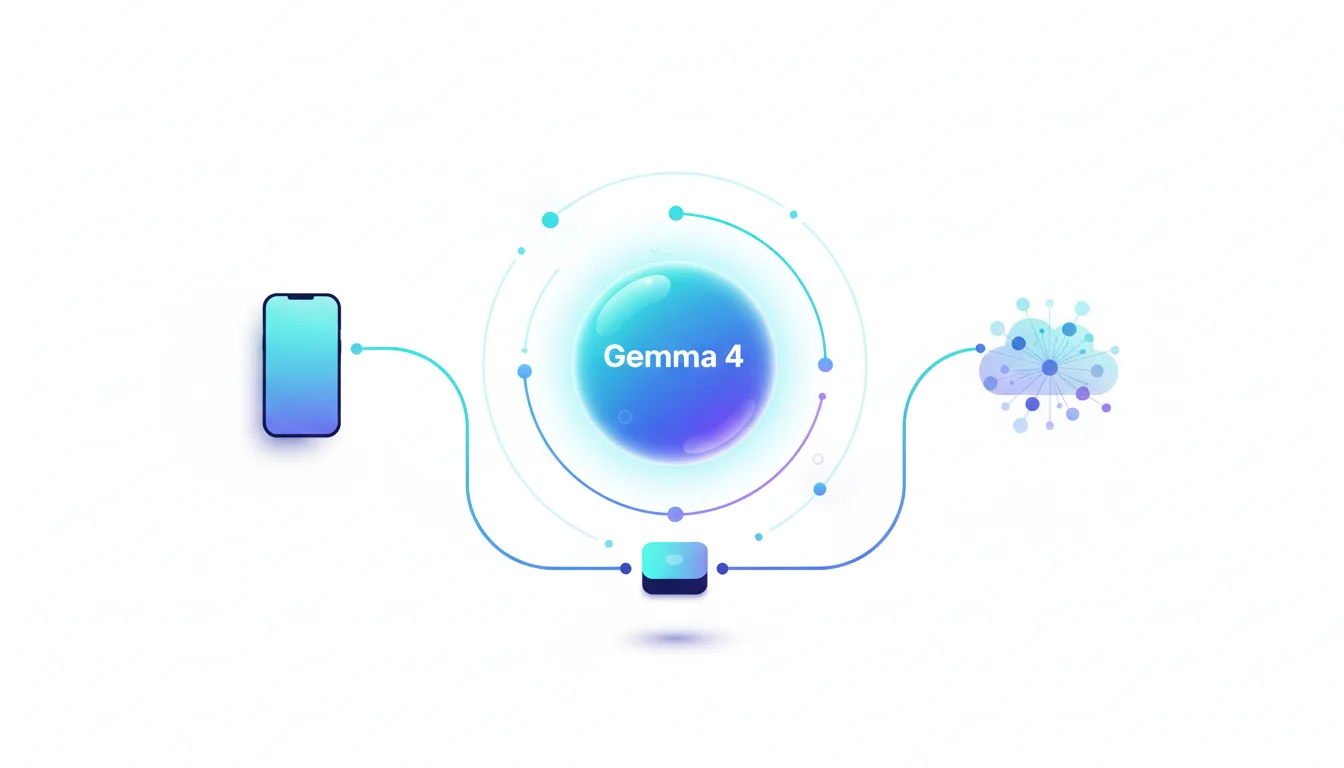
Google’s new Gemma 4 family of open models isn’t just another release; it’s a strategic move to unify the fragmented landscape of AI development, creating a seamless path from on-device inference to cloud-scale infrastructure. This initiative aims to make building cross-platform AI applications a default, not a developer nightmare.
Quick Take
- Summary: Google has launched Gemma 4, a new family of open AI models specifically engineered for efficient deployment across a wide spectrum of hardware. This includes highly optimized variants for mobile devices (Android/iOS), edge processors, and scalable server infrastructure on Google’s cloud offering.
- What happened: The release includes multiple model sizes and detailed guidance on quantization (e.g., int4/int8) and deployment. Google has provided a comprehensive suite of resources, including official docs, Hugging Face model cards, Vertex AI integration, and code samples, to accelerate developer adoption for on-device and edge use cases.
- Why it matters now: Ever wonder why AI feels stuck in the cloud when we need it right at our fingertips? In a market crowded by powerful open models from Meta (Llama), Mistral, and Microsoft (Phi), Gemma 4 is Google’s direct counter-play focused on performance-per-watt and developer experience. As AI shifts from the cloud to the device in your hand, models optimized for low-latency, memory-constrained environments are becoming the critical building blocks for the next wave of intelligent applications.
- Who is most affected: Mobile and edge application developers are the primary audience, gaining a powerful new toolkit for building responsive, privacy-preserving features. Enterprise architects and CIOs are also impacted, as the on-device/edge deployment model offers a new path to optimize inference costs (TCO) and reduce reliance on cloud-only workloads.
- The under-reported angle: Beyond the model benchmarks, the true story is Google’s strategic push to create a unified “intelligence fabric” that spans its entire ecosystem. By optimizing Gemma 4 for hardware APIs like Android’s NNAPI and offering a smooth on-ramp to Vertex AI, Google is subtly shaping the future of AI development around its own platforms – turning model choice into an infrastructure decision, really.
Deep Dive
Have you ever wrestled with getting an AI model to run smoothly on everything from a phone to a server, only to hit wall after wall? Google’s release of the Gemma 4 model family is a direct response to a fundamental developer pain point: the immense friction in deploying AI models across a diverse hardware landscape. While tech news focuses on a horse race against Llama and Mistral, the more significant narrative is Google’s attempt to solve the “last mile” problem of AI. Gemma 4 is engineered not just to be smart, but to be ubiquitously deployable – from an Android phone using NNAPI and an iPhone leveraging Core ML/Metal, all the way to GPU-powered servers running on Vertex AI.
The core value proposition is a spectrum of efficiency. Developers are no longer forced to choose a single, monolithic model. Instead, they are given a toolkit of different sizes and guidance on aggressive optimization techniques like int4/int8 quantization and KV-cache management. This allows for a granular trade-off between model quality, latency, and memory footprint. For an app developer, this means being able to run a capable LLM for real-time text summarization directly on a user’s phone, preserving privacy and eliminating network lag. For an industrial IoT company, it means deploying a model on an edge device like a Jetson Orin to analyze sensor data without a constant cloud connection – a real game-changer when connections falter.
That said, the official documentation and enthusiastic news coverage mask a critical gap the developer community is already pointing out: the need for independent, device-level benchmarks. While Google provides impressive performance charts, developers need to know the actual latency and RAM usage on a Pixel 8, a Samsung Galaxy S24, or a specific edge processor from Qualcomm or MediaTek. The web is filled with official claims, but lacks a clear, reproducible model selection flowchart based on real-world constraints – a crucial piece of the puzzle that will ultimately be filled by the community, from what I’ve seen in similar launches.
Ultimately, Gemma 4 is Google’s most coherent strategic play to weave its AI capabilities into the fabric of the developer ecosystem. By providing open models that are “best on its platforms” (from Android to Google Cloud), it creates a powerful gravitational pull. The on-device inference trend, driven by demands for better privacy and user experience, becomes a gateway to Google’s broader cloud and hardware infrastructure. The message is clear: start with an open model on any device, but scale with Google’s managed, enterprise-grade environment – and that path feels smoother than most alternatives.
Stakeholders & Impact
| Stakeholder / Aspect | Impact | Insight |
|---|---|---|
| AI / LLM Developers | High | Empowers developers with a versatile, cross-platform model family optimized for latency and memory, reducing the complexity of on-device AI deployment. |
| Hardware Platforms (Google, Apple, Qualcomm) | High | Intensifies competition to provide the best low-level acceleration APIs (e.g., NNAPI, Core ML, Qualcomm AI Engine) as model performance becomes a key hardware differentiator. |
| Enterprises & CIOs | Significant | Offers a new strategy for Total Cost of Ownership (TCO) reduction by shifting suitable inference workloads from expensive cloud GPUs to user devices or edge nodes. |
| End Users | Medium | Enables more responsive, private, and capable offline AI features in mobile and web apps, from smarter text predictions to instant visual analysis. |
About the analysis
Researched and written with AI assistance under the editorial responsibility of the i10X News team. The title image is an AI-generated illustration. Read our AI Use Policy. Spotted an error? Request a correction.
This is an independent analysis by i10x based on a synthesis of official Google documentation, developer community feedback, and comparative research across the open-source AI model landscape. It is written for developers, engineering managers, and product leaders tasked with evaluating and deploying AI models in production environments – folks who, like me, have spent too many late nights troubleshooting deployments.
i10x Perspective
What if the real AI battle isn’t in the models themselves, but in how easily they spread to every corner of our lives? The launch of Gemma 4 signals a crucial shift in the AI infrastructure war, moving the battlefield from the data center to the edge. It’s less about building the largest model and more about building the most distributed and accessible intelligence network. Google is leveraging open source not as an act of charity, but as a strategic asset to standardize the developer experience around its own hardware and cloud ecosystems.
This raises a critical tension for the future: can a truly open AI ecosystem flourish when the performance of open models is ultimately arbitrated by the proprietary, low-level hardware APIs controlled by platform owners like Google and Apple? The next winner in the AI race won’t just provide the best model; they will provide the least painful path from a developer’s laptop to a billion devices. Gemma 4 is Google’s bet on owning that path – and from what I’ve observed, it’s a smart one, weighing the upsides of integration against the risks of lock-in.