Grok 4.1: xAI's Innovative Public Feedback for AI Accuracy
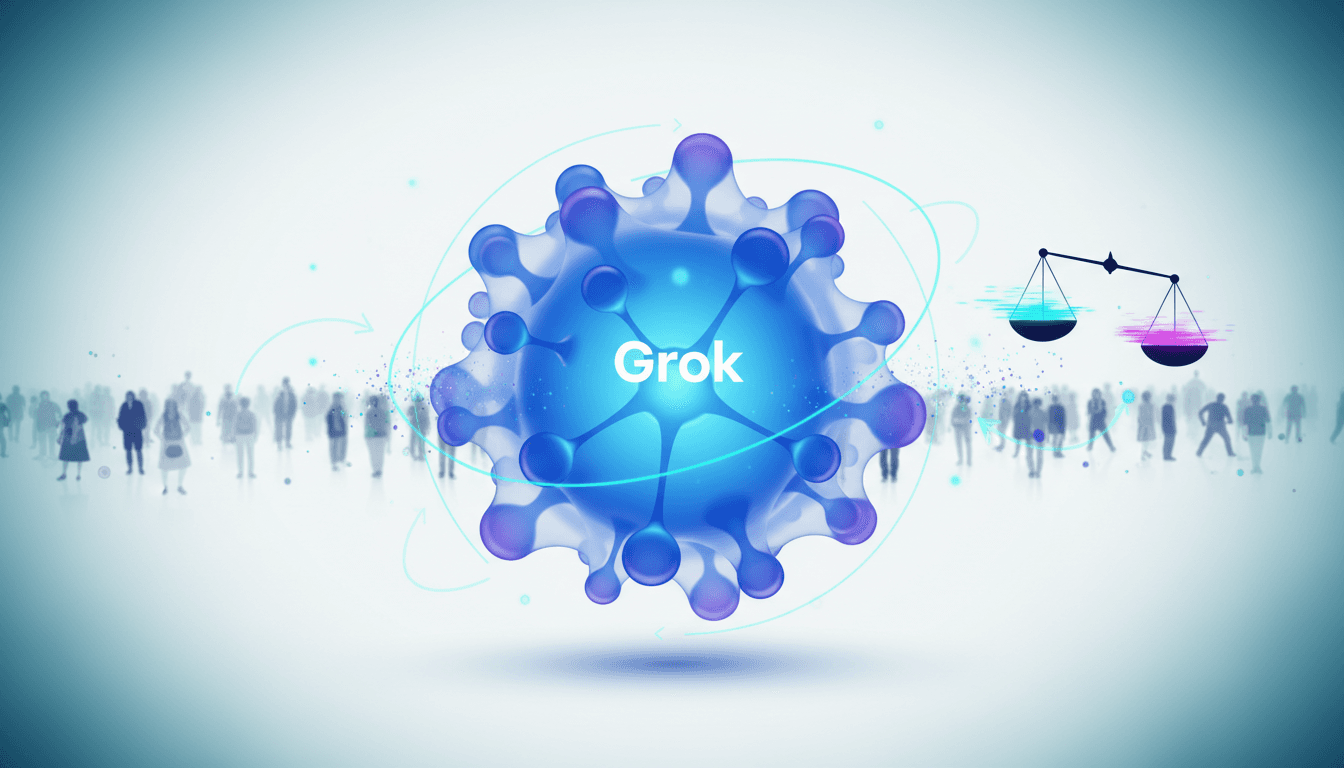
Grok 4.1: xAI's Public Reinforcement Learning Experiment
⚡ Quick Take
xAI just dropped Grok 4.1, touting major accuracy wins, but the real story isn't the model—it's the method. By openly soliciting feedback on X, Elon Musk is turning the social platform into a massive, real-time reinforcement learning engine, blurring the line between a product rollout and a public stress test. This is xAI’s high-stakes bet that a chaotic, community-driven approach can outpace the curated, closed-door development of its rivals.
Summary: Grok 4.1 and Grok 4.1 Fast claim significant reductions in hallucinations and boosts in factual accuracy. The update is available across X, web, and mobile apps and is accompanied by a public call from Elon Musk for users to submit suggestions to further improve the model's correctness.
What happened: Ever wonder how an AI could get a quick reality check from millions? The Grok 4.1 release focuses on enhanced factuality and "emotional intelligence," backed by metrics like a ~65% blind pairwise user preference rate over the previous version. More strategically, Musk has invited the entire X user base to act as a distributed QA team, directly feeding examples of inaccuracies into the development cycle—kind of like turning the crowd into a living, breathing filter for the truth.
Why it matters now: But here's the thing: this strategy weaponizes xAI's unique position as the sibling company to a global social network. While competitors like Google and Anthropic rely on structured RLAIF and internal red-teaming, xAI is attempting to build a public, high-velocity feedback loop to close the trust and accuracy gap. It's a radical experiment in open-source style iteration on a proprietary model, one that could reshape how we all think about AI evolution.
Who is most affected: Developers gain access to a more capable Grok 4.1 Fast with a 2M-token context window and improved tool-calling for building agents—plenty of reasons to dive in, really. Everyday X users are now implicitly part of Grok's training and evaluation pipeline, with their interactions and feedback serving as data points for future updates, which makes you pause and think about your role in all this.
The under-reported angle: That said, the focus on user feedback masks a critical infrastructure trade-off now exposed to the user: "compute per query." Grok's thinking vs. non-thinking modes are a direct productization of the universal latency vs. accuracy dilemma, asking users to consciously decide if they want a fast, cheap answer or a slow, potentially more accurate one. This externalizes a core architectural decision that other AI providers typically hide—I've noticed how that transparency can feel both empowering and a bit overwhelming in practice.
🧠 Deep Dive
Have you ever watched an AI company flip the script on how models get smarter? xAI’s announcement of Grok 4.1 isn't just another incremental model update; it’s a strategic pivot in the AI arms race. While the official release notes highlight improved performance on benchmarks like FActScore and EQ-Bench3, the more disruptive move is happening in plain sight on X. By publicly crowdsourcing accuracy feedback, xAI is transforming its user base from passive consumers into active participants in the model's reinforcement learning loop. This approach stands in stark contrast to the more guarded, enterprise-focused refinement processes at OpenAI and Anthropic, betting that the sheer volume and immediacy of public feedback can create a faster iteration cycle—faster than you'd expect, anyway.
From what I've seen in similar tech rollouts, this strategy hinges on Grok’s unique and controversial feature: its real-time access to X's data stream. This is both its greatest strength and its most significant vulnerability. For breaking news, it can provide up-to-the-minute context that competitors lack. However, it also exposes the model directly to the misinformation, bias, and noise inherent in a live social feed. The push for user-reported corrections is an attempt to build a real-time immune system against this informational chaos, but its effectiveness remains an open question—the model's accuracy is now directly tied to the quality and diversity of feedback it receives from an unpredictable public, which keeps things exciting, if a tad unpredictable.
Beneath the surface of this community-driven effort—and here's where it gets really interesting—is a telling product choice that reveals the raw economics of AI infrastructure. The introduction of thinking vs. non-thinking modes and Musk's mention of allocating "more compute per query" aren't just features; they are a transparent admission of the cost-capability trade-off. For simple queries, the "non-thinking" mode offers speed by using fewer resources. For complex reasoning, the "thinking" mode consumes more compute for a potentially better answer. By surfacing this choice, xAI is educating its users on the fundamental physics of AI: higher intelligence costs more in terms of time, energy, and silicon—weighing those upsides against the wait, you know?
Tread carefully here, though: for developers, the launch of Grok 4.1 Fast with its 2M-token context window and enhanced Agent Tools API is a clear signal of intent. xAI is not just building a consumer chatbot; it's competing for the future of agentic workflows. A massive context window combined with improved tool-calling accuracy is essential for building sophisticated applications that can reason over large documents, codebases, or complex user histories. This puts Grok in direct competition with Google's long-context Gemini models and OpenAI's function-calling capabilities, making the developer ecosystem the next major battleground—and one worth watching closely.
📊 Stakeholders & Impact
Stakeholder / Aspect | Impact | Insight |
|---|---|---|
xAI / LLM Provider | High | This public feedback strategy could either accelerate Grok's path to state-of-the-art accuracy or expose it to reputational damage from unvetted public input. Success validates a new, more open development paradigm—think of it as betting the farm on crowd wisdom. |
Developers & Builders | High | The 2M token context and improved agents in Grok 4.1 Fast unlock new possibilities for complex applications, but developers must now contend with a model whose reliability is in a state of public, continuous flux, which means adapting on the fly. |
X Users & Consumers | Medium-High | Users gain a more capable AI assistant but are also implicitly enlisted as unpaid QA testers. The choice between "thinking" and "non-thinking" modes forces them to actively manage the speed vs. accuracy trade-off—it's a small nudge toward being more involved. |
The AI Infra Stack | Medium | The concept of variable "compute per query" signals a shift toward more dynamic resource allocation at inference. This could drive demand for infrastructure that can efficiently scale power and processing up or down on a per-request basis, reshaping the backend game a bit. |
✍️ About the analysis
This is an independent i10x analysis based on official xAI announcements and a survey of public reporting from over a dozen technology news outlets—I've pulled from the most reliable ones to get the full picture. This piece is written for developers, AI product leaders, and strategists seeking to understand the competitive dynamics and underlying infrastructure shifts driving the AI market, so it aims to cut through the noise.
🔭 i10x Perspective
What if building AI meant embracing the mess of real life? Grok 4.1's release is less about the model's isolated capabilities and more about xAI's bet on building in public, leveraging a social network as a distributed human-in-the-loop system for continuous improvement. While rivals build walled gardens to ensure enterprise-grade stability, xAI is cultivating a public wilderness, hoping a kind of digital natural selection will produce a more resilient and timely intelligence. The unresolved tension is profound: Can a model tethered to the chaotic, real-time pulse of a social network ever achieve the level of trust required for mission-critical tasks, or will it forever be a mirror to our own collective, brilliant, and flawed intelligence? It's a question that lingers, doesn't it?
Related News
LLM Medical Prognosis Limits: Why Models Fail Survival Forecasts
Benchmarks show LLMs excel at extracting data from records but struggle with calibrated long-term risk estimates. Discover why prediction drift blocks clinical use and how hybrid pipelines are emerging. Explore the guide.
Shadow AI Risks: Securing Developer Endpoints in LLM Workflows
Enterprises secure production AI but overlook Shadow AI risks from unvetted developer tools and personal LLM keys. Discover how AI Bills of Materials and full-lifecycle controls close the gap.
Grok for Startups: xAI Credit Program for Founders
xAI launches Grok for Startups with 6-12 months of unified credits for Grok, API, Build and Bot. Discover the 20/80 staged release to cut early burn rates and secure ecosystem access.