Quick Take
Have you ever wondered if there’s a smarter way to tap into AI without getting stuck in one model’s quirks?
The era of relying on a single large language model as a monolithic oracle is ending. A new architectural pattern, Multi-AI Synthesis, is emerging as the enterprise-grade solution to the inherent bias and unreliability of today’s AI systems. By orchestrating multiple models in a “Plan-Synthesize-Judge” workflow, developers can build more robust, verifiable, and diverse AI-powered research and knowledge tools.
Summary: Multi-AI Synthesis is a workflow for AI-assisted research that uses multiple, diverse LLMs (e.g., from OpenAI, Anthropic, Google) in parallel to answer a single query. The outputs are then compared and reconciled by a “judge” model or process to produce a more comprehensive and less biased result, breaking the “filter bubble” of any single AI.
What happened: Thought leaders and early adopters are formalizing a structured methodology to combat the weaknesses of single-model AI systems. This pipeline involves creating a standardized research plan, running it across different AI providers, and using a final evaluation step to synthesize a consensus answer. This moves beyond simple prompting and towards an engineered, multi-agent system. From what I’ve seen in the field, it’s about time – it’s like finally admitting no one expert has all the answers.
Why it matters now: As enterprises integrate AI into critical workflows like market analysis, legal research, and compliance, the demand for factual reliability and auditability is skyrocketing. The “prompt-and-pray” approach is too risky. Multi-AI Synthesis provides a framework for building trust, quantifying confidence, and creating a verifiable provenance graph for AI-generated insights. That said, in high-stakes scenarios – think boardroom decisions or regulatory filings – you can’t afford the guesswork.
Who is most affected: AI developers and systems architects are now tasked with moving from using a single API to orchestrating a multi-provider pipeline. Knowledge workers and analysts will gain more reliable tools, and enterprises can mitigate the risks of AI hallucination and bias in high-stakes decision-making. It’s a shift that feels inevitable, really, once you start weighing the upsides against the potential pitfalls.
The under-reported angle: This isn’t just about ensembling outputs. It represents a fundamental market shift where individual LLMs become commoditized components in a larger, engineered system. The competitive battleground is moving from “whose model is best?” to “whose orchestration platform and developer tooling can build the most reliable multi-AI systems?” And here’s the thing – that change could redefine who leads in this space before we know it.
Deep Dive
Ever felt like your AI responses are echoing the same old tune, no matter which tool you pick? That’s the filter bubble at work, and it’s time to break free.
The core flaw in modern AI-assisted research is the “filter bubble” – a term once reserved for social media, now applicable to LLMs. Relying on a single model, whether it’s Gemini, Claude, or a GPT variant, confines the user to its unique training data, architectural biases, and blind spots. This creates a significant risk of generating outputs that are confidently wrong, incomplete, or skewed. Multi-AI Synthesis directly addresses this by treating any single LLM not as an answer engine, but as one expert voice in a committee. I’ve noticed how that committee approach – drawing from varied perspectives – just makes the final output feel more grounded.
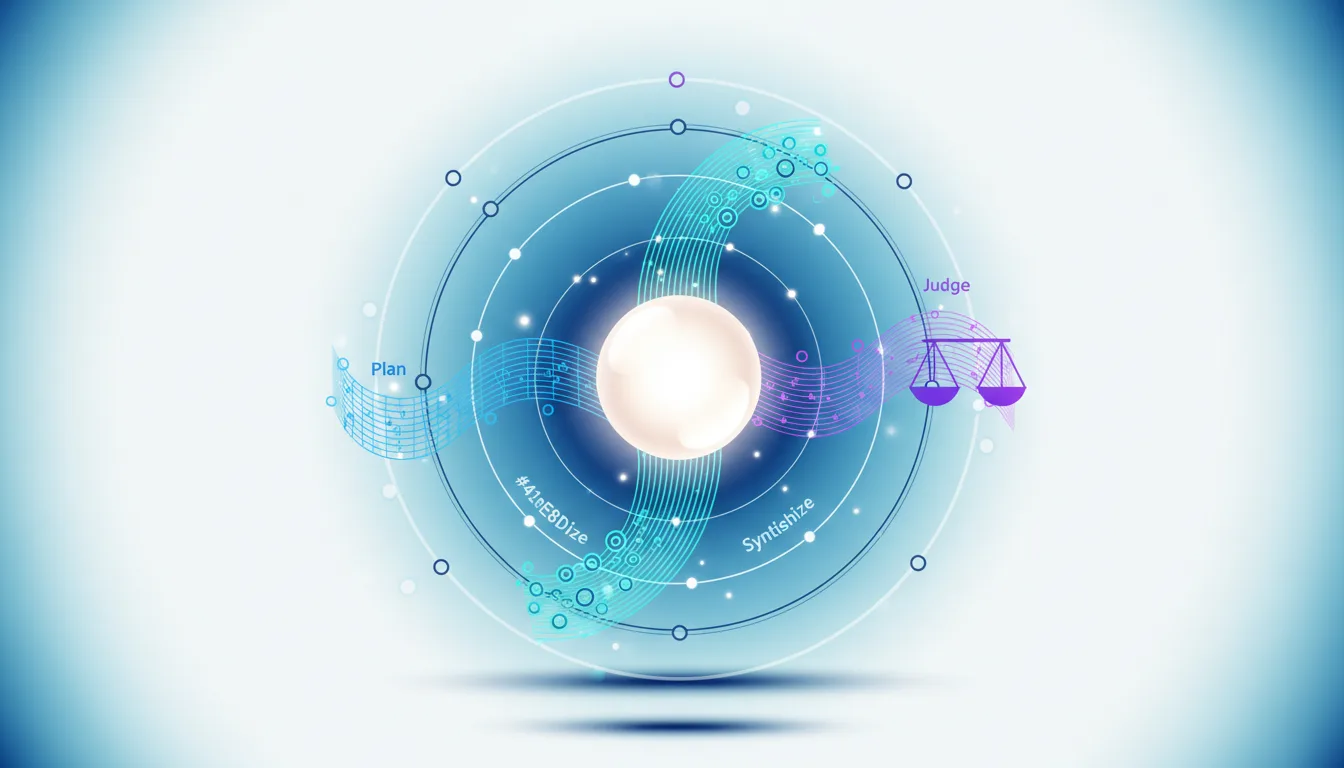
Plan → Synthesize → Judge
The most common implementation follows a three-stage pipeline: Plan → Synthesize → Judge. First, a clear, standardized research plan with specific questions is created. This plan acts as a version-controlled constant. Second, this plan is executed in parallel across a diverse set of AI models, leveraging their different strengths – one might excel at creative ideation, another at data extraction, and a third at logical reasoning. This is a form of “cross-engine RAG” (Retrieval-Augmented Generation) where the diversity comes from the models themselves, not just the data sources. It’s efficient, too, running things side by side rather than one after another.
The critical, and often missing, third stage is judging. Here, a separate process or “referee model” evaluates the divergent outputs. It doesn’t just average them; it scores responses based on evidence, checks for contradictions, and builds a consensus finding, complete with a rationale and confidence score. This transforms a chaotic collection of opinions into a structured, auditable result. Early analysis suggests this pattern is analogous to the PRISMA methodology used for systematic academic reviews, bringing a new level of rigor to automated research. That parallel to academic standards? It adds a layer of trust that’s hard to overstate.
For this to move from a conceptual framework to an enterprise reality, an entire tooling ecosystem is required. This is where the real work lies for developers: building orchestration layers to manage API calls, rate limits, and retries across providers; implementing citation verification pipelines that check link validity and trace information provenance; and designing governance protocols to manage the cost, latency, and privacy trade-offs of using multiple third-party services. The conversation is shifting from prompt engineering to systems engineering – a pivot that’s both challenging and, frankly, exciting for those building the future.
Stakeholders & Impact
| Stakeholder / Aspect | Impact | Insight |
|---|---|---|
| AI / LLM Providers (OpenAI, Google, Anthropic) | High | Models are increasingly seen as interchangeable components in a larger system. This commoditizes them and shifts competition toward specific capabilities (e.g., long-context, safety, cost-per-token) rather than all-around supremacy. From my vantage, it’s like watching specialists step up in a team sport – each one shines where it counts. |
| Developers & AI Engineers | High | The role evolves from prompt engineer to systems architect responsible for building and maintaining complex, multi-agent pipelines. Expertise in orchestration, API management, and evaluation metrics becomes paramount. It’s a role expansion that demands more, but rewards with deeper impact. |
| Enterprises | Significant | Gains major improvements in the reliability, auditability, and defensibility of AI outputs. However, this comes with increased implementation complexity, higher operational costs, and new governance challenges (data privacy, vendor management). Tread carefully here – the benefits are real, yet the setup isn’t trivial. |
| Knowledge Workers (Analysts, Researchers) | Medium–High | Access to more robust and trustworthy research tools, reducing the burden of manual cross-checking. However, it requires a mental model shift from “asking an AI” to “reviewing a synthesized report from an AI committee.” That shift might take some getting used to, but it could save hours in the long run. |
About the analysis
Researched and written with AI assistance under the editorial responsibility of the i10X News team. The title image is an AI-generated illustration. Read our AI Use Policy. Spotted an error? Request a correction.
This analysis is an independent synthesis produced by i10x, based on emerging architectural patterns and identified gaps in current public documentation. It is designed for AI developers, engineering managers, and CTOs who are building the next generation of reliable, enterprise-grade AI systems and need to look beyond single-model architectures. I’ve put it together with an eye toward those practical gaps – the ones that keep popping up in real-world projects.
i10x Perspective
What if the real breakthrough in AI isn’t the next big model, but how we bring them together?
Multi-AI Synthesis signals a crucial maturation point for the AI industry: we are leaving the era of the “magic black box” and entering the era of engineered intelligence. The future of building reliable AI isn’t finding a single, perfect God-model, but in the art of orchestrating a diverse committee of specialized agents. This elevates the role of the developer and the surrounding toolchain above the raw capability of any one foundation model. The key risk to watch is not model performance, but architectural brittleness; the winners will be those who build robust, observable, and governable multi-agent systems, not just those with the best benchmarks. It’s a reminder, really, that in tech as in life – strength often lies in collaboration, not isolation.