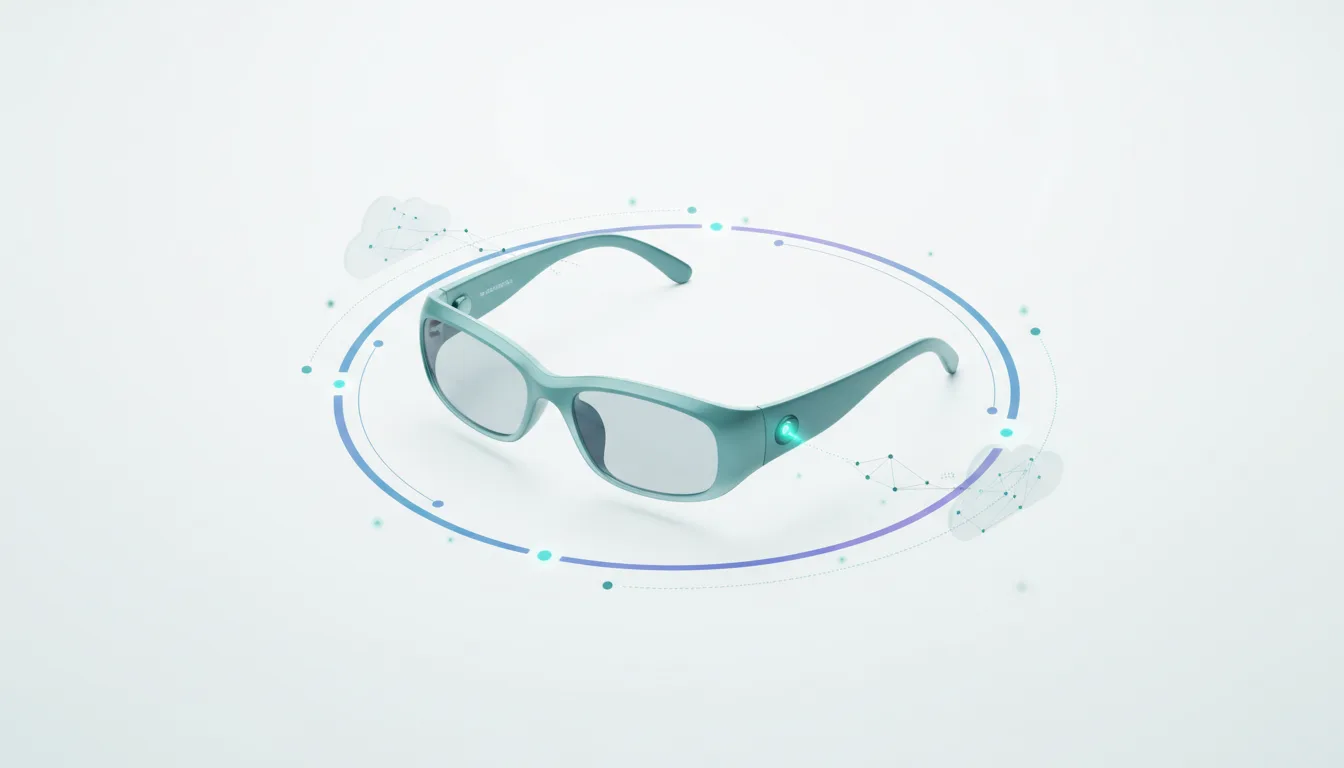
Have you ever wondered if the next big thing in wearables isn’t about flashy screens, but something that just blends into your day? Rokid has launched its AI Glasses Style, a 38.5-gram, display-free wearable that directly challenges Meta’s Ray-Ban glasses by offering longer 4K recording times and—most critically—an open ecosystem that connects to multiple LLMs like ChatGPT, Qwen, and DeepSeek. This move signals a strategic shift in the AI wearables market, betting that consumers will prefer hardware that offers a choice of intelligence engines over the vertically integrated, single-assistant approach favored by tech giants. From what I’ve seen in these early announcements, it’s a smart play—emphasizing flexibility in a space that’s often too locked down.
Quick Take
- Summary: Rokid, a company known for AR hardware, has released the “AI Glasses Style,” a set of lightweight smart glasses without a display. They are designed for hands-free photography, video capture, and voice-based AI assistance, positioning them as a direct competitor to the Ray-Ban Meta Smart Glasses. It’s the kind of device that feels like it could slip right into everyday routines, without pulling you out of them.
- What happened: The glasses weigh just 38.5 grams, feature a 12MP camera capable of 10-minute 4K video clips, and promise up to 12 hours of battery life, all starting at $299. Their key differentiator is the “Open AI Ecosystem,” allowing users to connect to various third-party LLMs instead of being locked into a single proprietary assistant. But here’s the thing—starting at that price point makes it accessible, yet the real value might unfold as users experiment with different AIs.
- Why it matters now: This launch introduces a new paradigm for AI hardware: “bring your own AI.” By decoupling the physical device from the AI model, Rokid is challenging the walled-garden ecosystems of Meta, Apple, and Google. It turns the wearable into an agnostic platform, giving LLM providers a new hardware gateway to users and potentially commoditizing the AI layer itself. Weighing the upsides here, it could open doors for innovation we haven’t fully grasped yet.
- Who is most affected: Meta is the most directly impacted competitor, as Rokid’s specs target the Ray-Ban’s key weaknesses (recording limits) and ecosystem philosophy (closed vs. open). LLM providers like OpenAI gain a new endpoint for their models, while creators and early adopters get a more flexible tool for content capture and ambient AI. That said, it’s worth keeping an eye on how this ripples out to smaller players too.
- The under-reported angle: Most coverage frames this as a hardware spec war against Meta. The real story is the strategic bet on a horizontal, multi-LLM future for personal AI. The critical question is no longer just “which glasses are better?” but “will the future of wearable AI be defined by integrated ecosystems or by open platforms with user-selected intelligence?” Plenty of reasons to think this could spark bigger debates down the line.
Deep Dive
Ever catch yourself wishing for a gadget that enhances your world without getting in the way? Rokid’s new AI Glasses Style are not AR glasses; they are ambient AI companions. By stripping out the display, Rokid has made a deliberate trade-off, sacrificing visual augmentation for extreme light weight (38.5g), longer battery life, and a less obtrusive form factor. Priced at $299, the device is built around two core functions: hands-free content capture with a 12MP camera that records 10-minute 4K clips, and voice-driven access to AI assistants. This hardware package alone presents a compelling alternative to competitors like the Ray-Ban Meta glasses, which have shorter recording limits. I’ve noticed how these choices—lightness over flash—could make all the difference for daily wear.
The true disruption, however, lies in its “Open AI Ecosystem.” Unlike Meta’s glasses which are tied to Meta AI, Rokid allows users to connect to a variety of leading models, including OpenAI’s ChatGPT, Alibaba’s Qwen, and DeepSeek. This is enabled by a dual-chip architecture designed to handle on-device tasks while flexibly routing more complex queries to the user’s preferred cloud-based LLM. This approach fundamentally reframes the device from a product to a platform, a conduit for third-party intelligence rather than a vertically-integrated system. It’s a bet that users will value choice and the ability to access best-in-class AI, regardless of its origin—treading carefully into what might become a more personalized era.
This open philosophy creates a new competitive dynamic. While Meta, Apple, and Google are building walled gardens where their hardware, OS, and AI are deeply intertwined, Rokid is proposing a horizontally-layered world. In this model, hardware manufacturers compete on design and performance, while AI providers compete on the quality of their intelligence. This could give LLM developers a direct-to-ear channel to users, bypassing the mobile phone duopoly and creating new avenues for monetization and user adoption. That pivot feels timely, especially as AI evolves so quickly.
However, this open model introduces significant unanswered questions that go beyond promotional spec sheets. The primary concerns revolve around data privacy and governance. When a user’s voice commands and environmental data are being piped to multiple third-party AI services, where is that data processed, how is it secured, and who ultimately owns it? The current marketing materials are silent on these critical details. Furthermore, real-world performance—independent tests on battery life under heavy use, microphone quality in noisy environments, and the actual latency of different AIs—remains unverified. The promise of “openness” is powerful, but its practical implementation and the associated privacy trade-offs will determine its long-term viability. And really, that’s the part worth watching closely as more details emerge.
Stakeholders & Impact
| Stakeholder / Aspect | Impact | Insight |
|---|---|---|
| AI / LLM Providers (OpenAI, etc.) | High | Rokid provides a new hardware endpoint for user adoption, allowing LLMs to compete for users on wearable devices outside the control of Meta or Google—it’s like handing them a fresh entry point. |
| Competitors (Meta) | High | This is a direct challenge to the Ray-Ban Meta’s feature set (e.g., recording time) and, more importantly, its closed-ecosystem strategy, pushing them to rethink their lock-in approach. |
| Consumers & Creators | High | Offers a more flexible and potentially more capable device for content capture and AI interaction, but shifts the burden of managing privacy and AI choice to the user—freedom with a side of responsibility. |
| Regulators & Policy | Medium | The multi-cloud, multi-LLM data flow creates a complex web of privacy liabilities that current regulations may struggle to address, escalating concerns around public recording and who watches the watchers. |
About the analysis
Researched and written with AI assistance under the editorial responsibility of the i10X News team. The title image is an AI-generated illustration. Read our AI Use Policy. Spotted an error? Request a correction.
This is an independent analysis by i10x based on public product announcements, competitor benchmarks, and an evaluation of gaps in current market coverage. This piece is written for builders, strategists, and investors in the AI and hardware ecosystems to understand the strategic implications of emerging AI-native devices—sharing insights that might spark a few late-night thoughts.
i10x Perspective
What if the battle for our attention isn’t just about the device, but about who controls the smarts inside it? The Rokid AI Glasses are a skirmish in the coming war over the interface for ambient intelligence. The central question is whether the future of personal AI will be dominated by vertically integrated giants or a more open, layered stack where hardware is decoupled from the intelligence engine.
Rokid’s bet on an open ecosystem is a direct challenge to the “Apple model” of total control. If successful, it could commoditize the hardware and turn the AI model into the primary axis of competition. The unresolved tension is a classic one: do users crave the simplicity and security of a single, unified system, or the power and flexibility of an open, modular one? Watch this space—it’s a proxy for the entire debate about the future architecture of AI, and honestly, the answers could reshape how we interact with tech every day.