
Quick Take
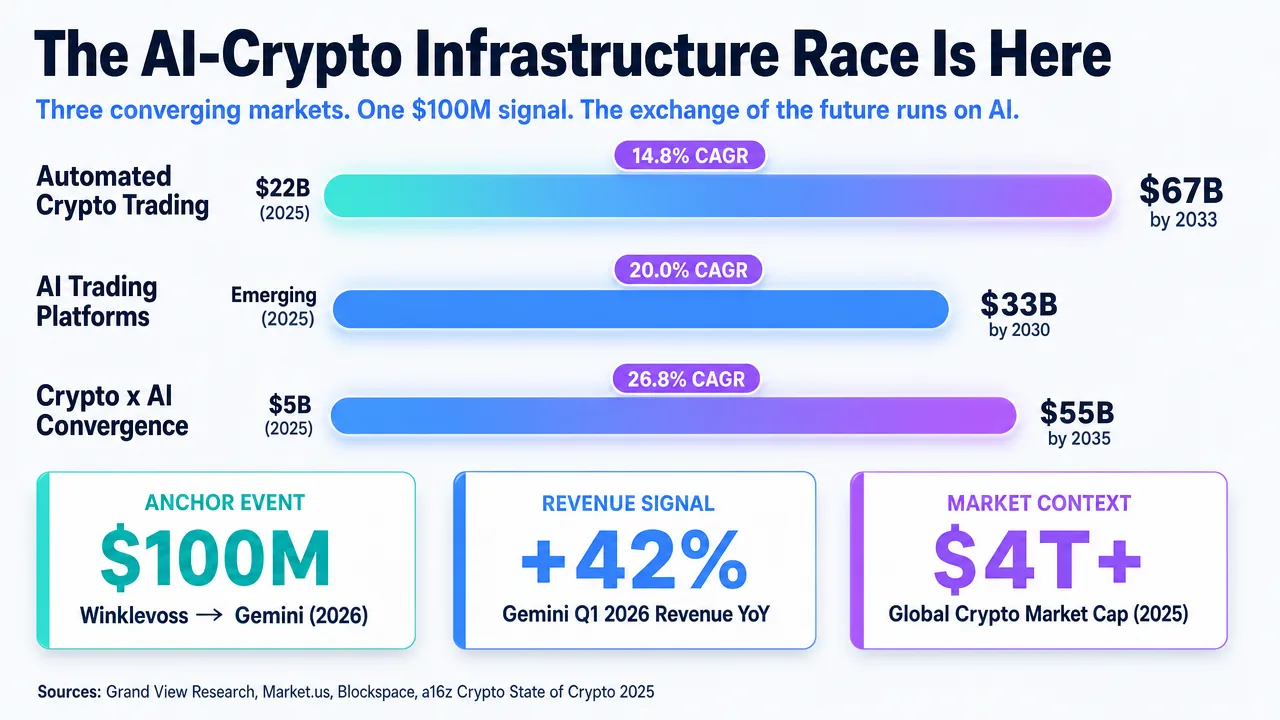
- Summary: Winklevoss Capital has injected $100 million into the Gemini crypto exchange following a strong revenue beat, stabilizing its financial runway and shifting its defensive posture back to growth.
- What happened: Have you followed Gemini’s ups and downs lately? The digital asset exchange just got a hefty $100 million boost from its founders, right on the heels of smashing revenue targets. It puts those nagging worries about liquidity and short-term ops firmly in the rearview.
- Why it matters now: In the intelligence world we track, a pumped-up crypto scene hits the AI infrastructure race head-on. These well-funded platforms are ramping up compute needs fast—think LLMs handling compliance on autopilot, plus the foundations for AI-agent trading networks that run algorithmic magic.
- Who is most affected: Look to the financial infrastructure builders, AI agent devs hunting programmable settlement layers, and data center folks juggling power and GPUs between exploding AI loads and a crypto sector that’s bouncing back strong.
- The under-reported angle: Mainstream finance chatter obsesses over retail volumes and Coinbase matchups, sure—but the real story runs deeper, structurally. This cash locks in the basics so Gemini can pivot its setup toward autonomous AI trading agents and those clever ML security barriers.
Deep Dive
Ever catch yourself wondering how a crypto lifeline like this $100 million from Winklevoss Capital ripples into AI territory? For Gemini, it’s more than survival cash—it’s a launchpad into a compute-hungry financial world. Sure, outlets like CNBC spin it as straight fintech grit, all revenue wins and longer runways. But from what I’ve seen parsing these infrastructure plays, it really buys them a seat at the table where exchanges evolve beyond basic matching.
That said, here’s the gap everyone seems to miss: digital asset platforms aren’t staying simple order books much longer. They’re morphing into API powerhouses for autonomous setups. I’ve noticed projections pointing to LLM-driven agents owning the next wave of on-chain trades—not humans clicking away, but machines negotiating non-stop. Exchanges need total makeovers in throughput, latency, risk prediction; that’s capital-intensive, AI-heavy work, no question.
And don’t get me started on the data center tug-of-war. Legacy crypto outfits getting fresh legs means they’re still in the fight for grid power and energy. Proof-of-work nodes, staking clusters—they’re clashing with AI training rigs over capacity, and as liquidity holds and tokens steady up, blockchains stay juicy enough to keep bidding on those mid-tier centers and power deals.
Inside these exchanges, AI is eating operational costs alive, especially compliance. Brute-forcing SEC and NYDFS rules with teams of people? That’s yesterday. This $100 million lets Gemini roll out LLMs for auto-pipelines, spot on-chain weirdness, scan smart contracts at scale—smart moves, really.
Views split on this round, naturally. Retail sees trust rebuilt post-2022 chaos; us infrastructure types see an arms race kicking off. Gemini can’t just coast on custody and spot trades against Coinbase or Kraken. It has to retool as a slick data layer for the AI-first finance wave ahead—watching that unfold will be telling.
Stakeholders & Impact
AI / LLM Developers
Impact: Medium
Insight: Well-capitalized exchanges guarantee the survival of robust APIs required to build and deploy autonomous, LLM-driven trading agents.
Grid & Data Center Proxies
Impact: High
Insight: A resilient crypto-exchange ecosystem sustains the industry’s demand for high-density compute and power, maintaining competition with AI hyperscalers.
Platform Users & Retail
Impact: Medium
Insight: Fresh capital directly funds enhanced LLM-driven security protections, automated compliance, and uninterrupted product continuity.
Regulators & Policy
Impact: Significant
Insight: Increased capital allows for the integration of sophisticated, AI-based regulatory technology to satisfy complex international and US jurisdictions.
About the analysis
Researched and written with AI assistance under the editorial responsibility of the i10X News team. The title image is an AI-generated illustration. Read our AI Use Policy. Spotted an error? Request a correction.
This independent analysis traces the downstream impacts of institutional crypto investments on the AI and compute infrastructure layer. It is designed for CTOs, AI ecosystem developers, and technical strategists mapping the convergence of decentralized finance and machine intelligence—handy for navigating that overlap, I’d say.
i10x Perspective
That $100 million into Gemini? It’s a heads-up – the digital economy’s backbone is gearing for automated smarts across the board. In five to ten years, “crypto exchange” and “AI agent settlement layer” won’t mean much apart. Forget chasing human sign-ups; it’s about who nails the quickest, safest, LLM-vetted stack to bankroll artificial intelligence by default. Exciting times, if you’re positioned right.