
Research · August 2026
Nine months after McKinsey’s 62% experiment / 23% scale reading, the AI agent gap has not closed. Gartner’s 2026 CIO survey finds only 17% of organizations have deployed AI agents. IBM, in June 2026, finds only 11% of tech leaders fully ready to scale them. This is a mid-year checkpoint against public forecasts, not a new i10X survey. Charts on this page are free to republish with credit.
“Intent is high. Production is still thin. Different surveys, same direction.”
Canonical URL: https://i10x.ai/blog/ai-agents-experiment-vs-scale
62% |
at least experimenting with AI agents (McKinsey State of AI, Nov 2025) |
23% |
scaling agentic AI in at least one function (McKinsey, Nov 2025) |
17% |
have deployed AI agents (Gartner 2026 CIO Survey) |
11% |
of tech CxOs fully ready for agent scale (IBM IBV, Jun 2026) |
Why August 2026 is the checkpoint
In August 2025 Gartner said roughly 40% of enterprise applications would include task-specific AI agents by the end of 2026. That date is about four months away. In November 2025 McKinsey said most organizations were still touring agents, not industrializing them. The live question is not whether agents worked in a demo. It is whether production caught up with intent.
It did not.
McKinsey’s 2026 State of AI is not out yet. Anyone still leading with 62/23 as if it were this year’s census is recycling November 2025. What we have instead is newer, narrower, and more useful: deployment rates, readiness, control gaps, and definitional cuts on what counts as an agent.
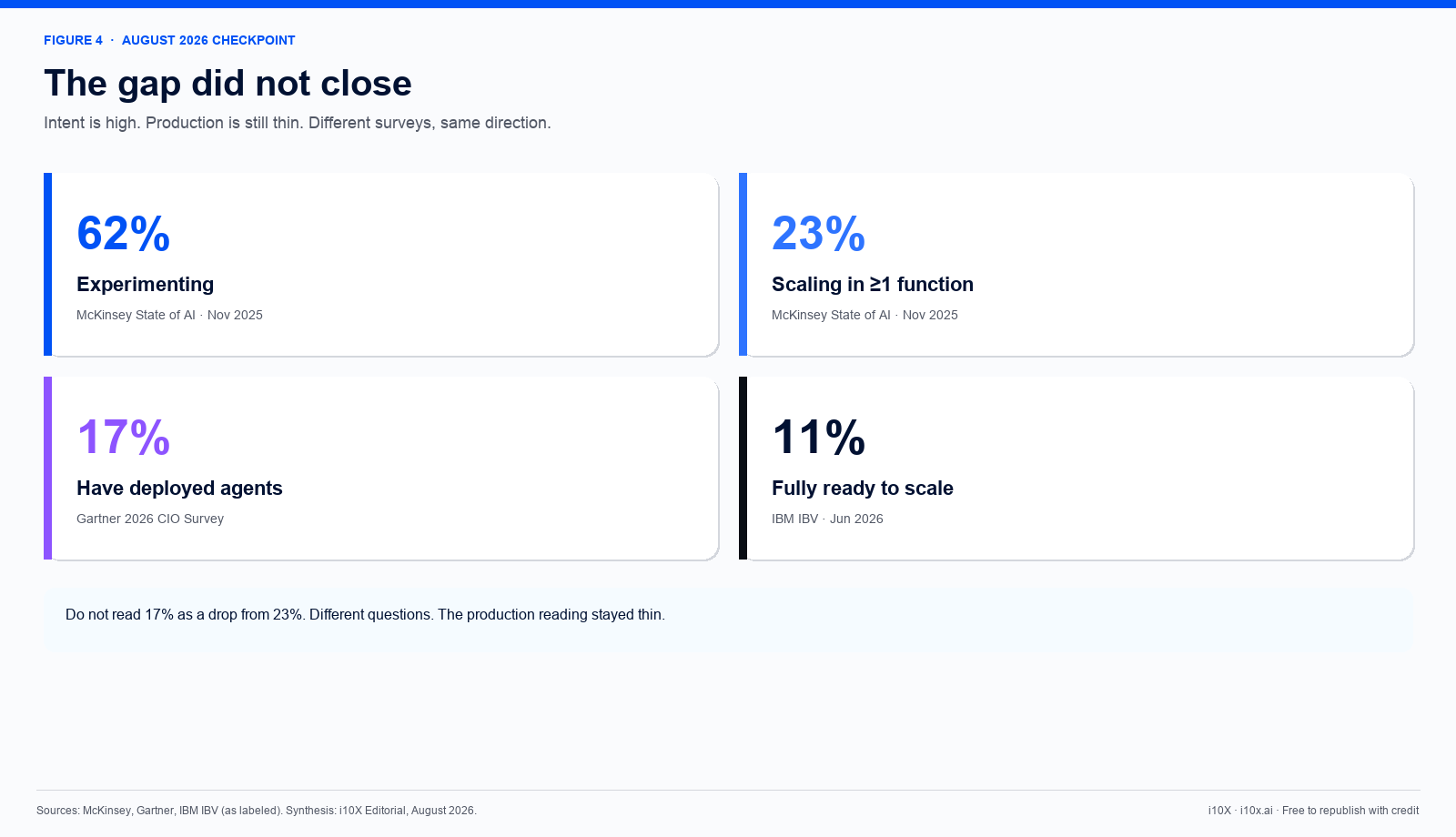
Do not read 17% as a drop from 23%. McKinsey asked who was scaling an agentic system in at least one function. Gartner asked who had deployed AI agents. IBM asked who felt fully prepared for the next wave. Three instruments. One picture: production is still the minority story.
The 2025 baseline (still the best broad census)
McKinsey’s State of AI 2025 remains the last broad, named census of experiment versus scale. The 62% / 23% pair at the top of this article is from that report. Two details matter for the charts below: an extra 39 percentage points inside the 62% are still earlier-stage (do not add 62 and 39), and in any given function scale stays at 10% or less. About two-thirds of organizations have not begun scaling AI across the enterprise. Regular AI use overall is higher: 88% in at least one function (up from 78% prior).
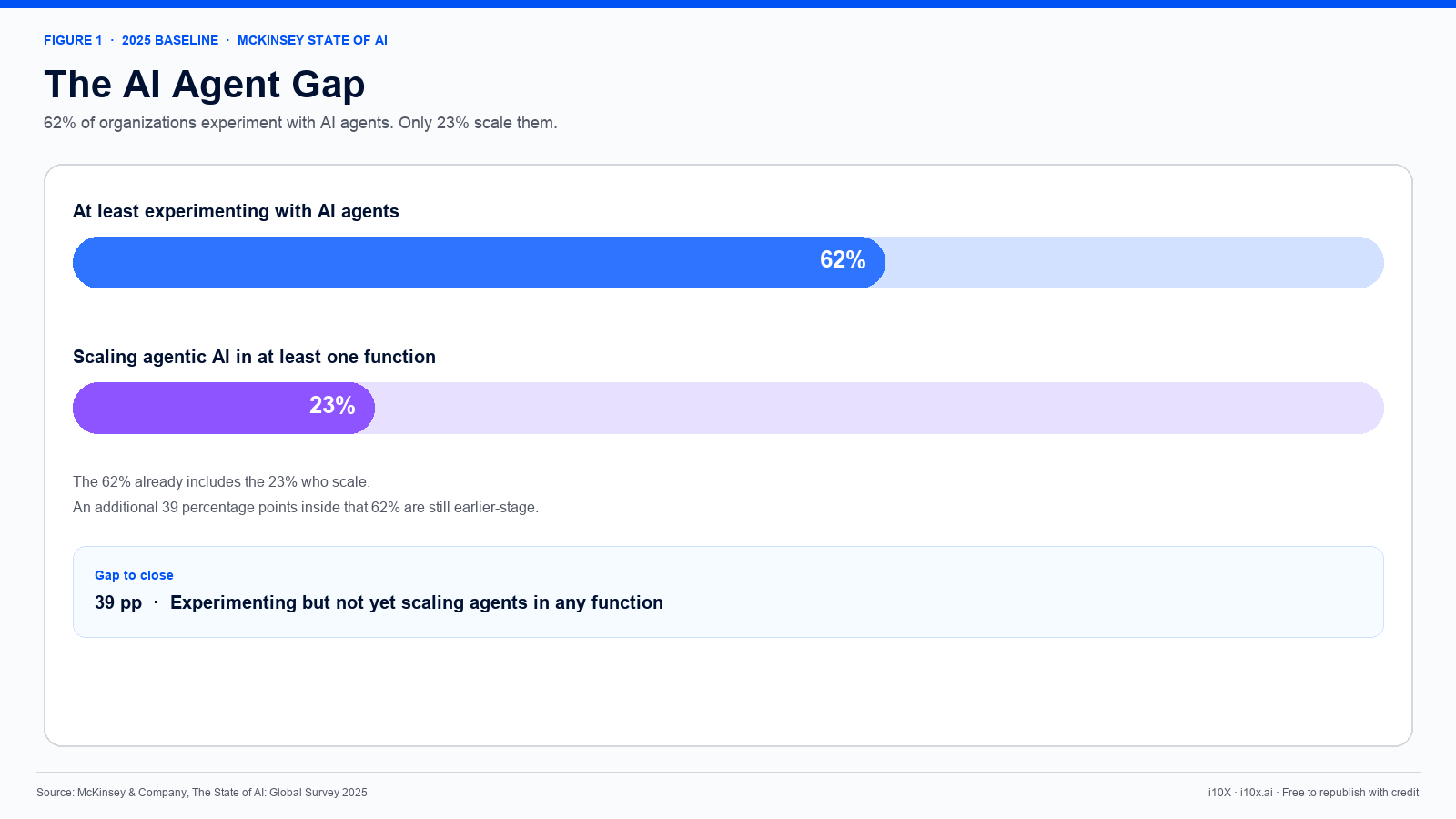
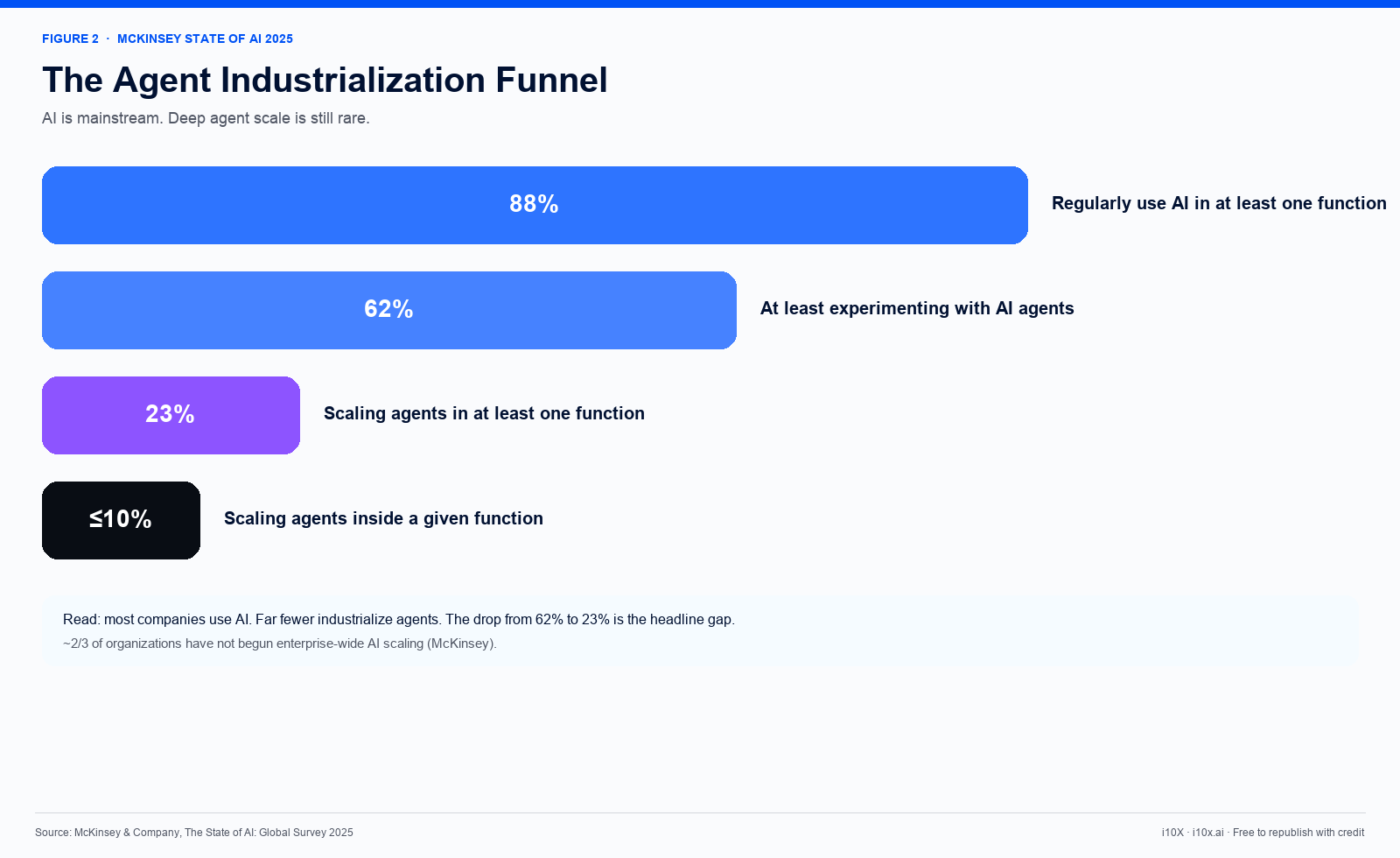
The drop from 62% experimenting to 23% scaling is the headline gap. The further drop to 10% or less inside a given function is the industrialization gap. Most companies use AI. Far fewer industrialize agents.
What 2026 actually measured
Deployment stayed thin
Gartner’s 2026 CIO and Technology Executive Survey finds only 17% of organizations have deployed AI agents. Another 42% expect to deploy in the next 12 months, and 22% in the year after. Gartner calls that the most aggressive adoption curve of any emerging technology in the survey. Intent is not the bottleneck. Shipping is.
Menlo Ventures’ December 2025 enterprise report adds a definitional cut: only 16% of enterprise AI deployments qualify as true agents, systems that plan, act, observe, and adapt. Most of what gets labeled “agent” is still a fixed workflow around a model call.
In April 2026 Gartner published its first dedicated Hype Cycle for Agentic AI and put agent development platforms at the Peak of Inflated Expectations. It named agent-washing (RPA and automation rebadged as agents) as an explicit market problem.
Readiness did not catch up
IBM Institute for Business Value, with Oxford Economics, surveyed 2,000 CIOs and CTOs from January to April 2026:
- 11% say they are completely prepared for the scale of AI agent deployment expected in the next year.
- 80% report a CEO-driven AI transformation mandate.
- 77% say AI adoption is already outpacing current governance.
- 70% say teams across the business deploy technology faster than IT can track.
- Surveyed organizations reported an average of 54 AI agent incidents in the prior year that needed human correction.
- 59% name security and compliance as a top barrier to scaling agents.
McKinsey’s own 2026 work is a trust survey, not a remake of State of AI. Fielded December 2025 to January 2026 among about 500 organizations that own AI risk: nearly two-thirds name security and risk as the top barrier to scaling agentic AI. Only about 30% reach maturity level 3 or higher on strategy, governance, and agentic-AI governance.
The gen-AI risk was AI saying the wrong thing. The agentic risk is AI doing the wrong thing.
Paraphrase of McKinsey’s 2026 trust framing. Source: McKinsey, State of AI trust in 2026.
The Three Clocks
Three clocks are running at once. Vendors ship. Projects die. Control lags. Companies can hit all three without a system of work.
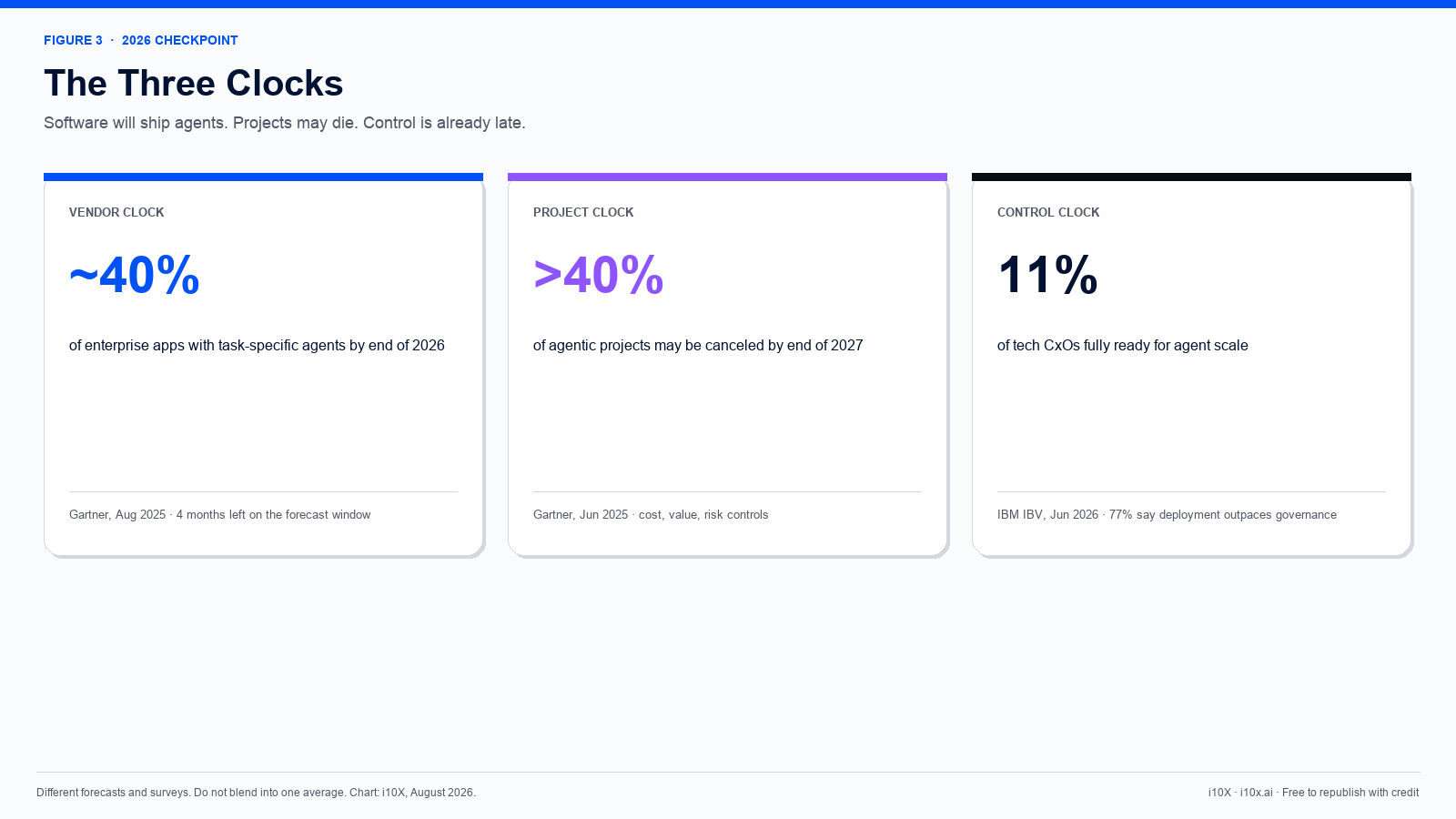
Clock |
Figure |
What it means |
Source / vintage |
|---|---|---|---|
Vendor clock |
~40% |
Enterprise apps forecast to carry task-specific agents by end of 2026 (from under 5% in 2025) |
Gartner, Aug 2025 |
Project clock |
>40% |
Agentic AI projects may be canceled by end of 2027 (cost, unclear value, weak risk controls) |
Gartner, Jun 2025 |
Control clock |
11% |
Tech CxOs fully ready for expected agent scale; 77% already behind governance |
IBM IBV, Jun 2026 |
Vendor clock: Software vendors do not wait for your operating model. Agents will keep arriving inside SaaS tools whether or not your control plane is ready.
Project clock: Gartner’s named drivers for cancellation are still cost, unclear business value, and inadequate risk controls, not model quality. A better model does not fix an unowned workflow.
Control clock (the 2026 addition): 11% ready. 77% already behind their own governance. 54 incidents a year as a surveyed average. This clock is not a 2027 forecast. It is already ringing.
Source map: do not mix these numbers
The headline box above is the only scoreboard on this page. Everything else is context, not a second ranking of the same figures.
- McKinsey 62% / 23% / ≤10%: experiment vs scale vs deep function scale (Nov 2025 census). Not the same question as Gartner “deployed.”
- Gartner 17% / 42% / 22%: have deployed AI agents, or expect to in the next 12 months / the year after (2026 CIO Survey).
- Menlo 16%: share of enterprise AI deployments that qualify as true agents (Dec 2025).
- IBM 11% / 77% / 54: fully ready for agent scale; adoption already ahead of governance; average agent incidents needing human correction (IBV, Jun 2026).
- Gartner forecasts: ~40% of enterprise apps with task-specific agents by end of 2026; >40% of agentic projects may be canceled by end of 2027 (2025 forecasts, not a live deployment census).
Limits: different surveys and definitions, not one panel over time. Do not average McKinsey, Gartner, Menlo, and IBM into a composite. McKinsey State of AI 2026 will be the next broad census. Until then, this is the checkpoint.
What the 2026 numbers mean together
- The bottleneck moved. In 2025 the story was curiosity without industrialization. In 2026 it is intent without control. 42% plan to deploy within a year. 11% feel ready.
- Label inflation is now a measured problem. Gartner named agent-washing. Menlo found only 16% of deployments are agents in the planning-and-acting sense.
- Projects will still die for operating reasons. Gartner’s cancellation drivers (cost, value, risk) match IBM’s incident and governance numbers.
- Security is the scale gate. McKinsey Trust and IBM both put risk and compliance at the center of why scale stalls.
Risks the 2026 reading adds
Risk |
2026 evidence |
What to do |
|---|---|---|
Pilot theater |
Still the 2025 funnel: high experiment, thin scale |
Kill or industrialize; no third year of demos |
Intent overhang |
17% deployed vs 64% who expect to within two years |
Fund control plane before another wave of pilots |
Agent-washing |
Named on Gartner’s 2026 Hype Cycle; Menlo’s 16% true-agent cut |
Tag every “agent” as wrapper vs planner-actor |
Control lag |
11% ready; 77% say adoption outruns governance |
Approval gates, logging, kill switches before scale |
Action risk |
McKinsey Trust: failure mode is doing, not saying |
Human ownership for irreversible actions |
Vendor sprawl |
~40% of apps forecast to carry agents by year-end |
Inventory SaaS-embedded agents; one system of work |
Interactive: Agent Scale Scorecard
Use this as a board or operating review checklist. Expand each item and mark where you actually are.
1. Inventory: Do we know every pilot and SaaS-embedded agent?
List named pilots, owners, and tools. Include agents that arrived inside vendor products without a formal program. If IT cannot list them, you are already in IBM’s 70% “faster than IT can track” bucket.
2. Definition: How many of our “agents” plan and act?
Apply Menlo’s cut: plan, act, observe, adapt. Tag the rest as wrappers or chat. Menlo’s 16% true-agent share exists because most “agent” deployments fail this test.
3. Industrialization: Which three workflows are in production this quarter?
Not demos. Not slideware. Three workflows with owners, KPIs, and a kill switch. McKinsey’s 23% scale figure is the bar for “at least one function,” not “we tried agents once.”
4. Control: Can someone stop a live run in under five minutes?
IBM’s 54-incident average and 77% governance lag make this non-optional. Name the person and the path before you scale volume.
5. Value: Is cost and business value explicit?
Gartner’s cancellation forecast (>40% of projects by end of 2027) is driven by cost, unclear value, and weak risk controls. If you cannot name the KPI, you are on the project clock.
6. Security: Is risk the scale gate, not an afterthought?
McKinsey Trust 2026: ~2/3 name security and risk as the top barrier to scaling agentic AI. Design review and monitoring before the next pilot wave.
Questions boards should ask before year-end
- Which three workflows are we industrializing this quarter, not demoing?
- Of the things we call agents, how many actually plan and act?
- What is the kill criterion, and who can stop a live run?
- Are we collecting SaaS-embedded agents, or running a system of work?
- Where does the 11% readiness gap show up in our org chart (security, IT, LOB)?
- What will we stop funding if it is still pilot theater in Q4?
What to do in the next 30 days
- Inventory every pilot and vendor-embedded agent.
- Tag each as wrapper vs true agent (plan / act / observe / adapt).
- Keep three workflows. Kill or freeze the rest.
- Write a KPI and a kill switch for each of the three.
- Move them into a shared workspace with logging and approvals.
- Decide kill or scale with a date on the calendar.
Frequently asked questions
Did the 62% / 23% gap get better in 2026?
We do not have a remake of that McKinsey census yet. The 2026 readings we do have (17% deployed from Gartner, 16% true-agent deployments from Menlo, 11% fully ready from IBM) do not show the gap closing. They show intent running ahead of production and control.
Is 17% a decline from 23%?
No. Different question, different sample. Treat them as two instruments pointing the same way: industrialization is still the minority outcome.
What does McKinsey mean by “scaling”?
In State of AI 2025, scaling an agentic system means expanding deployment and adoption inside at least one business function, not a one-off pilot, and not “we use ChatGPT.”
Is ChatGPT an AI agent?
Not by the working definition here. A chatbot answers a prompt. An agent plans and executes multi-step work. Some product features can act more like agents. The label is not the test. The job is. Menlo’s 16% figure exists because most “agent” deployments fail that test.
Why would more than 40% of agentic projects be canceled?
Gartner names cost, unclear value, and weak risk controls, not model quality. IBM’s 2026 control-gap numbers are what that forecast looks like on the ground: incidents, mandates without readiness, governance lagging deployment.
What should a team do in the next 30 days?
Inventory the pilots, tag wrappers vs agents, keep three workflows, write a KPI and a kill switch for each, move them into a shared workspace, then kill or scale.
Can we republish the charts?
Yes. Figures 1 to 4 may be reused with the credit line: Chart: i10X · i10x.ai/blog/ai-agents-experiment-vs-scale · sources as labeled. Keep a live link to this page. Do not alter percentages. Do not describe this briefing as an i10X survey.
Canonical URL: https://i10x.ai/blog/ai-agents-experiment-vs-scale
Suggested headline: The AI agent gap did not close in 2026: 62% experiment, 23% scale, 17% deploy, 11% ready
Quotable line: “Intent is high. Production is still thin. Different surveys, same direction.”
Nut graf: Nine months after McKinsey’s 62/23 reading, Gartner finds only 17% have deployed AI agents and IBM finds only 11% of tech leaders fully ready to scale them. The gap is not curiosity. It is production and control.
Charts: Figures 1 to 4 on this page may be republished with credit “Chart: i10X / i10x.ai” plus the original survey source under each figure. Do not alter the percentages. Do not blend 17% and 23% into a single trend line. Do not say McKinsey updated 62/23 in 2026.
Contact: i10x.ai/contact-us
Republish license: Figures 1 to 4 and the Agent Scale Scorecard may be reused with the credit line Chart: i10X · i10x.ai/blog/ai-agents-experiment-vs-scale · sources as labeled and a live link to this page. Do not describe this briefing as an i10X survey.
Where a workspace fits
The public data does not prove any vendor. It does show why a system of work matters more than another isolated agent: shared production patterns, a true-agent vs wrapper cut, measurement, and approval gates above the SaaS tools that will keep shipping their own agents.
That is the problem i10X is built around: one AI workspace for models, agents, and workflows, so teams can move a pilot into production instead of collecting another demo. Learn more at i10x.ai.
References
- McKinsey & Company. The State of AI: Global Survey 2025 (5 Nov 2025). mckinsey.com
- Gartner. 2026 CIO and Technology Executive Survey: 17% deployed; 42% / 22% expect to deploy (cited in the 2026 Hype Cycle for Agentic AI). gartner.com
- Gartner. Predicts 40% of Enterprise Apps Will Feature Task-Specific AI Agents by 2026 (26 Aug 2025). gartner.com
- Gartner. Predicts Over 40% of Agentic AI Projects Will Be Canceled by End of 2027 (25 Jun 2025). gartner.com
- IBM Institute for Business Value / Oxford Economics. 2026 Tech Leader Study (8 Jun 2026). IBM Newsroom
- McKinsey & Company. State of AI trust in 2026: Shifting to the agentic era (25 Mar 2026). mckinsey.com
- Menlo Ventures. 2025: The State of Generative AI in the Enterprise (9 Dec 2025). menlovc.com