Guide · August 2026
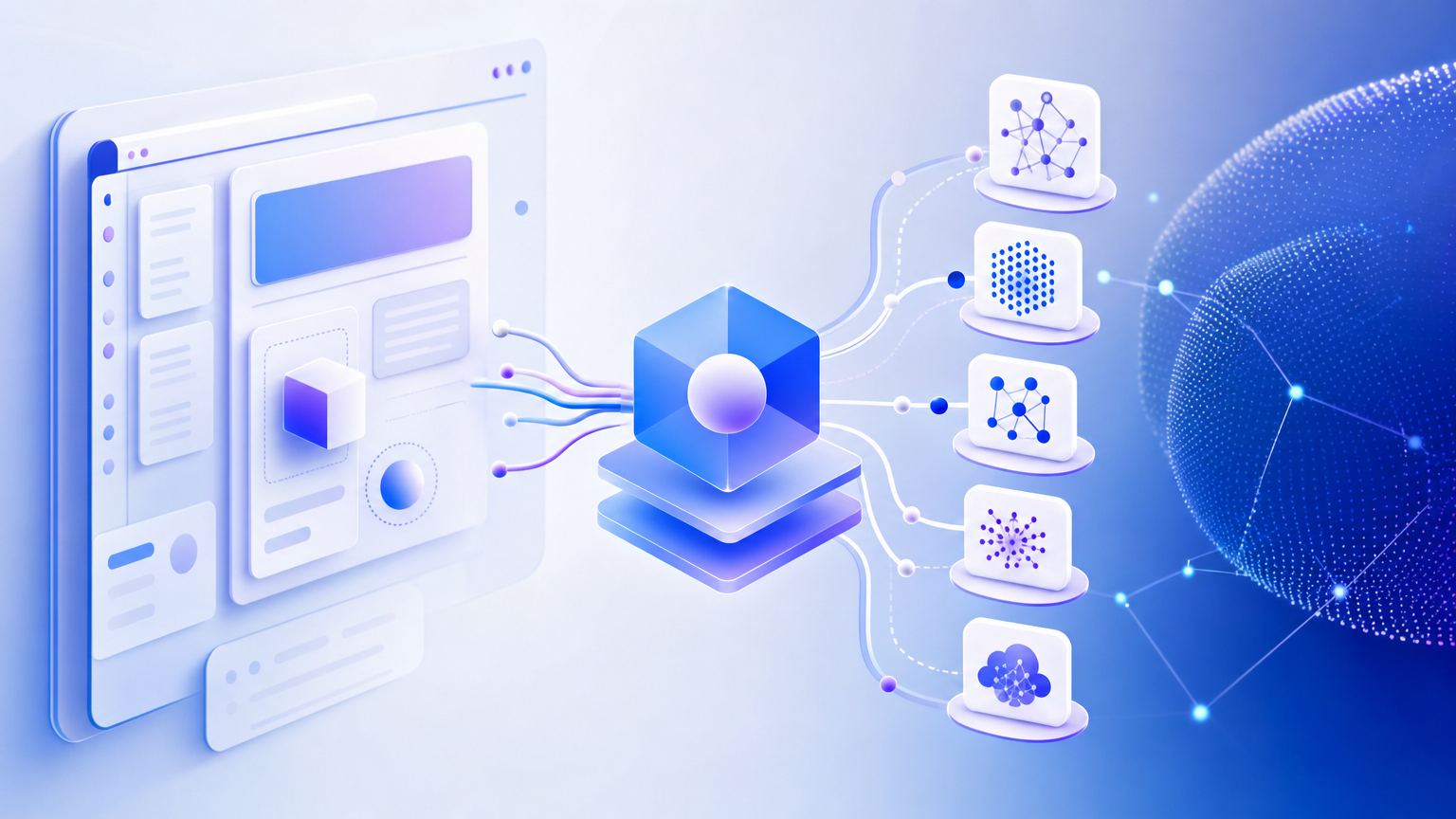
Multi-model AI means using more than one large language model or provider in the same work system (for example GPT, Claude, Gemini, Grok). It is not the same as multimodal AI, which is one model handling text, images, or audio together. This practical 2026 guide is the long-form pillar of the i10X multi-model series: why single-model stacks fail, how to map tasks to models, how routing and side-by-side checks work, how platforms and cost stack up, how Superagent multi-step work differs from chat, how to trust outputs, and a 30/60/90 plan you can run. The commercial home for the series is the multi-model AI workspace hub. Start free on i10x.ai.
Portfolio |
Gartner (Mar 2026): platforms that orchestrate a portfolio of models capture value; route routine work to smaller or specialized models |
42 pp |
Max hire-rate gap, same candidate, different AI resume style (i10X Research; model choice changes outcomes) |
1,576 / 100 |
Valid data points / candidate profiles in the i10X multi-model CV evaluation study |
62% / 23% |
Experiment vs scale for agentic AI (McKinsey 2025 baseline; full checkpoint on experiment vs scale) |
~$20 |
Typical consumer Plus/Pro-class monthly plan class when bought separately (verify live vendor pricing) |
What this guide covers
- What multi-model AI is (and is not)
- Why single-model stacks fail in 2026
- Task → model map
- Routing playbook summary
- Side-by-side and consensus
- Platforms landscape
- Cost math
- Superagent and agents
- Trust and hallucinations
- AI Multi-Model Operating Model 2026
- 30 / 60 / 90 implementation
- Key takeaways
- FAQ
What multi-model AI is (and is not)
Multi-model AI is the deliberate use of more than one LLM or AI provider inside a single operating rhythm: one workspace, shared prompts, explicit routing rules, optional side-by-side comparison, and optional multi-step agents that pick a model per step. The unit of design is the task, not the brand loyalty of last year’s subscription.
Multi-model is not:
- Multimodal AI: one system that accepts text plus images (or audio/video). Useful, different keyword, different design problem.
- Mixture-of-experts alone: internal sparse routing inside one trained model. You still call one product endpoint.
- Tab chaos: three logins, six tabs, no memory, no policy, no audit trail.
- A free “best model forever” ranking: versions change; task fit beats permanent winners.
Multi-model sits next to multi-agent work. Multi-agent means several roles or steps that plan and act. Multi-model means several model endpoints. The high-leverage combination is multi-step work where each step can use a different model under human gates. Product path: route GPT, Claude, and Gemini in one multi-model AI workspace.
Short definition post: what is multi-model AI.
Pattern |
What you operate |
Main failure mode |
|---|---|---|
Single model |
One default chat or API |
Blind spots on tasks that model handles poorly |
Manual multi-model |
Human pastes across apps |
Context loss, cost stack, inconsistent voice |
Routed multi-model |
Rules or agent pick model by task |
Stale rules; silent quality drop if not sampled |
Side-by-side multi-model |
Same brief, two outputs, scorecard |
Time cost; averaging away risk if misused |
Agent multi-model |
Multi-step goal with model per step |
Runaway steps without approval gates |
Why single-model stacks fail in 2026
Single-model stacks fail for structural reasons, not because any one vendor is “bad.”
1. Specialization is real. Public comparison culture in 2026 still repeats the same honest refrain: there is no permanent overall winner. Prose quality, tool ecosystems, long context, research browsing, code agents, refusal style, and latency all split differently. Locking every job to one default wastes that diversity.
2. Cost curves favor portfolio use. Gartner’s March 2026 commentary on inference economics is directional for operators: value accrues to platforms that orchestrate across a portfolio of models, and routine work should often land on smaller or specialized models rather than maximum frontier spend. A single expensive default for every bullet rewrite is an accounting problem, not a creativity strategy.
3. Model choice changes outcomes. Outside chat vibes, i10X Research measured concrete decision impact: up to a 42 percentage-point hire-rate gap for the same candidate depending only on which AI wrote the resume, across 1,576 valid data points and 100 profiles, with evaluator gaps including a largest single-evaluator score gap of 29 points. Full write-up: AI CV bias study. If writing-tool and evaluator choice swing hiring outcomes that hard, assuming one chat model is “good enough for everything” is a business risk, not a preference.
4. Agent ambition outruns control. Organizations experiment with agents far more than they scale them. The i10X mid-2026 checkpoint summarizes McKinsey’s 62% experiment / 23% scale baseline and later deployment and readiness readings (including Gartner 17% deployed and IBM 11% fully ready in the cited surveys). See AI agents experiment vs scale. A single chat tab with no gates is not a production system. A multi-model agent without gates is a faster way to ship wrong work.
5. Tab-hopping recreates the problem you paid to solve. Three ~$20-class consumer plans (verify live) buy three peak models and still lose shared memory, shared prompts, and shared audit. You paid for portfolio capacity and kept single-thread process debt.
Single-model remains rational when: one vendor’s ecosystem owns your workflow, compliance allows only one endpoint, or your work is truly narrow. For everyone else, design for multi-model on purpose inside a multi-model AI platform mindset.
Task → model map (summary)
Do not memorize leaderboards. Memorize task families and second-pass habits. Detailed posts: writing, coding, research.
Task family |
Primary instinct |
Second pass |
Human gate |
|---|---|---|---|
Long-form writing |
Strong prose / structure model |
Edit pass on different model for tone and claim risk |
Before client or public publish |
Marketing short copy |
Model that follows brand constraints |
Compliance-sensitive claims checked elsewhere |
Before paid ads or legal claims |
Code planning |
Strong reasoning model |
Implementation may use faster model |
Before merge to main |
Code review |
Different model or tool than author |
Tests still rule |
Before production |
Web research |
Retrieval-aware tools + synthesis |
Adversarial model attacks weak sources |
Before strategic decisions |
Long document analysis |
Large context strength |
Extract claims table; spot-check quotes |
Before board or legal use |
Boilerplate / rewrite |
Smaller or cheaper model |
Spot sample quality weekly |
Light review |
High-stakes factual claims |
Never sole-model confidence |
Consensus protocol or primary sources |
Mandatory |
Operating comparison across major chat stacks (not a permanent winner board): Claude vs ChatGPT vs Gemini.
Routing playbook summary
AI model routing is how you decide which model gets the next job. Full playbook: AI model routing.
Three control modes
- Static rules: “writing → Model A; code review → Model B; research → tools stack.” Fast, auditable, stale if never reviewed.
- Human pick: operator chooses per task with a short rubric. Best during the first 30 days.
- Dynamic / agent pick: router or Superagent selects model from signals (length, risk, need for tools, latency). Needs logging and samples.
Signals that should change the route
- Risk of wrong facts (publish, finance-ish, medical: do not DIY high-stakes).
- Need for citations or browsing.
- Need for code execution or repo tools.
- Latency and cost sensitivity.
- Whether a second opinion is cheaper than rework.
Failure modes
- Always routing to the most expensive frontier model “to be safe.”
- Lock-in: rules written once, never retested after model updates.
- Silent quality drop when a cheaper model takes over without sampling.
- Routing without version IDs in logs (you cannot debug last month’s output).
Week 1: human pick only, log task type and model. Week 2: encode static rules for the top three task types; sample 10 outputs for rework. Only then allow agent auto-pick for low-risk steps.
Run routing inside a free multi-model AI workspace so rules and history live in one place instead of three chat histories.
Side-by-side and consensus
Side-by-side is not “ask two models and vibe.” It is a method: fixed prompt pack, shared scorecard, disagreement rules, and a decision owner. Full method: side-by-side AI comparison.
Minimal scorecard dimensions
- Instruction following
- Structure and completeness
- Tone fit
- Factual caution (does it invent sources?)
- Actionability
Disagreement rules (operator version)
Situation |
Action |
|---|---|
Models agree on facts and structure |
Use either; sample weekly for correlated error |
Soft disagree (tone/structure) |
Human picks; log preferred model for that task type |
Hard disagree (claims, numbers, recommendations) |
Do not average. Open primary sources or hold publish |
Both fluent, both thin on evidence |
Treat as high risk; research pass required |
Hiring teams already use a rigorous cousin of this logic for screening panels: multi-model AI screening. Knowledge work can borrow the spirit without copying HR process.
Consensus is the trust variant: Model A drafts, Model B attacks weak claims, human or sources resolve. Protocol depth: multi-model hallucination checks.
Platforms landscape
2026 multi-model platforms fall into rough buckets:
Bucket |
What it optimizes |
Weak when |
|---|---|---|
Native single-vendor apps |
Depth of one ecosystem |
You need another model’s strength often |
Chat aggregators / malls |
Many models, one login |
You need multi-step agents and shared ops |
Side-by-side UIs |
Compare answers fast |
No workflow memory or team policy |
API routers (OpenRouter-class) |
Dev control and price |
Non-dev operators need a work OS |
Workspace + agents (i10X class) |
Route, compare, multi-step Superagent, tools |
You only need raw API for engineers |
Score platforms with a written scorecard: model catalog, side-by-side, agents, team controls, BYOK, free tier honesty, pricing clarity, privacy docs. Full commercial investigation: best multi-model AI platforms 2026. Always verify live pricing and model lists before you publish a buy decision.
Fair i10X placement: strong when you want multi-model access plus Superagent workflows and a large tools layer. Not a claim that every native vendor feature is cloned. Product home: i10x.ai and series hub multi-model AI.
Cost math (one subscription vs three)
Rough operator math for 2026 (illustrative; verify live):
- Three separate consumer Plus/Pro-class plans often land near about $20 each per month (vendor pages change).
- That buys three peak ecosystems and still leaves tab-switching tax, context loss, and no shared team policy.
- A multi-model workspace subscription can replace part of that stack for operators who do not need every native feature daily.
- API usage can be cheaper at high volume for engineers and more expensive for chatty non-dev use without caps.
Hidden costs that do not appear on invoices:
- Rework when the wrong model drafts the wrong shape of answer
- Lost context when pasting between apps
- Shadow AI seats nobody tracks
- Agent steps that call frontier models for boilerplate
Gartner’s portfolio orchestration thesis reinforces the design goal: put expensive models on high-value steps and smaller or specialized models on routine ones. Full calculator-style post: AI subscription stack cost.
Superagent and agents
Chat waits for a prompt. An agent pursues a multi-step goal with tools and intermediate state. Superagent, in i10X language, is the workspace agent layer that can research, draft, and package work while you sleep or while you review gates. Explainer: What is the i10X Superagent?
Why agents need multi-model:
- Research steps want retrieval and cautious synthesis.
- Writing steps want prose quality and brand tone.
- QA steps want a different model than the author model.
- Boilerplate steps should not burn maximum frontier budget.
Why agents fail without operating discipline: the industry still shows a large experiment-to-production gap. Link the numbers and control discussion via experiment vs scale. Do not industrialize multi-step autonomy until you have approval gates, logs, and a kill switch for runaway cost.
Deep product-education post: Superagent multi-model routing.
Trust and hallucinations
Operational definition: a hallucination is a confident false statement presented as fact (invented citation, wrong number, fabricated quote). Multi-model checks help when models disagree or when a second model is prompted to attack claims. Multi-model does not eliminate hallucinations. Correlated training data can make models agree while wrong.
Practical tiers
Tier |
Example |
Minimum control |
|---|---|---|
Low |
Brainstorm titles |
Single model fine |
Medium |
Internal brief |
Spot-check numbers; optional second model |
High |
Public article with claims |
Sources + adversarial pass |
Critical |
Legal, medical, safety |
Qualified human + domain systems; do not DIY |
Protocol post: multi-model hallucination checks. Never market multi-model as “hallucination free.”
AI Multi-Model Operating Model 2026
Name it so teams can cite it in policy docs. The AI Multi-Model Operating Model 2026 is five layers:
Layer |
Question |
Artifact |
|---|---|---|
L1. Task taxonomy |
What work do we actually run? |
List of task families with risk tier |
L2. Model policy |
What is allowed default / checker / banned? |
Routing matrix + version log |
L3. Workspace |
Where does context live? |
One multi-model workspace (not five chats) |
L4. Agents |
Which multi-step jobs are automated? |
Superagent playbooks + gates |
L5. Governance |
Who samples, who owns publish, who pays? |
Weekly sample, cost caps, data rules |
Cite “AMMOM 2026” in team docs: taxonomy → policy → workspace → agents → governance. If any layer is missing, you have a chatbot hobby, not an operating model.
Team-scale version with policy templates: multi-model AI for business.
Implementation: 30 / 60 / 90 days
Days 1-30: foundation
- Inventory every AI login and monthly cost (include shadow seats).
- Write task taxonomy (L1) for your real week, not a fantasy org chart.
- Pick one multi-model workspace as system of work. Candidate: i10X.
- Human-pick models for two weeks; log task → model → rework flag.
- Ban high-stakes sole-model publish without source check.
- Read the hub overview: multi-model AI workspace.
Days 31-60: encode and compare
- Turn logs into static routing rules for top three task types (L2).
- Run weekly side-by-side on one fixed prompt pack.
- Introduce consensus checks on any client-facing claims.
- Pilot one Superagent multi-step workflow with mandatory pause before send.
- Set a cost cap alert for agent runs.
Days 61-90: harden and expand
- Sample 20 outputs for quality and model fit; update the matrix.
- Add team shared prompts and ownership (who can change defaults).
- Retire redundant subscriptions only after two weeks without pain.
- Document AMMOM 2026 layers for onboarding.
- Only then expand agent autonomy on low-risk steps.
If productivity storytelling is needed for sponsors, cite carefully: LinkedIn Future of Recruiting 2025 reports gen AI adoption and about 20% of the workweek saved on average among TA professionals using gen AI, with 37% of organizations integrating or experimenting with gen AI in hiring. That is a recruiting survey, not proof that your content team will see the same number. Use it as a productivity analogy only with attribution, or skip it for non-TA audiences.
Who should not go multi-model yet
- You have not written what “good” looks like for your top task.
- Compliance has not approved any external model for your data class.
- You cannot name a human owner for publish decisions.
- You expect multi-model to invent strategy you do not have.
Fix process first. Tools amplify whatever you already do.
Worked day: multi-model without chaos
A concrete day shows the operating model better than another definition table.
09:00 Research. You need a competitor landscape for a call. Superagent (or a structured multi-step chat) uses a retrieval-aware path, writes a source list, then a second model attacks weak claims. You spend ten minutes on the disagreement card, not sixty minutes rebuilding the brief from scratch. Method cousins: research model guide and hallucination checks.
11:00 Writing. Outline on Model A, draft on Model B, edit pass on A or B with a tone rubric. You do not argue about which brand is “best at writing.” You run the writing workflow from best AI model for writing and keep a human on the publish button.
14:00 Coding-adjacent work. Spec and edge cases on a strong reasoning model; boilerplate tests on a cheaper model; review notes on a different configuration. You remember that coding agent products and raw models are not the same purchase. Guide: best AI model for coding.
16:00 Comparison ritual. Once a week you freeze a prompt pack and score two models with the side-by-side method. Results update the routing matrix. That is how “no single winner” stays true without becoming “no standards.”
17:00 Cost glance. You check whether boilerplate still hits frontier endpoints. Gartner’s portfolio thesis is not a slogan here; it is a line item. If Superagent steps are expensive, open the Agent Step → Model Policy and move transform steps down the cost tier.
All of that happens inside one multi-model AI workspace so context, prompts, and policy live together. The day fails when each hour uses a different personal login with no memory and no owner.
Starter prompt packs (copy and adapt)
Routing classifier
You are a task router. Classify the user job as one of: write, edit, code, research, analysis, creative, admin. Recommend primary model class and optional checker. List risks if sole-model. Do not produce the full deliverable until I approve the route.
Side-by-side judge
You will see Output A and Output B for the same brief. Score each 1-5 on instruction following, structure, tone, factual caution, and actionability. List hard factual conflicts. Recommend which output to use or whether to hold for sources. Never average scores into a silent publish decision.
Adversarial claim attack
Attack the following draft. List every factual claim that lacks a source, every number that could be invented, and every recommendation that overreaches the evidence. Propose a revised draft that removes or hedges unsupported claims.
Superagent package brief
Goal: [X]. Constraints: [Y]. Deliverable: one package with sources, open questions, and next actions. Pause after plan. Pause before any external send. Use cheaper models for transforms and stronger models for plan, research synthesis, and final prose.
Expand these in the routing playbook and side-by-side method posts. Product path for running them: i10x.ai.
Metrics that matter (operator scoreboard)
Metric |
How to measure |
Why it beats vanity |
|---|---|---|
Rework rate |
% of AI drafts needing heavy rewrite |
Direct quality signal for routing fit |
Time-to-accepted draft |
Clock from brief to human-accepted version |
Captures multi-model overhead vs gain |
Cost per accepted package |
Model spend for finished work unit |
Shows portfolio routing value |
Hard disagree rate |
Dual-model claim conflicts per week |
Uncertainty visibility, not failure |
Shadow seat count |
Personal AI reimbursements and logins |
Governance and spend leakage |
Sampled error rate |
Weekly audit of high-risk outputs |
Trust without marketing theater |
Do not celebrate token volume. Celebrate accepted work with fewer surprises. Business teams can wrap these metrics in the Team Model Policy Template and quarterly reviews.
Common objections (and calm answers)
“I already know which model I like.” Preference is real. Policy is still useful when you are tired, when teammates join, and when vendors ship new versions that change behavior overnight.
“Multi-model is for engineers.” API routers are for engineers. Task routing, side-by-side scorecards, and Superagent packages are for operators. The multi-model AI hub is written for that second group.
“Two models will just double my cost.” Dual-model on every low-risk rewrite can. Dual-model on high-risk claims and weekly samples usually costs less than one public error or a reopened project. Route boilerplate down the cost stack.
“Agents will replace this whole guide.” Agents without taxonomy, policy, workspace, and governance recreate the experiment-vs-scale gap. The checkpoint at experiment vs scale is the industry’s reminder: demos are common, industrialization is not.
“Comparisons online already picked a winner.” Use Claude vs ChatGPT vs Gemini as an operating comparison, then re-test on your prompts monthly. Winner posts age in weeks.
From guide to habit
Reading is not an operating model. Habit is:
- Keep the hub bookmarked: multi-model AI.
- Keep one workspace as system of work: i10x.ai.
- Keep one matrix live (task → model) with a monthly date stamp.
- Keep one weekly sample on the calendar (15 minutes is enough to start).
- Keep one Superagent workflow in assist mode before you dream of autonomy.
When those five habits exist, the rest of this guide becomes reference material instead of aspiration.
Key takeaways
Multi-model AI is an operating system for work across several LLMs, not a synonym for multimodal media models. Single-model defaults waste specialization and overpay frontier calls for boilerplate. Model choice changes real outcomes (i10X 42 pp hire-rate gap evidence for writing-tool effects). Route by task, compare with scorecards, dual-check claims, and put Superagent multi-step work behind gates because experiment rates still dwarf production readiness. Use the AI Multi-Model Operating Model 2026 (taxonomy, policy, workspace, agents, governance). Start from the commercial hub and free product path rather than collecting another orphan chat login.
Frequently asked questions
1. What is multi-model AI in one sentence?
Using more than one language model or provider in a shared work system so each task can be routed, compared, or dual-checked.
2. Is multi-model the same as multimodal?
No. Multimodal is one system handling multiple media types. Multi-model is multiple models. This guide is about multi-model.
3. Do I need multi-model if I already pay for ChatGPT Plus?
Only if other models win often enough on your tasks to justify switching cost, or if you want second opinions and agent workflows. Many people need both a strong native app and multi-model for the rest.
4. What is AI model routing?
The policy that sends each task to a suitable model (static rules, human pick, or agent pick). See
routing playbook.
5. Will multi-model eliminate hallucinations?
No. It can catch some errors via disagreement and adversarial passes. Primary sources and humans still matter. See
hallucination checks.
6. Is multi-model always cheaper than three subscriptions?
Not always. Do the stack math with live prices and include rework time. Guide:
subscription stack cost.
7. How is a multi-model workspace different from OpenRouter?
OpenRouter-class tools optimize API routing for developers. Workspaces optimize operator UX, history, side-by-side, and often agents. You may use both in larger orgs.
8. What is the Superagent?
i10X’s multi-step agent workspace layer. Explainer:
Superagent
and
multi-model routing for agents.
9. How do I start in one week?
Inventory logins, pick one workspace, log task→model for five workdays, ban sole-model publish on high-risk claims, read the
hub.
10. Which model is best overall in 2026?
None permanently. Use task posts and
Claude vs ChatGPT vs Gemini
as an operating comparison, then re-test.
11. What is the AI Multi-Model Operating Model 2026?
The five-layer standard on this page: task taxonomy, model policy, workspace, agents, governance.
12. How does i10X research prove model choice matters?
The CV bias study found up to a 42 pp hire-rate gap by AI resume style across 1,576 points and 100 profiles. Link:
ai-cv-bias.
Use it as outcome sensitivity evidence, not as a chat leaderboard.
13. Should teams share one model policy?
Yes. Shared defaults reduce chaos. Department exceptions need written risk tiers. Business guide:
multi-model AI for business.
14. Where do I go next after this guide?
Commercial home:
multi-model AI hub.
Then routing, platforms 2026, and Superagent posts linked above. Product:
i10x.ai.
“Build a portfolio of models and a policy for the next step. The workspace is how the policy becomes habit instead of another slide deck.”
i10X
Put this guide to work
Open the multi-model AI workspace, encode your first routing rules, and run one Superagent workflow with a human gate. Free start on the product site.
Multi-model AI workspace hub · Routing playbook · Superagent multi-model routing
- Gartner (25 Mar 2026 press commentary on inference economics): portfolio orchestration and routing routine work to smaller or specialized models (high-level; verify primary wording at publish).
- i10X Research (June 2026), AI resume writing style and screening outcomes: up to 42 pp hire-rate gap; 1,576 valid data points; 100 profiles; 29-point largest single-evaluator score gap.
- McKinsey State of AI 2025 agentic baseline (62% / 23%) and 2026 checkpoint figures (including Gartner 17% deployed; IBM IBV 11% fully ready) as compiled on AI agents experiment vs scale.
- LinkedIn Future of Recruiting 2025: 37% of organizations integrating or experimenting with gen AI in hiring; ~20% workweek saved on average for TA professionals using gen AI (productivity analogy only; domain-limited).
- Consumer Plus/Pro-class pricing near ~$20/mo each when cited: verify live vendor pages; stack discussion in AI subscription stack cost.
- i10X Superagent and product: Superagent explainer; i10x.ai; series hub multi-model AI.
- Internal methodology cluster: routing, side-by-side, hallucination checks, platforms 2026, task posts for writing/coding/research (linked in body).