Guide · August 2026
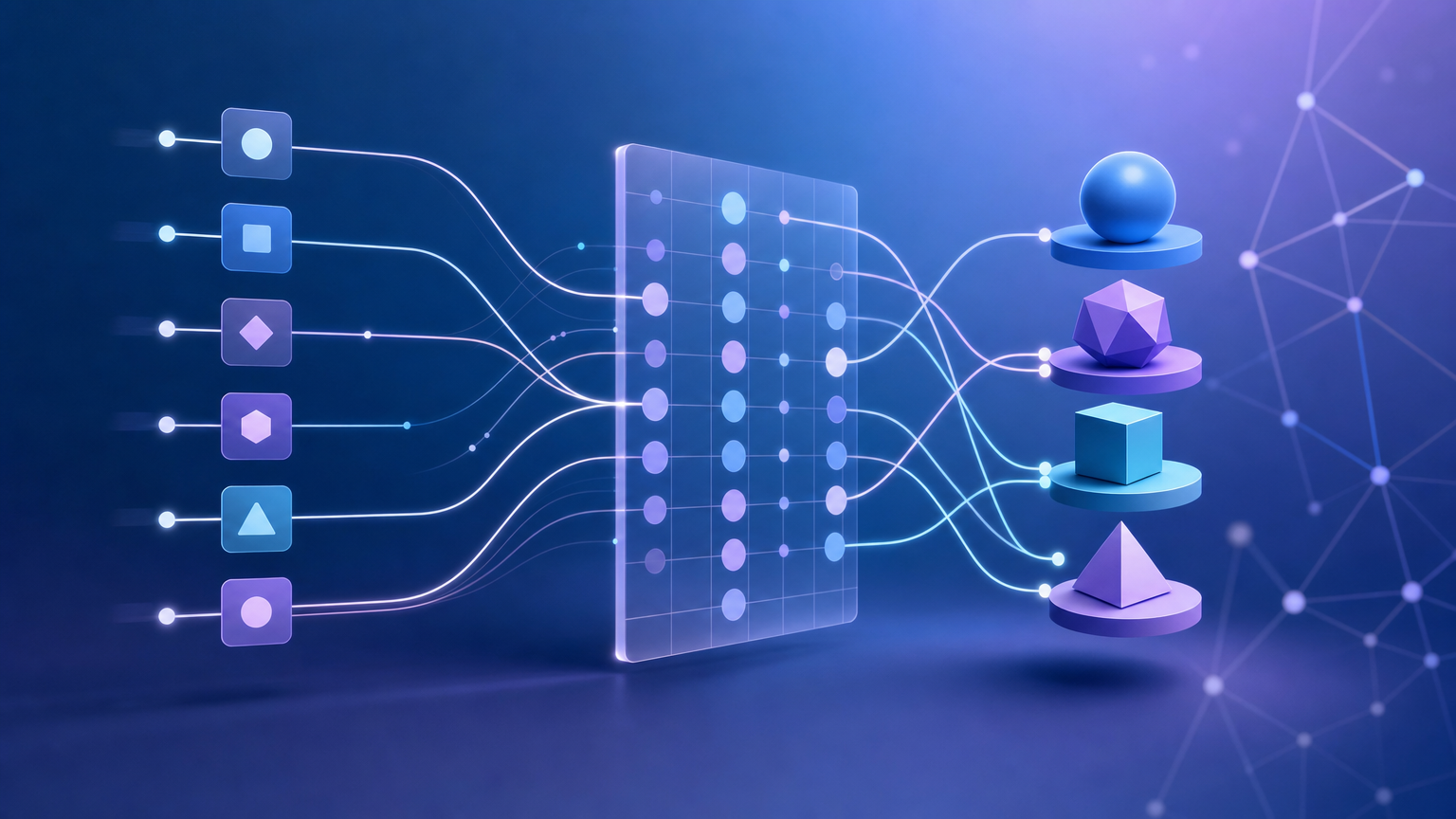
AI model routing is the practice of sending each task to the model (or model set) that best fits quality, cost, latency, and risk rules instead of using one permanent default. Multi-model AI means operating a portfolio of models; multimodal AI means one system handling multiple media types such as text and images. Routing is how multi-model becomes operational rather than a pile of unused logins. This guide gives you a full Task → Model Routing Matrix 2026, compares static maps, dynamic routers, and human pick, outlines a 14-day pilot, and places routing next to Gartner’s portfolio orchestration framing. Hub: multi-model AI. Workspace: i10x.ai.
Portfolio |
Gartner (Mar 2026 direction): value to platforms that orchestrate across models and route routine work to smaller or specialized models |
8 lanes |
Writing, code, research, analysis, creative, long-doc, realtime, quick admin in the 2026 matrix below |
14 days |
Pilot length to lock taxonomy, defaults, fallbacks, and first dual-model gate |
Re-test |
No permanent “best model”; leaderboards change and your tasks change |
Multi-model vs multimodal (routing context)
Before you build a router, fix vocabulary. Multi-model is portfolio selection across models or providers. Multimodal is whether a given model can ingest or emit more than text. A routing policy might send screenshot-heavy support tickets to a multimodal model and pure prose rewriting to a different text-strong model. Those are two orthogonal axes. If your team says “we need multimodal routing” when they mean “we need multi-model routing,” fix the language in the first meeting or every architecture diagram will lie.
Primer if you need foundations: what is multi-model AI. Comparison context: Claude vs ChatGPT vs Gemini.
What is AI model routing?
AI model routing is a control decision that answers: Given this input, this task label, these constraints, which model endpoint(s) should run, in what order, and with what human gate?
Routing can be:
- Manual: a human chooses from a short menu.
- Static: a table maps task type → primary model / secondary model.
- Dynamic: a classifier, rules engine, or agent selects based on features (length, language, risk tags, tool needs, past failure).
- Panel: always two models for a risk class, then merge or human resolve.
Routing is not the same as load balancing. Load balancing spreads identical traffic for capacity. Routing changes destination because the job differs. Routing is also not MoE (mixture-of-experts) inside one model. MoE is internal. Routing is an external policy you own.
If you cannot write the rule that chose the model on a sticky note, you do not have routing. You have habit.
Why routing matters in 2026
Three pressures make routing a first-class design problem:
- Model sprawl without policy: teams collect ChatGPT, Claude, Gemini, and niche tools, then still paste everything into whichever tab is open.
- Economics of inference: flagship models are powerful and often more expensive per token. Gartner’s March 2026-style message is clear at a high level: value accrues to systems that orchestrate a portfolio and send routine work to smaller or specialized models as cost and performance trajectories evolve. You do not need fabricated percentage savings to act on that logic.
- Agent ambition vs production: many organizations experiment with agents while fewer scale them. McKinsey’s November 2025 State of AI framing (as covered on i10X) put experiment near 62% and scale near 23% for agentic AI in at least one function; later public checkpoints still show thin deployment (Gartner 17% deployed; IBM 11% fully ready). Read experiment vs scale. Routing policies are a stepping stone: you can route models before you fully trust autonomous tool loops.
Routing also protects quality when model choice changes outcomes. i10X Research showed that AI writing style and evaluator setup can move hire-rate style outcomes by large margins (up to 42 pp, 1,576 points, 100 profiles, 29 pt evaluator gap). That is a screening story, but the general lesson holds: defaults are not neutral. Source: ai-cv-bias.
Task → Model Routing Matrix 2026 (magnet)
Use this matrix as a starting policy, not a permanent ranking. Cells describe roles (what the model should be good at), not a claimed leaderboard winner. Re-test quarterly and after major model releases. Consumer flagship plans often sit in a ~$20/mo class (ChatGPT Plus / Claude Pro / Gemini Advanced); verify live pricing.
Task lane |
Primary model role |
Secondary / critic role |
Cheap path (when quality gates allow) |
Human gate |
Notes for 2026 operators |
|---|---|---|---|---|---|
Writing (blog, email, docs) |
Strong long-form prose and structure model |
Separate critic for clarity, claims, brand voice |
Smaller model for outline bullets and subject lines |
Before external publish or customer send |
See writing guide. Split by content type; no single forever winner. |
Code (implement, refactor, tests) |
Code-strong model or coding agent harness |
Independent review model on risky diffs |
Fast model for boilerplate and renames |
Before merge; tests are truth |
Separate raw model vs products like Cursor / Copilot-class / Claude Code-class tools. Guide: coding. |
Research (collect, cite, map) |
Model or mode with strong retrieval / browsing / multimodal file handling |
Synthesis model that must keep citations |
Cheap model for de-duplicating notes |
Before decisions that spend money or reputation |
research guide. Never treat uncited claims as facts. |
Analysis (tables, tradeoffs, scoring) |
Model that follows rubrics and structured outputs |
Second model on high-stakes scores (panel) |
Rules or smaller model for obvious filters |
On irreversible classifications |
Panel when outcomes resemble hiring or credit-like decisions. Bias evidence: CV bias. |
Creative (concepts, names, angles) |
High-variance generative model you like for ideation |
Brand-safe critic with constraints |
Optional; ideation volume can stay on mid tier |
Brand and legal review for public creative |
Optimize for option quality, not first-token speed. |
Long-doc (books, packs, RFPs) |
Large-context model good at coherence over long inputs |
Sectional critic; optional second model for summary fidelity |
Chunking pipeline with smaller models per section |
On executive summaries and commitments |
Context window is not understanding. Chunk + map-reduce still helps. |
Realtime (chat support, live assist) |
Low-latency model with tool hooks |
Escalation model when confidence low |
Small model for intent classification |
Human for refunds, legal, safety, VIP |
Latency SLAs beat flagship vanity. Measure p95 response time. |
Quick admin (cleanup, format, tags) |
Small / fast / cheap model |
Flagship only on failure |
This lane is the cheap path |
Spot checks; not every item |
Default waste pattern is flagship-for-bullets. Stop it. |
Print the matrix. Put it in the team wiki. Update the “primary role” column with the actual model IDs you approve this month (for example “Provider A flagship dated August 2026”), not eternal brand names alone.
Static vs dynamic vs human pick
Static routing
A table or config file: if task=writing and subtype=long-form, use Model X; if fail quality gate, retry Model Y. Strengths: auditable, cheap, easy to train. Weaknesses: brittle when tasks are mixed; humans still mislabel.
Best for: teams under 50 people, clear task taxonomy, first 90 days of multi-model maturity.
Dynamic routing
A lightweight classifier or rules on features: token estimate, file types, PII flags, customer tier, language, past edit distance. Strengths: scales, enforces cost policy. Weaknesses: router errors become silent quality bugs; needs monitoring.
Best for: productized AI features, shared platforms, agent workspaces. Aligns with Gartner’s portfolio orchestration direction when done with logs and fallbacks.
Human pick
A menu of three models with recommended defaults. Strengths: expert judgment on weird tasks. Weaknesses: inconsistency, training cost, “favorite model” bias.
Best for: specialists (senior ICs, researchers) and for exceptions the static map cannot encode.
Hybrid that usually wins
Layer |
Mechanism |
Example |
|---|---|---|
Default |
Static matrix |
Quick admin → small model |
Exception |
Human override |
Board memo → user forces flagship A |
Risk class |
Forced panel |
Analysis high-stakes → Model A + Model B |
Scale path |
Dynamic assist |
Auto-detect image attachments → multimodal endpoint |
Routing inputs and signals
A router is only as good as its features. Minimum viable signal set:
- Task label from the matrix (required).
- Risk tag: low / medium / high / irreversible.
- Audience: internal, customer, public, regulated.
- Modalities present: text only vs images, PDFs, audio.
- Size: short, medium, long-doc.
- Tool needs: code execution, browser, repo access, none.
- Latency budget: interactive vs batch.
- Data class: public, internal, confidential (drives which vendor contracts are allowed).
Optional advanced signals: user role, historical acceptance rate per model on similar tasks, cost budget remaining for the month.
Designing fallbacks that are not theater
Every primary needs a fallback that is not “try harder with the same prompt.” Useful fallback types:
- Same model, different prompt mode: stricter schema, lower temperature, shorter answer.
- Different model, same brief: true multi-model second try.
- Human: when two models disagree or confidence is low.
- Non-LLM path: template, search, rules, calculator.
Log which fallback fired. If Model B wins 80% of fallbacks on a lane, promote B to primary for that lane after a re-test, not based on vibes.
14-day pilot playbook
This pilot is deliberately short so you ship a policy, not a white paper.
Days 1-2: Inventory
- List every AI app and API key in use.
- Note monthly cost (consumer ~$20/mo class plans: verify live pricing; APIs: last invoice).
- Export or estimate top 30 task types from real work, not from a wishlist.
Days 3-4: Taxonomy
- Collapse tasks into the eight lanes of the matrix (or fewer if honest).
- Add risk tags for each recurring workflow.
- Write one paragraph definition per lane so people classify the same way.
Days 5-7: Baseline bake-off
- Pick three real tasks per high-volume lane.
- Run side-by-side with identical briefs ( side-by-side method).
- Score with a fixed rubric: correctness, completeness, edit distance to publishable, time to useful draft.
- Do not declare eternal winners. Declare defaults for the next 30 days.
Days 8-10: Encode policy
- Fill primary / secondary / cheap path columns with actual model IDs.
- Define human gates in one checklist.
- Choose static table in a shared doc or simple config; skip fancy routers until the table is stable.
Days 11-12: Add one panel
- Pick one high-risk analysis or writing workflow.
- Always run two models; show both outputs; human decides.
- Measure disagreement rate and time added.
Days 13-14: Review and cut
- Drop one unused subscription or seat if possible ( subscription stack cost).
- Publish v1 routing matrix with an owner and a re-test date.
- Schedule a 30-day retrospective.
Classification agreement among humans on task labels; percent of tasks that followed the map; edit time vs pre-pilot; dual-model disagreement rate on the panel lane; cost per successful task if you have API data. Skip vanity “tokens used.”
Routing for agents and superagents
Agents amplify routing mistakes because they call models in loops. If experiment rates still exceed scale rates (McKinsey 62% / 23% framing; thin deployment readiness in later surveys), treat model policy as part of agent readiness, not as a later optimization.
For workspace-level design, see what is the i10X Superagent and superagent multi-model routing. Principles that transfer:
- Bound tools and models per agent role.
- Escalate risk classes to stronger models or humans.
- Never let cost-only routing silently downgrade regulated or customer-facing work.
- Keep model ID and prompt version in every run log.
Implementation patterns (from spreadsheet to platform)
Pattern 1: Spreadsheet OS
Columns: task, primary, secondary, cheap, risk, human gate, owner. Everyone bookmarks it. Good enough for many SMBs.
Pattern 2: Slash commands or templates
In chat tools, named prompts that include the intended model choice in the title (“/write-long-form”). Still human-initiated, more consistent.
Pattern 3: API gateway
One internal endpoint that accepts task metadata and chooses upstream models. Requires eng ownership and eval harnesses.
Pattern 4: Multi-model platform
Buy or build a surface that already supports multiple providers, comparison views, and policies. Survey options in best multi-model AI platforms 2026. i10X’s product direction is a unified workspace: i10x.ai.
Quality gates before and after the model call
Routing without gates is just expensive spaghetti.
- Pre-call: data class allowed? brief complete? task labeled?
- Post-call: schema valid? citations present when required? policy language absent?
- Cross-model: if panel, classify agree / soft disagree / hard disagree.
- Human: only for residual risk, not for rubber-stamping every token.
Hallucination-specific workflows: multi-model hallucination checks.
Common anti-patterns
- Flagship monogamy with multi-model branding: three logos on the slide, one model in the logs.
- Router opacity: users never know why Model B was chosen; trust dies.
- Optimizing only for cost: cheap wrong answers cost more in human repair.
- Optimizing only for peak benchmarks: your task is not the public leaderboard.
- No re-test calendar: last year’s default becomes this year’s silent regression.
- Identical correlated models: “two models” that share the same base and training era without diversity of failure modes.
- Skipping admin lane: 40% of prompts are cleanup and still hit the largest model.
Business rollout: RACI and change management
Role |
Responsibility |
|---|---|
Executive sponsor |
Approves multi-vendor policy and budget envelope |
AI / platform owner |
Maintains matrix, model allowlist, re-test calendar |
Security / legal |
Data classes, retention, vendor DPAs |
Team leads |
Lane-level defaults for writing, code, research |
ICs |
Label tasks, honor gates, file quality bugs |
For broader org framing, see multi-model AI for business and the full multi-model AI guide.
Measuring routing success
Track a small set for 30/60/90 days:
- Map adherence: % of sampled tasks that used the intended primary or an approved override.
- Override quality: were overrides justified, or was the map wrong?
- Time-to-acceptable-draft: by lane.
- Panel disagreement rate: for high-risk lane only.
- Cost per lane: especially quick admin vs writing vs code.
- Incident count: wrong model used on confidential data; customer-facing errors.
If map adherence is low, fix training or the map. If adherence is high but quality is low, fix model choice or prompts, not compliance theater.
Key takeaways
AI model routing turns multi-model from a shopping list into an operating system. Start static with eight lanes, force panels on irreversible work, push admin to cheap models, and re-test when vendors ship. Gartner’s portfolio message is your economic north star; your matrix is the daily instrument. Agents can inherit the same policy later.
Frequently asked questions
1. What is AI model routing?
It is the policy and mechanism that chooses which model (or models) handle a task based on type, risk, cost, latency, and tools, instead of always using one default.
2. How is routing different from multi-model AI?
Multi-model AI is the portfolio. Routing is how work is assigned inside that portfolio. You can own multiple models and still fail to route.
3. Multi-model vs multimodal: which does routing care about?
Both. Multi-model is which weights you call. Multimodal is whether the task needs image/audio/file understanding. Routers should read modality signals.
4. Should routing be automatic on day one?
Usually no. Start with a static matrix and human pick. Automate after labels and defaults stabilize in a 14-day pilot.
5. What is the Task → Model Routing Matrix 2026?
The eight-lane table in this article: writing, code, research, analysis, creative, long-doc, realtime, and quick admin, each with primary, secondary, cheap path, and human gate guidance.
6. How do Gartner’s comments affect my stack?
At a high level, Gartner points value toward orchestrating a portfolio and routing routine work to smaller or specialized models. Use that as strategy; implement with your own cost and quality data, not invented savings percentages.
7. Can one model still win most lanes?
Yes for a period. The point of routing is explicit choice and cheap paths, not forced diversity. Re-test when quality or price shifts.
8. How does routing relate to agents?
Agents need routing policies even more because they loop. Many orgs still experiment more than they scale agents (McKinsey 62%/23% framing; Gartner 17% deployed; IBM 11% fully ready in the i10X checkpoint). Get model policy right early.
9. What should never be auto-routed without a human?
Irreversible people decisions, legal commitments, large financial actions, and any output that will be published as fact without review. Panel plus human is safer than single-model auto.
10. How often should we update the matrix?
After major model releases, after quality incidents, and on a monthly or quarterly calendar. Leaderboards are not a schedule.
11. Do we need a multi-model platform to route?
No. Spreadsheets work initially. Platforms reduce friction as volume grows. Compare options in the platforms guide; try
i10x.ai
for a workspace-centric approach.
12. Where does cost control actually happen?
Mostly in the quick admin and high-volume low-risk lanes, plus killing unused seats. Flagship monogamy on cleanup is the classic leak. Verify live pricing for ~$20/mo class consumer plans and APIs.
“A model portfolio without routing is a drawer of keys. Routing is knowing which door each key opens before you start sprinting.”
i10X
Put routing into practice
Read the full silo, then run routed multi-model work in one place.
- Gartner (March 2026 context): strategic emphasis on platforms that orchestrate across a portfolio of models and route routine workloads to smaller or specialized models amid evolving inference economics. Consult primary Gartner research for formal citations in procurement.
- McKinsey State of AI (November 2025 framing via i10X): ~62% experimenting with AI agents / ~23% scaling in at least one function; later checkpoint figures include Gartner 17% deployed and IBM 11% fully ready. https://i10x.ai/blog/ai-agents-experiment-vs-scale
- i10X Research CV evaluation study: 42 pp hire-rate gap; 1,576 points; 100 profiles; 29 pt evaluator gap. https://i10x.ai/blog/ai-cv-bias
- Consumer plan pricing class (~$20/mo) for major assistants: verify live pricing with OpenAI, Anthropic, Google, and resellers.
- i10X multi-model cluster: what is multi-model AI, Claude vs ChatGPT vs Gemini, writing, coding, research, side-by-side comparison, hallucination checks, platforms 2026, subscription cost, superagent routing, business guide. https://i10x.ai/blog/multi-model-ai