
Comparison · August 2026
Claude Opus 5 and GPT-5.5 are the Anthropic and OpenAI flagships teams actually route between in mid-2026. This guide is a decision piece, not a leaderboard dump: live pricing caveats, three workload cost scenarios, public benchmark signals, charts, and our own side-by-side runs on writing, coding, false premises, research caution, and product routing. Multi-model AI means you can keep both. Start in a multi-model AI workspace or on i10X.
Pick Claude Opus 5 if: you want deeper coding/agentic writeups in the SWE-bench Pro lane, warmer narrative writing, and slightly cheaper output at the same $5/M input ($25 vs $30).
Pick GPT-5.5 if: you want tighter subject-line style prose, strong Terminal-Bench / tool-orchestration signals from earlier GPT-5.5 coverage, a hair more context (~1.05M vs 1M), or clearer self-knowledge about current model names in routing prompts.
Best default for many SaaS teams: route by task. Keep both. Do not crown a permanent overall winner.
Data checked: 2026-08-21 via live side-by-side API tests. Prices and benches change. Verify live.
1M |
Claude Opus 5 context (API) |
1.05M |
GPT-5.5 context (API) |
$5 / $25 |
Claude Opus 5 input/output per 1M tokens (API pricing, 2026-08-21) |
$5 / $30 |
GPT-5.5 input/output per 1M tokens (API pricing, 2026-08-21) |
Persona picker
You are… |
Start with |
Why |
|---|---|---|
Writer / CS / marketer |
GPT-5.5 (often); Opus for warm narrative |
In our rewrite test, GPT stayed tighter and more subject-line clean; Opus added warmer greeting energy. |
Developer / agent builder |
Opus default for deep coding; GPT for tool loops |
Public SWE-bench Pro / deep-coding writeups often favor Opus; Terminal-Bench / orchestration coverage often favors GPT-5.5. Our micro bug-fix was a tie. |
Researcher / analyst |
Either (~1M class); GPT slight context edge |
Both sit in the million-token class; GPT lists ~1.05M vs Opus 1M at current API list rates. |
Budget / high volume API |
Claude Opus 5 |
Same $5/M input, lower output ($25 vs $30) and matched cache ($0.50/M) at current API list rates. |
Routing / version-aware defaults |
GPT-5.5 for the meta-prompt |
In our product-decision test, GPT named both models and built a matrix; Opus deferred on exact “Opus 5 / GPT-5.5” labels. |
What we are comparing (exact versions)
Multi-model AI means using more than one large language model in one work system. This page compares two specific API models, not vague “Claude vs ChatGPT” brand names and not multimodal-as-in-one-model marketing language.
Field |
Claude Opus 5 |
GPT-5.5 |
|---|---|---|
Provider |
Anthropic |
OpenAI |
API model |
|
|
Listed API name |
Anthropic: Claude Opus 5 |
OpenAI: GPT-5.5 |
App vs API note |
Also in Claude.ai / Anthropic API; this article uses the API model above |
Also in ChatGPT / OpenAI API; this article uses the API model above |
Sibling line |
Opus 4.x / 4.8-era coverage still appears in older SERPs; treat this page as the Opus 5 ID |
GPT-5.x family; do not confuse with older GPT-4o or GPT-5.0 writeups |
If you still see posts comparing Claude Opus 4.x to GPT-5.0 without the Opus 5 / GPT-5.5 labels, treat them as older. For routing across many models, see AI model routing.
Spec sheet (API pricing, 2026-08-21)
Spec |
Claude Opus 5 |
GPT-5.5 |
|---|---|---|
Context window |
1,000,000 tokens |
1,050,000 tokens |
Input modalities (card) |
text, image, file |
file, image, text |
Output |
text |
text |
Cache read / 1M |
$0.50 |
$0.50 |
Open weights |
No |
No |
Vendor positioning (short) |
Frontier Anthropic Opus-class reasoning, coding, long-context agents |
Frontier OpenAI flagship for reasoning, tools, and general chat |
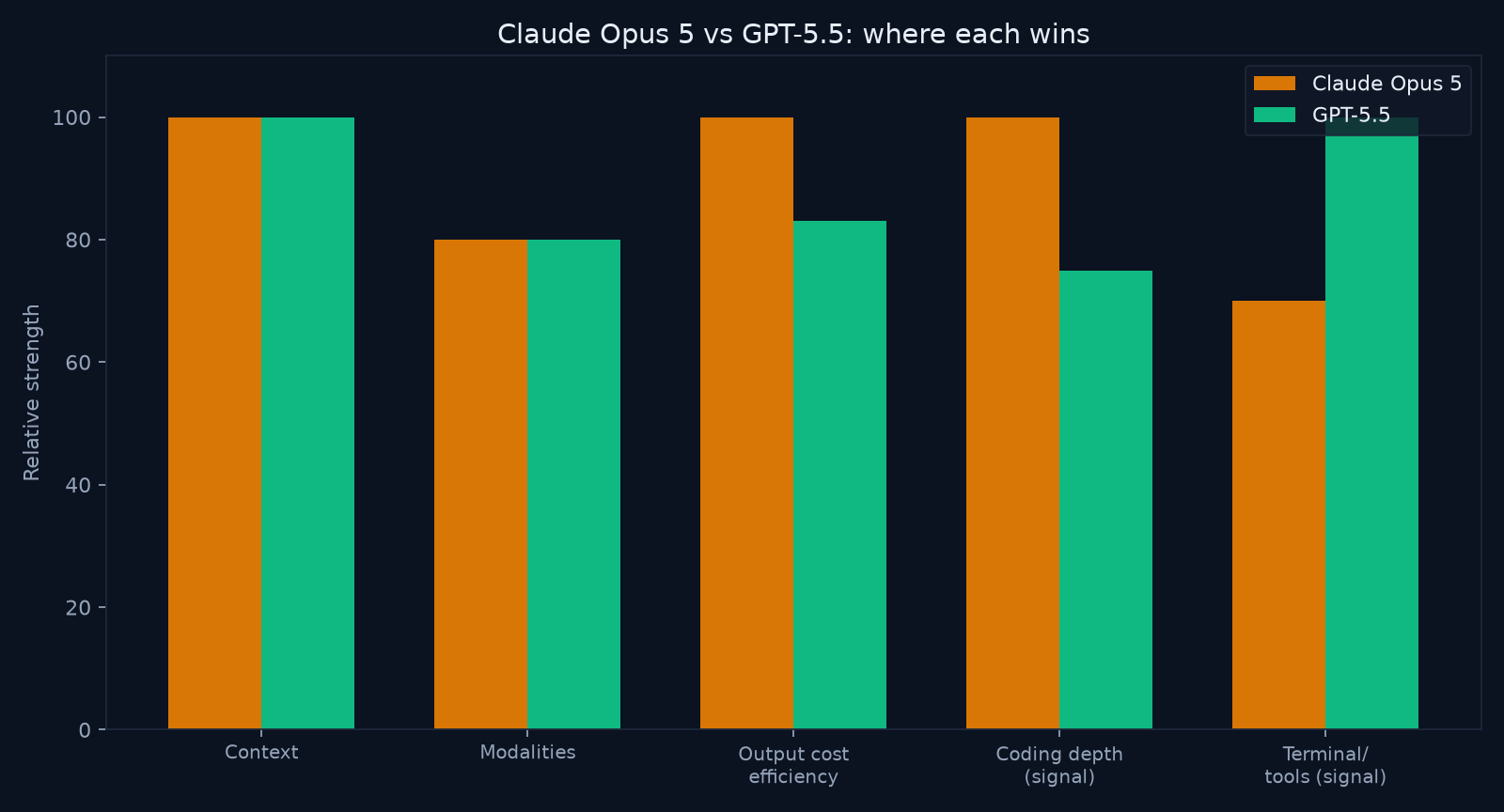
Structurally these two are close cousins on paper: both million-token class, both text/image/file, both closed weights. The meaningful gaps show up in output price, public coding vs terminal-tool signals, and the live voice tests below.
Pricing and real workload cost
List prices are easy to misread. Workload cost is what you feel. Rates below are from published API pricing on 2026-08-21.
Price |
Claude Opus 5 |
GPT-5.5 |
|---|---|---|
Input / 1M tokens |
$5.00 |
$5.00 |
Output / 1M tokens |
$25.00 |
$30.00 |
Cache read / 1M |
$0.50 |
$0.50 |
Same input sticker and same cache read. Opus costs less on output ($25 vs $30). That gap compounds on chatty agents and long answers.
Scenario |
Assumed tokens |
Est. Claude Opus 5 |
Est. GPT-5.5 |
|---|---|---|---|
Chat turn |
1k in + 0.5k out |
$0.0175 |
$0.020 |
Repo / doc review |
80k in + 4k out |
$0.500 |
$0.520 |
Agent loop |
200k in (50% cached) + 20k out |
$1.050 |
$1.150 |
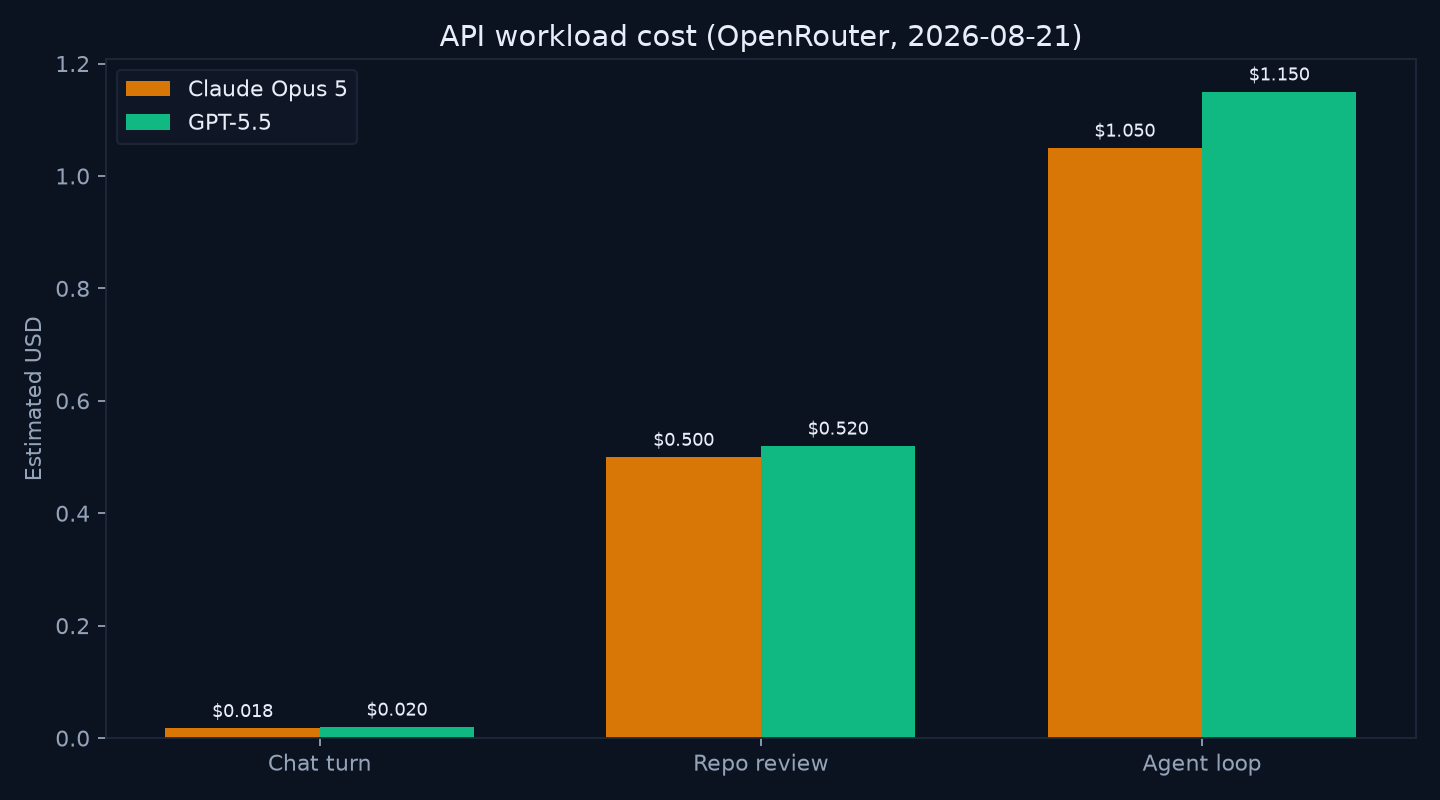
Opus is cheaper on every stylized workload above, mostly from the output delta. For subscription stacks (Claude Pro / ChatGPT Plus style plans), see AI subscription stack cost. Always verify live vendor pages before budgeting.
Performance by job (public signals)
Public benches disagree by harness, effort mode, and date. Treat them as signals. Confirm with your prompts. Language below is verify-live: third-party pages move weekly.
Signal |
Claude Opus 5 |
GPT-5.5 |
Reading |
|---|---|---|---|
SWE-bench Pro / deep coding depth |
Often leads in 2026 Opus 4.8-era and Opus 5 launch writeups |
Competitive, not always first in those writeups |
Opus strong for hard repo work; verify your harness |
Terminal-Bench / tool orchestration |
Strong, but earlier GPT-5.5 vs Opus 4.x coverage often favored GPT |
Often leads in those earlier Terminal-Bench style boards |
GPT edge on shell/tool loops in cited coverage |
Context |
1,000,000 |
1,050,000 |
Near tie; GPT slight edge on the API model card |
Output price |
$25 / 1M |
$30 / 1M |
Opus cheaper at matched $5 input |
Modalities (card) |
text / image / file |
file / image / text |
Parity for typical SaaS stacks |
Coding leaderboards and terminal-agent benches measure different skills. When launch posts crown Opus for SWE-bench Pro depth and older GPT-5.5 vs Opus 4.x posts crown GPT for Terminal-Bench, do not force a fake permanent coding champion. Run your repo and your tool loop. Method: side-by-side AI comparison.
Coding and agents
Opus 5 launch coverage and late Opus 4.8-era writeups often put Anthropic ahead on deep software-engineering benches (SWE-bench Pro style). Earlier GPT-5.5 vs Opus 4.x coverage more often gave OpenAI the edge on Terminal-Bench and multi-step tool orchestration. Our empty-list micro-test was a clean tie on correctness, with Opus slightly more thorough in naming an alternate ValueError path. Use that as a caution: one snippet is not a coding crown.
Writing and tone
Benchmarks barely measure voice. That is why we ran the email rewrite below. Expect Opus to sound warmer and more conversational. Expect GPT-5.5 to sound tighter, closer to a clean subject-line / ops-email register.
Long context and files
Both are ~1M class with text/image/file inputs in the API. GPT’s listed 1.05M is a small structural edge. For most diligence packs that fit under 1M, the difference is noise; pick on quality and cost instead.
Job |
Edge |
Why |
|---|---|---|
Hard / deep coding |
Claude Opus 5 (public signals) |
SWE-bench Pro / deep-coding writeups often favor Opus |
Tool / terminal agents |
GPT-5.5 (public signals) |
Earlier Terminal-Bench / orchestration coverage often favors GPT |
Everyday writing |
Split (test tone) |
GPT tighter in our rewrite; Opus warmer |
Long docs / files |
Near tie / slight GPT |
1.05M vs 1M; same modality set |
Cost at output-heavy volume |
Claude Opus 5 |
$25 vs $30 output / 1M at current API list rates |
Side-by-side test (live API test, 2026-08-21)
We ran the same prompts on Claude Opus 5 and GPT-5.5 side by side in a multi-model workspace (temperature 0.2-0.3). Scores are editorial 1-5 across instruction following, depth, factual caution, style, and usefulness (max 25 per prompt).
Test 1: Client email rewrite
Task: Keep every fact. Warmer. Under 120 words.
Claude Opus 5 (excerpt): Opened with a friendly greeting, then hit the Q3 deck follow-up, missing finance numbers, stakeholder reschedule, and Acme pricing slide. Warm, complete, slightly more conversational padding.
GPT-5.5 (excerpt): Same facts in a cleaner, subject-line style register. Less greeting energy, tighter sentences, still under the word budget.
Edge: GPT for fidelity-plus-tightness (~23/25). Opus for warm human tone (~22/25). If your brand voice hates filler greetings, prefer GPT. If managers want “human warmth,” prefer Opus.
Test 2: Empty-list average bug
Both models correctly named ZeroDivisionError on empty input and proposed a minimal guard. Opus also mentioned a ValueError alternative path, which is more thorough documentation. Correctness: tie 24/24.
Test 3: False premise (Moon cheese)
Both refused the premise first. Opus wrote a longer educational redirect. GPT gave a tighter practical plan for what to research instead. Both pass; style preference only.
Test 4: Invented geography inflation
Both refused Atlantis inflation and asked for a real statistical office / country. Both pass the “do not invent numbers” bar. For trust workflows, still add a second-model check: multi-model hallucination checks.
Test 5: Self-knowledge / version awareness (important)
Asked which model should be the SaaS team default for emails, long PDFs, Python, and structured automation, comparing “Claude Opus 5” vs “GPT-5.5” by name:
- Claude Opus 5: Refused to compare those exact product names. Identity framing sounded like Opus 4.5-era self-description. It would not produce a named matrix for Opus 5 vs GPT-5.5.
- GPT-5.5: Produced a full matrix: Claude for emails / PDF narrative; GPT for Python; switch for structure / automation.
This is a real self-knowledge / version awareness finding, not a scandal. Models often lag their own marketing names in system identity. If your agent asks a model to route work by current flagship labels, GPT-5.5 was usable out of the box in this run; Opus needed a different prompt style (capabilities, not brand strings).
Prompt |
Claude Opus 5 |
GPT-5.5 |
Note |
|---|---|---|---|
Email rewrite |
22/25 |
23/25 |
GPT tighter; Opus warmer |
Bug fix |
24/25 |
24/25 |
Tie; Opus more thorough on ValueError |
False premise |
24/25 |
24/25 |
Both refuse; Opus longer, GPT tighter |
Refuse invented stat |
24/25 |
24/25 |
Both refuse Atlantis rate |
Routing / self-knowledge |
16/25 |
23/25 |
Opus deferred on exact names; GPT built a matrix |
Total |
110/125 |
118/125 |
Gap is mostly the version-awareness prompt; jobs still split |
Ecosystem and where you run them
- Claude Opus 5: Anthropic API / Claude.ai / API access. Strength: Projects, Artifacts-style workflows, and long coding sessions in Anthropic’s product surface.
- GPT-5.5: OpenAI API / ChatGPT / API access. Strength: Assistants/tools ecosystem, Custom GPTs, and broad third-party connector coverage.
- Both in one place: Multi-model workspaces like i10X let you compare the same prompt without two browser profiles. See also the multi-model AI guide.
Pros, cons, and failure modes
Claude Opus 5
- Pros: Strong deep-coding / SWE-bench Pro signals in 2026 writeups; cheaper output at matched $5 input; warm narrative writing; thorough coding explanations in our micro-test; 1M context.
- Cons: Slightly smaller listed context than GPT-5.5; higher output than mid-tier models (still $25/M); version self-description can lag brand strings in routing prompts.
- Fails when: you ask it to authoritatively rank “Opus 5 vs GPT-5.5” by exact marketing names, or you need the absolute cheapest high-volume generation outside the Opus price band.
GPT-5.5
- Pros: Strong Terminal-Bench / tool-orchestration signals in earlier coverage; tighter ops-email writing in our rewrite; ~1.05M context; clear named routing matrix in our live test; broad ChatGPT ecosystem.
- Cons: 20% higher output price vs Opus at current API list rates ($30 vs $25); deep SWE-bench Pro writeups often still lean Anthropic; can feel colder when you want conversational warmth.
- Fails when: you optimize purely for output-token burn at Opus-class quality, or you need the warmest customer-facing letter without an extra rewrite pass.
Decision guide: pick one or route both
If you need… |
Choose |
|---|---|
Output-cheaper high volume at this tier |
Claude Opus 5 |
Tight ops email / subject-line style |
GPT-5.5 (A/B once) |
Warm customer narrative |
Claude Opus 5 (A/B once) |
Deep repo / SWE-style coding (per recent writeups) |
Start Opus 5; verify on your tools |
Terminal / multi-tool agent loops (per earlier boards) |
Start GPT-5.5; verify on your tools |
Named model routing advice inside the prompt |
GPT-5.5 in our 2026-08-21 run; or prompt Opus by capability, not brand |
Mixed SaaS week |
Both: route deep coding → Opus; tool loops / tight prose → GPT |
Stop asking which model is “best.” Ask which model is best for the next step. Keep a second model for critique or a different job shape. That is multi-model AI.
Application walkthroughs: where each model is better
1) Customer support email
Better often: GPT-5.5 when you want a short, subject-line clean rewrite without extra greeting padding. In our live test, GPT preserved every operational fact and stayed tighter. Opus produced a warmer letter with greeting energy that some brands love and some reject.
Switch to Opus if your brand voice is deliberately human and managers prefer warm scaffolding.
2) Long PDF / research pack
Near tie. Both sit in the ~1M class with file input. GPT’s 1.05M is a small edge on the API model card. Pick on which model summarizes cleaner for your domain, then use the other as a second-pass critic. Method: side-by-side AI comparison.
3) Everyday Python scripting
Often Claude Opus 5 as the interactive deep-coding partner, especially if you weigh SWE-bench Pro style writeups. Our micro bug-fix was a tie on correctness, with Opus slightly more thorough. For shell-heavy agent loops, bring GPT-5.5 in.
4) Tool orchestration / terminal agents
Often GPT-5.5 per earlier Terminal-Bench and tool-orchestration coverage versus Opus 4.x. Re-verify against Opus 5 on your exact tool schema; boards move.
5) Output-heavy generation at API scale
Better on cost: Claude Opus 5. Matched $5/M input, lower output rate ($25 vs $30), matched $0.50 cache. On our agent-loop estimate, Opus landed $1.050 vs GPT $1.150 per stylized run. That compounds.
6) “Which model should I use?” meta-prompts
Better in our live run: GPT-5.5. It accepted the Opus 5 / GPT-5.5 labels and returned a usable matrix. Opus deferred on exact names. If you still prefer Opus as the worker, hard-code routing rules in your app instead of asking the model to name its rivals.
Consumer plans vs API (do not mix them up)
SERP pages often blur ChatGPT / Claude subscriptions with API model IDs. Keep them separate:
- API comparison (this article):
Claude Opus 5vsGPT-5.5in the API. - Consumer apps: Claude.ai / Anthropic plans vs ChatGPT / OpenAI plans may expose different tool defaults, rate limits, and bundled models (including cheaper mid-tiers).
If your question is “which subscription feels better on my phone,” run a week-long lived test in both apps. If your question is “which model ID should my agent call,” use this API page.
What this means for routing
Opus 5 and GPT-5.5 are close enough on context and modalities that routing should be job-based, not brand-based. A practical default for many SaaS teams:
- Deep coding / long reasoning → Opus 5
- Tight prose / tool-heavy agents → GPT-5.5
- Publishable claims → second-model check either direction
- Cost-sensitive output volume at this tier → prefer Opus
For a fuller routing playbook, see AI model routing and the multi-model AI guide.
Frequently asked questions
Which is better overall, Claude Opus 5 or GPT-5.5?
Neither permanently. Opus leads many deep-coding writeups and wins on output price. GPT often leads tool-orchestration signals and won our tighter-writing plus version-awareness prompts. Pick by job.
Which is better for coding?
Public SWE-bench Pro / deep-coding coverage often favors Opus 5. Terminal-Bench / tool loops in earlier GPT-5.5 vs Opus 4.x coverage often favor GPT. Our empty-list micro-test was a tie.
Which is better for writing?
Taste. In our rewrite, GPT stayed tighter; Opus sounded warmer. A/B on your brand voice.
Which is cheaper?
At published API rates (2026-08-21), input is $5/M for both; output is $25 (Opus) vs $30 (GPT-5.5). Cache reads match at $0.50/M. Opus is cheaper on output-heavy work.
Which has the larger context window?
GPT-5.5 (~1.05M) vs Claude Opus 5 (1M) in the API. Practically a near tie.
Do I need both?
If your week mixes deep repo work, tool agents, and customer email, yes. That is the multi-model thesis.
Are we comparing apps or API models?
This page uses API models Claude Opus 5 and GPT-5.5. Consumer apps may wrap different defaults or tools.
Why did Opus refuse the Opus 5 vs GPT-5.5 routing question?
In our 2026-08-21 run it did not treat those exact marketing names as known identities (self-description sounded Opus 4.5-era). GPT-5.5 produced a full matrix. Prompt by capabilities, or hard-code routes.
How often should I re-test?
After any major version bump. Monthly is sane for production teams.
Where can I run them side by side?
A multi-model workspace such as
i10X
workspace. Method guide:
side-by-side AI comparison.
What about hallucinations and trust?
Both refused our false-premise and Atlantis traps. Still use source grounding and second-model checks for publishable claims.
Multi-model hallucination checks.
Did model choice ever change outcomes in i10X research?
Yes, in hiring evals: up to a 42 percentage-point hire-rate gap for the same candidate depending on which AI wrote the resume (
ai-cv-bias). Different domain, same moral: which model you call is a product decision.
Try both in one workspace
Run the five prompts above on Claude Opus 5 and GPT-5.5 yourself, then route the next step to the stronger model for that job.
Multi-model AI hub · Side-by-side method · Model routing · Multi-model AI guide · Grok 4.6 vs Gemini 3.1 Pro
- Vendor API docs for
Claude Opus 5andGPT-5.5(context, modalities, pricing, cache pulled 2026-08-21). - 2026 Opus 4.8-era and Claude Opus 5 launch writeups citing strong SWE-bench Pro / deep coding / agentic signals (verify live primary boards).
- Earlier GPT-5.5 vs Opus 4.x comparison coverage citing Terminal-Bench / tool-orchestration leads for GPT-5.5 (verify live; harnesses differ).
- i10X workload cost estimates from Published API list rates on 2026-08-21 (chat, repo review, cached agent loop).
- i10X live side-by-side runs via live side-by-side API tests on 2026-08-21 (writing, coding, false premise, research caution, product routing / self-knowledge).
- i10X Multi-Model silo: hub, routing, side-by-side method, hallucination checks, guide.
- i10X Research, AI resume screening bias study (42 pp hire-rate gap; model choice matters).