
Comparison · August 2026
Claude Opus 5 (Anthropic API) and GPT-5.6 Sol (OpenAI API) are the two expensive-feeling flagships people still argue about in 2026, except the price gap is no longer close. This is a decision guide: published API rates, three workload cost scenarios, live writing and coding snippets, and a routing matrix. Keep both if the jobs split. Start in a multi-model AI workspace or on i10X.
Pick Claude Opus 5 if: you want warmer narrative email, deeper bug writeups (cause, crash path, optional ValueError), and richer geology-style refusals when a premise is false.
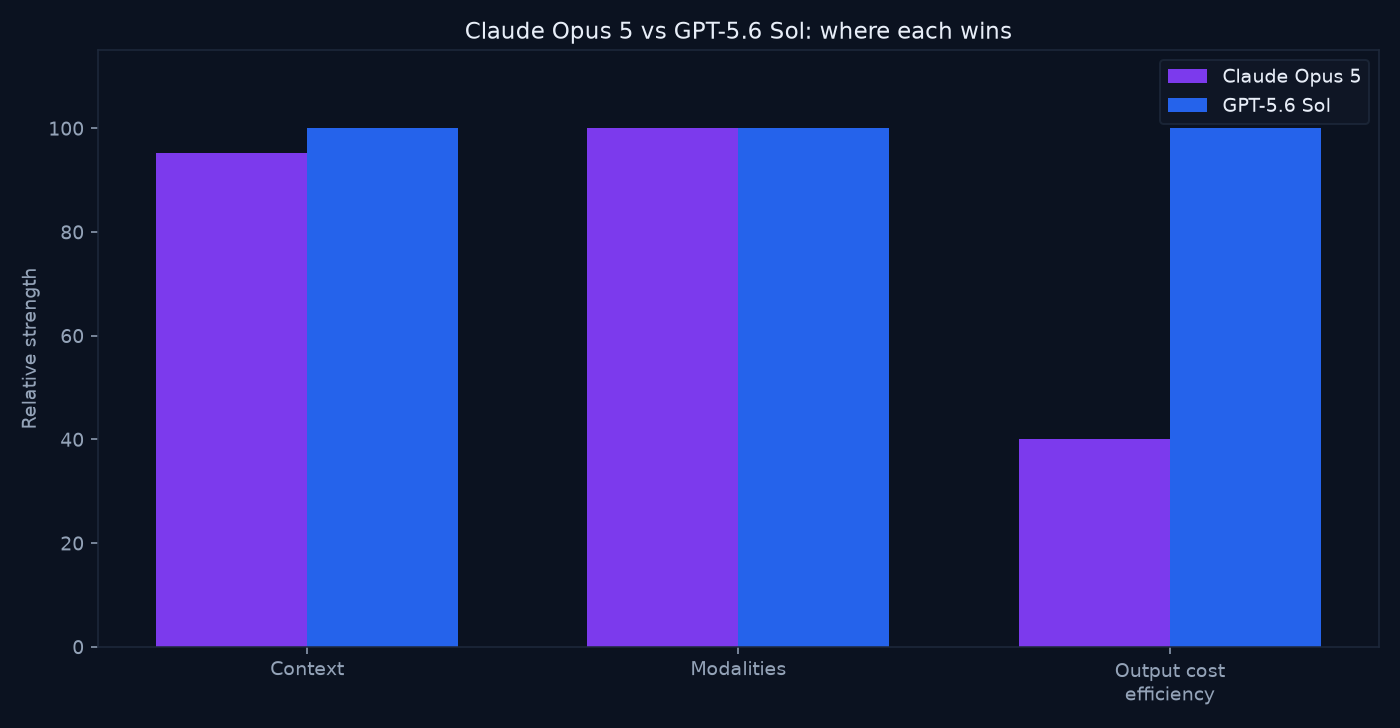
Pick GPT-5.6 Sol if: you want a much cheaper flagship ($2/$10 vs $5/$25), ~1.05M context, cheaper cache, and tighter send-ready prose that still keeps every fact.
Best default for many teams: Sol as the volume flagship. Opus as the review/critique model. Do not pay Opus rates for every chat turn.
Data checked: 2026-08-24. Prices and model cards change. Verify live API test and vendor pages.
1M |
Claude Opus 5 context (API) |
1.05M |
GPT-5.6 Sol context (API) |
$5 / $25 |
Claude Opus 5 input/output per 1M tokens (API pricing, 2026-08-24) |
$2 / $10 |
GPT-5.6 Sol input/output per 1M tokens (API pricing, 2026-08-24) |
Persona picker
You are… |
Start with |
Why |
|---|---|---|
Writer / marketer |
GPT-5.6 Sol for send-ready. Opus for warm narrative. |
Sol kept every fact in two tight paragraphs. Opus added “I hope you are doing well” and flexible meeting language. Our Opus capture also truncated before Acme pricing. |
Developer / agent builder |
Sol default on cost. Opus for deep review. |
Micro bug-fix was a tie on the guard. Opus wrote a fuller crash path. Sol is 2.5× cheaper on output and 2.5× cheaper on input. |
Researcher / analyst |
Either on window. Sol on bill. |
1M vs 1.05M is a hair. Same text/image/file input set. Cost is not a hair. |
Budget / high volume |
GPT-5.6 Sol |
Chat $0.007 vs $0.0175. Repo $0.20 vs $0.50. Cached agent $0.42 vs $1.05. |
What we are comparing (exact versions)
Multi-model AI means using more than one LLM in your stack. This page compares Claude Opus 5 (Anthropic API) with GPT-5.6 Sol (OpenAI API), not Claude vs ChatGPT as consumer apps, and not the older GPT-5.5 ID. For that older pair see Claude Opus 5 vs GPT-5.5.
Field |
Claude Opus 5 |
GPT-5.6 Sol |
|---|---|---|
Provider |
Anthropic |
OpenAI |
API model |
|
|
Listed card name |
Claude Opus 5 |
OpenAI: GPT-5.6 Sol |
Family / tier |
Anthropic Opus flagship |
GPT-5.6 series flagship |
App vs API note |
Also in Claude.ai / Anthropic apps. This article uses the API model. |
Also in ChatGPT-family apps. This article uses the API model. |
If a page still prices “Opus vs GPT” from a 2025 screenshot, throw it out. For routing across many models, see AI model routing.
Spec sheet (API card, 2026-08-24)
Spec |
Claude Opus 5 |
GPT-5.6 Sol |
|---|---|---|
Context window |
1,000,000 tokens |
1,050,000 tokens |
Input modalities (card) |
text, image, file |
text, image, file |
Output |
text |
text |
Open weights |
No |
No |
Vendor positioning (card) |
Flagship for demanding reasoning, coding, long-horizon agents. Strong at end-to-end software, code review, bug finding, visual analysis. |
GPT-5.6 flagship for complex reasoning, coding, and agentic workflows. Particularly strong at command-line and multi-step coding. |
We did not invent max-output, reasoning-effort, or realtime-search rows. Those fields were not on the cards we pulled. Confirm tool and effort switches on the live vendor pages if your agent depends on them.
Pricing and real workload cost
This pair is not a close cost race. Numbers use published per-million rates as of 2026-08-24. Verify live before you budget.
Price |
Claude Opus 5 |
GPT-5.6 Sol |
|---|---|---|
Input / 1M tokens |
$5.00 |
$2.00 |
Output / 1M tokens |
$25.00 |
$10.00 |
Cache read / 1M |
$0.50 |
$0.20 |
Sol is cheaper on every sticker: input, output, and cache. Opus is the premium review model in this pairing, not the default meter.
Scenario |
Assumed tokens |
Est. Claude Opus 5 |
Est. GPT-5.6 Sol |
|---|---|---|---|
Chat turn |
1k in + 0.5k out |
$0.0175 |
$0.007 |
Repo / doc review |
80k in + 4k out |
$0.500 |
$0.200 |
Agent loop |
200k in (50% cached) + 20k out |
$1.050 |
$0.420 |
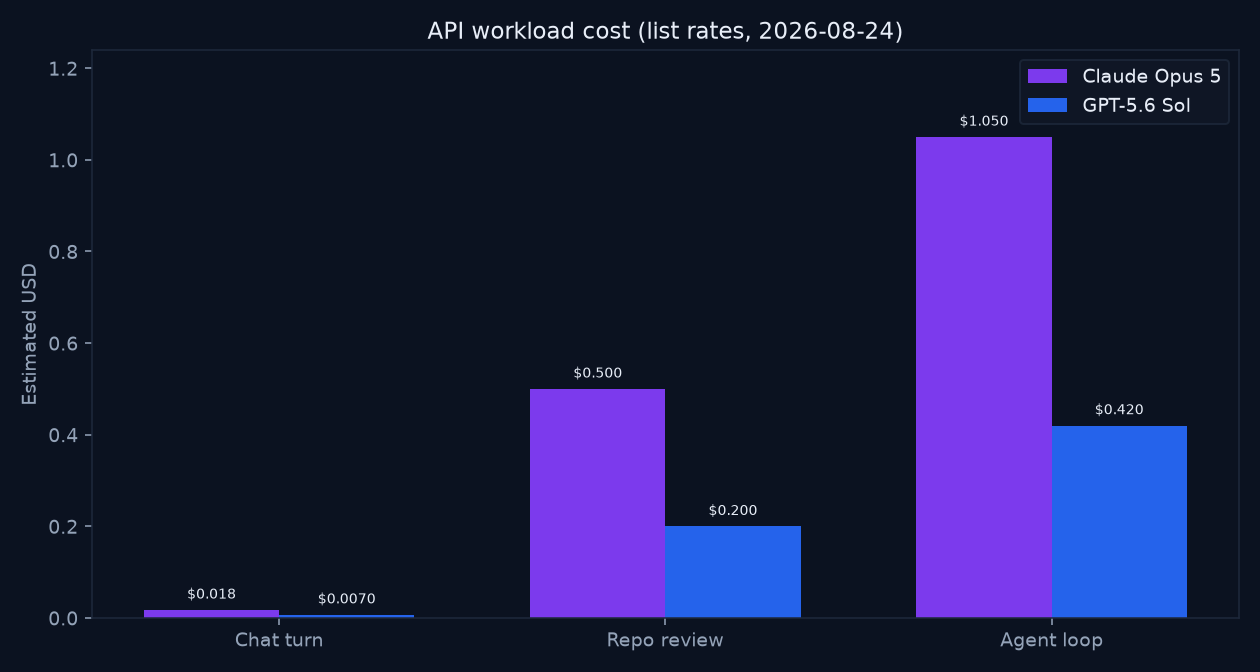
Opus costs about 2.5× Sol on each stylized run. That is the whole plot for budget owners. You can still justify Opus on a hard review, a long-horizon agent that actually uses the extra depth, or a brand-voice pass. You cannot justify it as the only model in a high-volume loop unless quality on your eval set pays for itself. For subscription math across ChatGPT / Claude / Gemini plans, see AI subscription stack cost.
Performance by job (not one score)
We are not inventing SWE-bench or intelligence-index numbers we do not have for GPT-5.6 Sol. Treat vendor cards as positioning. Treat our snippets as a small live pack. Re-run on your prompts. Method: side-by-side AI comparison.
Coding and agents
Anthropic’s card pushes Opus on end-to-end software, code review, and bug finding. OpenAI’s card pushes Sol on command-line and multi-step coding. In our micro-test, both named ZeroDivisionError and guarded empty input. Opus explained the 0/0 crash path and floated a ValueError alternative. Sol shipped a cleaner runnable snippet plus a print smoke test. Style split inside a tie, not a reason to pay 2.5× on every call.
Writing and tone
Opus sounded like a careful account manager: greeting energy, flexible Wednesday, “happy to adjust.” The capture cut off at “the competitive slide,” so Acme pricing is not visible. Sol sounded like a tight PM: name slot, two paragraphs, Friday miss, Wednesday move, Acme, “Thanks!” Warmth vs completeness.
Research, math, reasoning
We did not run a science-QA pack, so we will not fake one. On the false-premise prompt, both refused the green-cheese Moon. Opus added Apollo and Luna sample geology (basalt maria, anorthosite highlands, dusty regolith, no biological organics). The capture then trails into “But if the…” Sol refused, then listed a practical lunar-resource plan (polar ice, split water, habitat protein, recycle). Opus wins depth on the refuse. Sol wins a usable redirect. For publishable work, still add multi-model hallucination checks.
Multimodal and long context
Both cards list text, image, and file in, text out. Context is a hair: 1M vs 1.05M. Neither card in this pull lists audio or video. If you need those, see Gemini 3.1 Pro: Claude Opus 5 vs Gemini 3.1 Pro and GPT-5.6 Sol vs Gemini 3.1 Pro.
Speed
No latency numbers in this pack. Measure p50 from your region. Do not ship on a third-party tokens-per-second screenshot.
Job |
Edge |
Why |
|---|---|---|
Hard coding / agents |
Split (Opus depth, Sol default) |
Micro-test tie. Opus fuller review writeup. Sol cheaper to loop. |
Everyday writing |
Split (taste) |
Opus warmer. Sol tighter and complete in our capture. |
Long docs / multimodal |
Near tie |
1M vs 1.05M. Same modality set on the cards. |
Realtime / conversational |
Product-dependent |
Claude.ai vs ChatGPT apps wrap different tools. Not measured here. |
Cost at volume |
GPT-5.6 Sol |
Not close. ~2.5× cheaper on our three recipes. |
When we lack a primary public table for an ID, we do not invent one. Card positioning plus a live pack is the honest floor. Re-test on your workload.
Side-by-side test (i10X pack, 2026-08-24)
Same three prompts, scored 1-5 on instruction following, depth, factual caution, style, and usefulness (max 25). Writing, coding, false premise only. No invented fourth and fifth scores.
Test 1: Client email rewrite
Task: Keep every fact. Warmer. Under 120 words.
Claude Opus 5 (excerpt): “I hope you are doing well.” Q3 deck from last Tuesday. Finance promised Friday, nothing arrived. Ask to move stakeholders to next week, Wednesday preferred, happy to adjust. Then “One more thing: the competitive slide…” Capture truncated there, so Acme pricing is not visible in the snippet we scored.
GPT-5.6 Sol (excerpt, sanitized): Name slot. Two paragraphs. Finance numbers still out after Friday. Move to next Wednesday if it works. Update competitive slide with new Acme pricing. “Thanks!”
Edge: Sol on completeness and tightness in the capture. Opus on warmth and scheduling flexibility. Deduct for the truncated Acme line on Opus. If your live Opus run includes that line, the writing gap shrinks.
Test 2: Empty-list average bug
Both named ZeroDivisionError. Both guard with an empty check before dividing. Opus wrote a longer “why it crashes” note and mentioned raising ValueError as an alternative to returning 0. Sol wrote a shorter explanation and a runnable snippet with print(average([])). Tie on correctness. Opus for the review comment. Sol for the paste-and-run patch.
Test 3: False premise (Moon cheese)
Both refused first. Opus (sanitized): folk joke, not a fact. Apollo and Luna samples. Basalt, anorthosite, impact-shattered regolith. No cheese, no protein, essentially no biological organics. Capture cuts at a “But if the…” redirect. Sol: silicate rock and metal, no mineable protein, then four practical resource steps. Both pass. Opus more geological. Sol more operational after the refuse.
Prompt type |
Claude Opus 5 |
GPT-5.6 Sol |
Note |
|---|---|---|---|
Client email rewrite |
22/25 |
24/25 |
Sol complete. Opus warmer, truncated before Acme. |
Bug explain + minimal fix |
24/25 |
24/25 |
Both catch ZeroDivisionError. Tie. |
Logic + false premise |
24/25 |
23/25 |
Both refuse. Opus more geology. Sol more operational redirect. |
Total |
70/75 |
71/75 |
Essentially a tie on quality. Not a tie on cost. |
A one-point editorial gap does not buy a 2.5× invoice. Use Opus where the extra review depth shows up in your evals. Use Sol as the default meter.
Ecosystem and where you run them
- Claude Opus 5: Anthropic API. Claude.ai and Anthropic console apps. Strength in long writing and careful review workflows teams already run in Claude Projects.
- GPT-5.6 Sol: OpenAI API. ChatGPT-family apps may wrap different defaults. This page is the GPT-5.6 flagship, not GPT-5.5.
- Both in one place: Multi-model workspaces (including i10X) let you compare the same prompt without two native subscriptions for every test.
Pros, cons, and failure modes
Claude Opus 5
- Pros: Warmer client voice. Fuller bug-review writeups. Stronger geology on the false-premise refuse. 1M context. Card aimed at long-horizon agents and visual analysis.
- Cons: $5/$25 list rates. $0.50 cache. Our writing capture truncated before a required fact. Easy to over-spend if Opus is the only default.
- Fails when: you run it on every chat turn, every agent loop, and every nightly summary without a cheaper sibling in the router.
GPT-5.6 Sol
- Pros: $2/$10. $0.20 cache. 1.05M context. Tighter complete email in our pack. Runnable coding snippet with a smoke print. Cheaper on all three recipes.
- Cons: Less greeting warmth. False-premise answer is operational, not geological. Still not audio/video on this card.
- Fails when: you need Opus-like narrative care or a deep review comment and you only called Sol.
Decision guide: pick one or route both
If you need… |
Choose |
|---|---|
Default flagship at API volume |
GPT-5.6 Sol |
Deep code review / bug writeup |
Claude Opus 5, then keep Sol for the cheap loop |
Warm client narrative |
Claude Opus 5 (check that every fact survived) |
Tight send-ready email |
GPT-5.6 Sol |
Mixed week (docs + code + review) |
Keep both. Sol default. Opus critique. |
Stop asking which model is “best.” Ask which model is best for the next step. Pay Opus when the extra depth is the product. That is multi-model AI.
Application walkthroughs: where each model is better
1) Customer support email
Better often: GPT-5.6 Sol when completeness and a short edit pass matter. Our Sol letter had the Acme line. Our Opus letter had the warmth and a flexible meeting offer, then the capture died mid-sentence. If your live Opus run finishes the Acme beat, this becomes taste: warmth vs tightness.
Switch to Opus when the relationship is delicate and managers want “I hope you are doing well” scaffolding. Edit the greeting if your brand hates it.
2) Long PDF / research pack
Near tie on window, Sol on cost. 1M vs 1.05M will not decide most packs. $0.50 vs $0.20 per review will. Start Sol. Escalate a hard chapter to Opus if the first pass is thin.
3) Everyday Python scripting
Tie on the guard, split on the comment. Use Sol for cheap iterative coding. Use Opus when you want the pull-request comment that explains why empty filters crash callers. Do not overclaim from one average() function.
4) Code review and bug finding
Lean Opus on the card’s own positioning (code review, bug finding, end-to-end software) and on the fuller crash-path writeup we saw. Still verify on your repo. Card language is not a bench.
5) Output-heavy generation at API scale
Better on cost: GPT-5.6 Sol, by a lot. $0.007 vs $0.0175 chat. $0.20 vs $0.50 repo. $0.42 vs $1.05 cached agent. If Opus is in the graph, put it behind a router for hard tasks only.
6) False-premise and trust gates
Both pass. Opus for the science-flavored refuse. Sol for the “here is what you would actually do on the Moon” redirect. For publishable claims, second-model check both.
Consumer plans vs API (do not mix them up)
Claude Pro / Max and ChatGPT plans are not these API stickers.
- API comparison (this article):
Claude Opus 5 (Anthropic API)vsGPT-5.6 Sol (OpenAI API). - Consumer apps: Claude.ai vs ChatGPT may hide cheaper siblings, different tools, and different rate limits.
Phone-app feel is a week-long lived test. Agent model IDs are this page.
Speed notes
No tok/s in this pack. Log p50 and p95 from your API region. Reasoning or effort modes, if you enable them, will move latency more than the brand name on the card.
Related comparisons
- Claude Opus 5 vs GPT-5.5 for the prior OpenAI flagship ID.
- Claude Opus 5 vs Grok 4.6 if Grok is the cheap flagship in the mix.
- Claude Opus 5 vs Gemini 3.1 Pro for audio/video and Google-ecosystem fit.
- Grok 4.6 vs GPT-5.6 Sol and GPT-5.6 Sol vs Gemini 3.1 Pro.
- Grok 4.6 vs Gemini 3.1 Pro and GPT-5.5 vs Gemini 3.1 Pro.
Frequently asked questions
Which is better overall, Claude Opus 5 or GPT-5.6 Sol?
70/75 vs 71/75 on our pack: a quality tie. Sol wins cost. Route Opus for review and voice.
Which is better for coding?
Tie on ZeroDivisionError and the empty-list guard. Opus writes a richer review. Sol is cheaper to loop. Run your repo.
Which is better for writing?
Opus warmer, Sol tighter. Our Opus snippet truncated before Acme pricing. A/B on brand voice.
Which is cheaper?
GPT-5.6 Sol, by a wide margin (2026-08-24): $2/$10 vs $5/$25, cache $0.20 vs $0.50.
Which has the larger context window?
GPT-5.6 Sol (1,050,000) vs Claude Opus 5 (1,000,000). Practically a tie.
Do I need both?
If you want Opus-quality review and volume, yes. Sol default, Opus critique.
Are we comparing apps or API models?
API models Claude Opus 5 (Anthropic API) and GPT-5.6 Sol (OpenAI API). Apps wrap different defaults. Sol is not GPT-5.5.
How often should I re-test?
After version bumps, monthly in production, and whenever list rates move.
Where can I run them side by side?
i10X.
Method:
side-by-side AI comparison.
What about hallucinations and trust?
Both refused the Moon-cheese trap. Still ground publishable claims.
Multi-model hallucination checks.
Try both in one workspace
Compare Claude Opus 5 and GPT-5.6 Sol on the same prompt, then route the next step to the stronger model for that job.
- Vendor API model cards and published list pricing for Claude Opus 5 (Anthropic API) and GPT-5.6 Sol (OpenAI API), pulled 2026-08-24. Context, modalities, and per-million rates. Verify live.
- Anthropic card positioning: Opus 5 as flagship for demanding reasoning, coding, and long-horizon agentic work, including code review and bug finding.
- OpenAI card positioning: GPT-5.6 Sol as the GPT-5.6 series flagship for complex reasoning, coding, and agentic workflows, with emphasis on command-line and multi-step coding.
- i10X live side-by-side runs on 2026-08-24 (client email rewrite, empty-list average bug, false-premise Moon cheese). Writing and false-premise captures truncated on Opus. Snippets sanitized for punctuation.
- i10X workload estimates using the published rates above: 1k+0.5k chat, 80k+4k repo review, 200k in at 50% cache + 20k out agent loop.
- i10X Multi-Model silo: hub, routing, side-by-side method.