Comparison · August 2026
Gemini 3.7 Flash and GPT-5.6 Luna are the fast, cheap pair teams actually put on the default route. Neither is a flagship. Both claim ~1M context. Flash is Google’s multimodal workhorse for responsive agentic work. Luna is OpenAI’s cost-efficient GPT-5.6 SKU for high-volume chat, classification, and lightweight agents. This guide is a decision piece: exact versions, published API rates, three workload costs, and a live side-by-side pack. Keep both in a multi-model AI workspace or start on i10X.
Pick Gemini 3.7 Flash if: the job includes audio, video, or mixed files and you still want Flash-tier pricing ($0.375 / $1.875 per 1M).
Pick GPT-5.6 Luna if: the job is high-volume text (and images/files) and you want the cheaper meter. Luna is $0.20 / $1.20 per 1M, and our agent-loop estimate is $0.046 vs $0.0788.
Best default for many teams: Luna for cheap text volume, Flash when the input is a clip or a recording. Do not crown a permanent overall winner.
Data checked: 2026-08-24. Prices and model cards change. Verify live API test and vendor pages.
1,048,576 |
Gemini 3.7 Flash context (API) |
1,050,000 |
GPT-5.6 Luna context (API) |
$0.375 / $1.875 |
Gemini 3.7 Flash input/output per 1M tokens (API pricing, 2026-08-24) |
$0.20 / $1.20 |
GPT-5.6 Luna input/output per 1M tokens (API pricing, 2026-08-24) |
Persona picker
You are… |
Start with |
Why |
|---|---|---|
Writer / marketer |
Gemini 3.7 Flash (often) |
Flash wrote a fuller stakeholder note with a subject and a greeting. Luna compressed to an internal ping. |
Developer / agent builder |
Luna for cheap loops; Flash when media arrives |
Both fixed the empty-list bug. Luna raised |
Researcher / analyst |
Flash for audio/video packs; Luna for cheap text |
Context is tied. Flash lists audio and video. Luna does not. |
Budget / high volume |
GPT-5.6 Luna |
Lower input, output, and cache. Chat $0.0008 vs $0.0013. |
Latency-sensitive chat |
Either; measure |
Both cards pitch fast/responsive work. We did not publish tok/s. Measure p50 in your region. |
What we are comparing (exact versions)
Multi-model AI means using more than one LLM in your stack. This page compares two specific cheap/fast API models, not Gemini 3.1 Pro and not GPT-5.6 Sol.
Field |
Gemini 3.7 Flash |
GPT-5.6 Luna |
|---|---|---|
Provider |
OpenAI |
|
API model |
|
|
Listed API name |
Google: Gemini 3.7 Flash |
OpenAI: GPT-5.6 Luna |
Family / tier |
Gemini Flash (fast / volume) |
GPT-5.6 fast / cost-efficient SKU |
App vs API note |
Also in Gemini apps; this article uses the API model above, not Pro |
Also in ChatGPT-family products; this article uses the API model above, not Sol |
If a page still compares Gemini 2.5 Flash to GPT-4o mini, treat it as historical. For routing across many models, see AI model routing.
Spec sheet (API card, 2026-08-24)
Spec |
Gemini 3.7 Flash |
GPT-5.6 Luna |
|---|---|---|
Context window |
1,048,576 tokens |
1,050,000 tokens |
Max output (if published) |
Not published on this card |
Not published on this card |
Input modalities |
text, image, video, file, audio |
file, image, text |
Output |
text |
text |
Reasoning / effort modes |
Positioned for complex multi-step reasoning; effort knobs not listed on this card |
Positioned as capable reasoning for lightweight agents; effort knobs not listed on this card |
Realtime / search |
Not listed on this card; confirm tools in your app |
Not listed on this card; confirm tools in your app |
Open weights |
No |
No |
Vendor positioning (short) |
Fast agentic workflows, coding, complex multi-step reasoning; responsive performance |
High-volume, latency-sensitive chat, classification, lightweight agentic workflows |
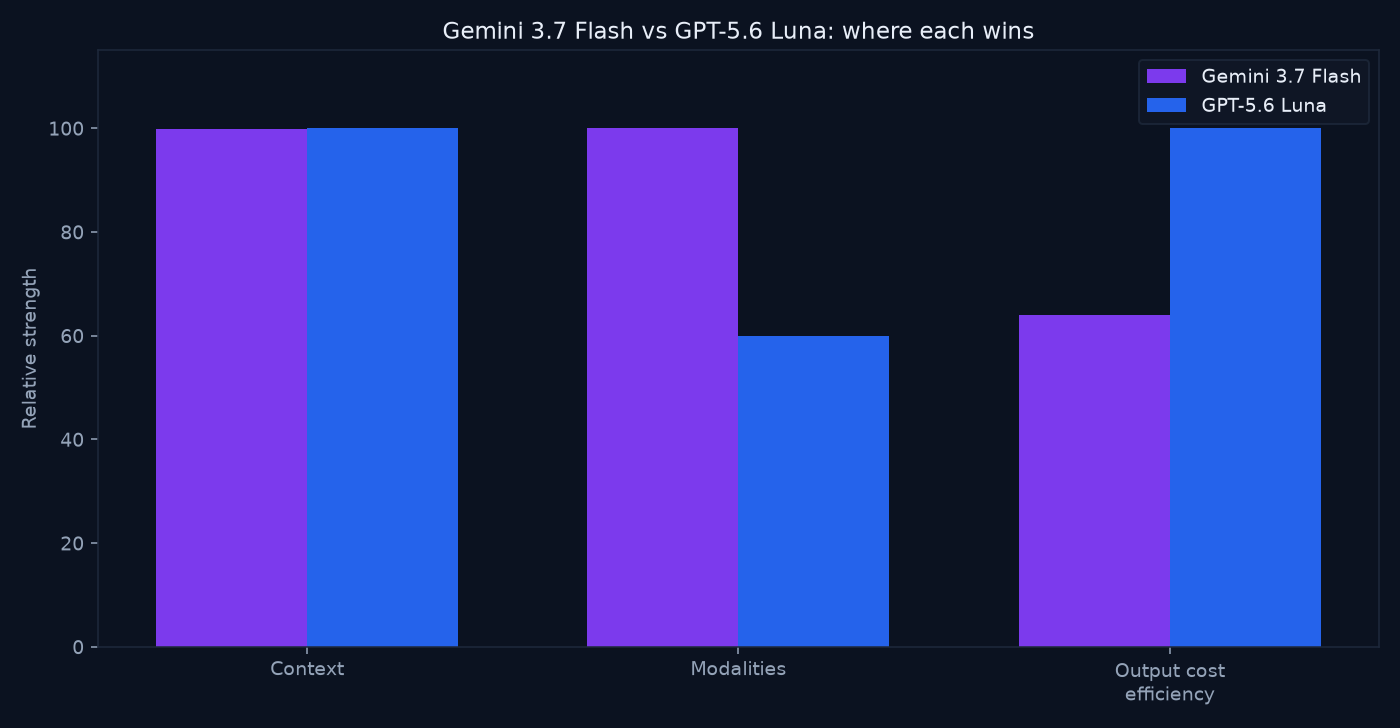
Figure 1 is the whole product argument. Context: tie. Modalities: Flash, because audio and video are listed. Output-cost efficiency: Luna. That is a clean route: media → Flash, volume text → Luna. Do not pay Flash prices on a classification queue just because “Gemini is good at documents.” Do not send a meeting recording to Luna just because it is cheaper if the card does not list audio.
Pricing and real workload cost
These are small numbers that get large at volume. Rates below are published per-million figures as of 2026-08-24. Verify live before you budget. Compared with Sonnet or Opus, both of these SKUs are cheap. Compared with each other, Luna is cheaper on every line we pulled.
Price |
Gemini 3.7 Flash |
GPT-5.6 Luna |
|---|---|---|
Input / 1M tokens |
$0.375 |
$0.20 |
Output / 1M tokens |
$1.875 |
$1.20 |
Cache read / 1M |
$0.0375 |
$0.02 |
Scenario |
Assumed tokens |
Est. Gemini 3.7 Flash |
Est. GPT-5.6 Luna |
|---|---|---|---|
Chat turn |
1k in + 0.5k out |
$0.0013 |
$0.0008 |
Repo / doc review |
80k in + 4k out |
$0.0375 |
$0.0208 |
Agent loop |
200k in (50% cached if available) + 20k out |
$0.0788 |
$0.0460 |
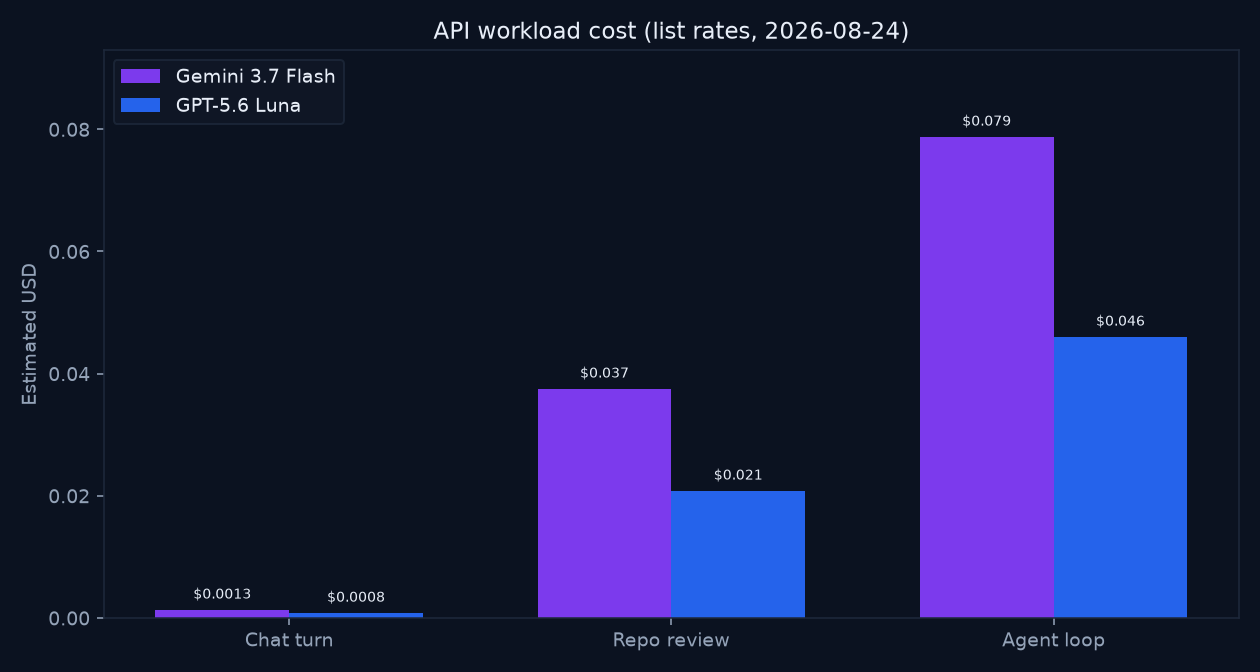
A single chat turn is fractions of a cent either way. The repo review is $0.0375 vs $0.0208. The agent loop is $0.0788 vs $0.0460. At 100,000 classification calls a day, Luna’s edge is the budget. At 40 meeting recordings a day, Flash’s audio/video list is the product. For seats vs API, see AI subscription stack cost. A Gemini or ChatGPT subscription is not these line items.
Performance by job (not one score)
We are not inventing a public Flash-vs-mini leaderboard. Both cards pitch speed, agents, and “good enough” reasoning for volume. Confirm with your prompts. Method: side-by-side AI comparison.
Coding and agents
Flash is positioned for fast agentic workflows and coding. Luna is positioned for lightweight agentic workflows. That wording is a hint about expected difficulty, not a bench. Our empty-list test split on API contract: Flash returned 0 for empty input; Luna raised ValueError("cannot average an empty sequence"). Both are defensible. Returning 0 hides the bug from callers. Raising makes the caller handle it. If you are generating library code, Luna’s fail-loud default is often safer. If you are generating a dashboard metric, Flash’s 0 may match the product. Do not treat “Flash is worse at coding” as the takeaway. We did not show that.
Writing and tone
Flash wrote outward. Subject line, “hope you’re having a great week,” Finance still missing after Friday, competitive slide needs Acme pricing, ask to push the meeting. Luna wrote inward: “Hi team,” same facts, shorter close. If the audience is a customer, Flash is closer. If the audience is Slack, Luna is closer. Neither invented facts in the excerpt we captured.
Research, math, reasoning
No scored science set. On the false-premise trap, both refused. Flash: silicate rock, basalt, regolith; no protein; real lunar mining is ice, oxygen, metals. Luna: rocky Moon, no cheese protein; grow algae/yeast/cultured meat in sealed bioreactors. Both pass. Flash redirected to industrial ISRU. Luna redirected to food systems. For publishable claims, still add multi-model hallucination checks.
Multimodal and long context
Context will not decide this pair. Flash: 1,048,576. Luna: 1,050,000. Modalities will. Flash lists text, image, video, file, audio. Luna lists file, image, text. If the blob is a WAV or an MP4, Flash is the listed model. If the blob is a PDF or a PNG, both cards match and Luna is cheaper.
Speed
Both vendors use “fast” in the pitch. We did not measure tokens per second. Measure p50 and p95 from your region with the batch size you actually ship. A cheap model that retries twice is not cheap.
Job |
Edge |
Why |
|---|---|---|
Hard coding / agents |
Split on contract; Luna cheaper |
Live bug: Flash returns 0, Luna raises. Luna is the lighter-agent SKU on the card. |
Everyday writing |
Flash for external; Luna for internal |
Live rewrite: Flash fuller, Luna compressed. |
Long docs / multimodal |
Flash when audio/video; else Luna on cost |
Flash has the wider input list. Context tied. |
Realtime / conversational |
Not scored here |
Both pitch latency-sensitive work; we did not cite a tok/s number. |
Cost at volume |
GPT-5.6 Luna |
$0.20/$1.20 vs $0.375/$1.875; agent loop $0.046 vs $0.0788. |
Two cheap models can still be the wrong pair if the job needs a flagship. Route Luna/Flash for volume. Escalate to Sol, Opus, or a Pro SKU when quality gates fail. That is multi-model AI.
Side-by-side test (i10X pack, 2026-08-24)
We ran the same three prompts on Gemini 3.7 Flash and GPT-5.6 Luna and scored 1-5 on instruction following, depth, factual caution, style, and usefulness (max 25 per prompt). Excerpts are sanitized and truncated. Add a long-paste summary and a refuse-if-unknown research prompt in your workspace; those were not in this capture.
Test 1: Client email rewrite
Task: Keep every fact. Warmer. Short enough to send.
Gemini 3.7 Flash (excerpt): Subject “Update on Q3 Deck & Stakeholder Meeting.” Greeting. Last Tuesday’s deck. Finance numbers expected Friday, still waiting. Competitive slide needs new Acme pricing. Ask to push to next week / Wednesday. External cadence.
GPT-5.6 Luna (excerpt): “Hi team.” Same Finance miss, same Wednesday ask, same Acme slide. Shorter. Reads like Slack, not like a customer letter.
Edge: Flash for a note you might send outside. Luna for an internal poke.
Test 2: Empty-list average bug
Both named the divide-by-zero. Flash: if not nums: return 0. Luna: if not nums: raise ValueError(...). Split on contract, not on diagnosis. Score them on whether they matched the prompt (“minimal fix”). Returning 0 is the more common “minimal.” Raising is the more correct library default. We scored Luna a hair lower on “minimal” and a hair higher on caution, netting a tie.
Test 3: False premise (Moon cheese)
Both refused. Flash pointed at real ISRU (ice, oxygen, metals). Luna pointed at bioreactors. Both pass.
Prompt type |
Gemini 3.7 Flash |
GPT-5.6 Luna |
Note |
|---|---|---|---|
Client email rewrite |
23/25 |
21/25 |
Flash external; Luna internal |
Bug explain + minimal fix |
23/25 |
23/25 |
Same diagnosis; different empty-list contract |
Logic + false premise |
24/25 |
24/25 |
Both refuse; different useful redirects |
Total |
70/75 |
68/75 |
Close; cost and audio/video still decide the stack |
Two points is not a reason to ignore Luna’s unit cost. It is a reason to keep Flash on customer-facing drafts and on media. If your queue is classifiers, Luna’s $0.0008 chat turn is the headline.
Ecosystem and where you run them
- Gemini 3.7 Flash: Google AI / Gemini apps / Workspace adjacency. Strength: audio + video + file + image on one cheap SKU.
- GPT-5.6 Luna: OpenAI API and ChatGPT-family products. Strength: a named cheap GPT-5.6 ID so you are not accidentally calling Sol.
- Both in one place: Multi-model workspaces (including i10X) let you compare without two native subscriptions for every test.
Pros, cons, and failure modes
Gemini 3.7 Flash
- Pros: Five input types (text, image, video, file, audio); ~1M context; still Flash-priced vs Pro/Sonnet; fuller external email in our pack; clean false-premise redirect to real lunar resources.
- Cons: Dearer than Luna on every list rate; not a flagship if the job is actually hard.
- Fails when: you use it as the volume default against Luna on text-only traffic, or you expect Opus-class code review from a Flash SKU.
GPT-5.6 Luna
- Pros: Cheapest meter in this pair; file + image + text; fail-loud empty-list pattern; tight internal notes; positioned for chat, classification, lightweight agents.
- Cons: No audio/video on this card; writing can read too internal; “lightweight” is a ceiling, not a compliment.
- Fails when: the input is a recording, or the job needed Sol and you stayed on Luna to save $0.03.
Decision guide: pick one or route both
If you need… |
Choose |
|---|---|
Cheapest text volume at ~1M context |
GPT-5.6 Luna |
Audio or video in |
Gemini 3.7 Flash |
External stakeholder email |
Gemini 3.7 Flash (A/B) |
Internal Slack-style ping |
GPT-5.6 Luna |
Library code that should fail loud |
GPT-5.6 Luna (in our micro-test) |
Mixed week (docs + code + research) |
Keep both; route by task in a multi-model workspace |
Stop asking which cheap model is “best.” Ask which model is best for the next step, then keep a flagship for critique. That is multi-model AI.
Application walkthroughs: where each model is better
1) Customer support email
Better often: Gemini 3.7 Flash. Subject, greeting, complete facts, Acme pricing. Luna sounded like it was writing to the team, not to the customer. If your CS macros are internal, Luna is fine and cheaper.
2) Classification / triage queue
Better on cost: GPT-5.6 Luna. This is the SKU OpenAI describes for high-volume, latency-sensitive chat and classification. Flash can do it. You will pay more per million for no extra modality if the input is already text.
3) Meeting recording to notes
Better on the card: Gemini 3.7 Flash. Audio is listed. Luna is file/image/text. Sending a transcript to Luna is a valid two-step pipeline; sending the WAV to Luna is not what this card describes.
4) PDF and screenshot
Either, then Luna on cost. Both list file and image. Unless Flash quality wins your OCR eval, Luna’s $0.0208 repo-review estimate beats Flash’s $0.0375.
5) Lightweight agent loop
GPT-5.6 Luna on the meter ($0.046 vs $0.0788) if tool use holds. Escalate to Sol or a Pro/Opus SKU when the loop starts inventing tool arguments. Cheap agents fail expensive when they retry.
6) When to leave this pair
If the job is merge-blocking code review, long-horizon research, or anything you would not trust a Flash/Luna SKU to ship, stop comparing these two and route up. This page exists so you do not pay flagship rates for classification.
Consumer plans vs API (do not mix them up)
Gemini app defaults and ChatGPT defaults are not these IDs.
- API comparison (this article):
Gemini 3.7 FlashvsGPT-5.6 Lunaat the list rates above. - Consumer apps: may silently use other Flash/Pro or GPT-5.6 cousins. Check the ID your agent actually calls.
If your question is “which phone app feels snappier,” run a week in both products. If your question is “which cheap ID belongs on this queue,” use this API page.
Frequently asked questions
Which is better overall, Gemini 3.7 Flash or GPT-5.6 Luna?
Neither permanently. Our three-prompt card was 70-68 for Flash, mostly on writing. Luna wins list cost. Flash wins audio/video.
Which is better for coding?
Unknown beyond one bug. Both diagnosed it. Flash returned 0; Luna raised. Match the contract, then prefer Luna on cost for lightweight loops.
Which is better for writing?
Flash for external notes. Luna for internal pings. A/B on brand voice.
Which is cheaper?
GPT-5.6 Luna at published API rates (2026-08-24): $0.20 vs $0.375 input, $1.20 vs $1.875 output, $0.02 vs $0.0375 cache read. All three workloads favor Luna.
Which has the larger context window?
GPT-5.6 Luna (1,050,000) vs Gemini 3.7 Flash (1,048,576). Practically a tie.
Do I need both?
If some jobs are recordings and some jobs are text classifiers, yes.
Are we comparing apps or API models?
This page uses API models Gemini 3.7 Flash and GPT-5.6 Luna. Consumer apps may wrap different defaults.
How often should I re-test?
After any major version bump. Monthly is sane. Re-price when list rates move. Volume queues feel rate changes first.
Where can I run them side by side?
A multi-model workspace such as
i10X.
Method:
side-by-side AI comparison.
What about hallucinations and trust?
Both refused the Moon-cheese premise. Still ground publishable claims. Cheap models need the same checks as flagships. See
multi-model hallucination checks.
Is this GPT-5.6 Sol or Gemini Pro?
No. Sol and Pro-class SKUs are dearer and belong on a different comparison page.
Try both in one workspace
Compare Gemini 3.7 Flash and GPT-5.6 Luna on the same prompt, then route the next step to the stronger model for that job.
- Vendor / API model cards / pricing for
Gemini 3.7 FlashandGPT-5.6 Luna(checked 2026-08-24). Verify live. - Google positioning for Gemini 3.7 Flash: multimodal model for fast agentic workflows, coding, and complex multi-step reasoning; input text/image/video/file/audio.
- OpenAI positioning for GPT-5.6 Luna: fast, cost-efficient GPT-5.6 model for high-volume, latency-sensitive chat, classification, and lightweight agentic workflows; input file/image/text.
- i10X live side-by-side pack on 2026-08-24: client email rewrite, empty-list average bug, false-premise Moon cheese. Editorial scores, not a public benchmark.
- Workload cost model: 1k in + 0.5k out chat; 80k in + 4k out repo; 200k in (50% cache read) + 20k out agent, using published per-million rates from the same date.
- i10X Multi-Model silo: hub, routing, side-by-side method.