
Comparison · August 2026
Grok 4.6 and Claude Fable 5 sit in the same “frontier knowledge work” conversation and almost nowhere near the same price. This is a decision guide, not a leaderboard dump: exact API cards, three workload cost scenarios, live writing/coding/false-premise snippets, and a routing matrix you can rerun. Multi-model AI means you can keep both. Start in a multi-model AI workspace or on i10X.
Pick Grok 4.6 if: you want a cheaper frontier default for everyday coding, email, and agent loops, with matched text/image/file input and a 500K context window.
Pick Claude Fable 5 if: you need Mythos-class Anthropic depth, a 1M context window, and you can absorb roughly 5× input and 8× output list rates for autonomous knowledge work.
Best default for many SaaS teams: route by task. Use Grok as the volume worker. Reserve Fable for the jobs that justify the bill. Do not crown a permanent overall winner.
Data checked: 2026-08-24 via live side-by-side API tests. Prices and model cards change. Verify live.
500K |
Grok 4.6 context (API) |
1M |
Claude Fable 5 context (API) |
$2 / $6 |
Grok 4.6 input/output per 1M tokens (API pricing, 2026-08-24) |
$10 / $50 |
Claude Fable 5 input/output per 1M tokens (API pricing, 2026-08-24) |
Persona picker
You are… |
Start with |
Why |
|---|---|---|
Writer / CS / marketer |
Grok 4.6 for volume; Fable for high-stakes prose |
Grok kept every operational fact. Fable added a subject line and warmer meeting language. |
Developer / agent builder |
Grok 4.6 default; Fable for hard knowledge-work loops |
Both named |
Researcher / analyst |
Claude Fable 5 |
1M context vs 500K and Mythos-class positioning. Pay the premium when the pack is huge. |
Budget / high volume API |
Grok 4.6 |
Chat, repo, and agent estimates are all several times cheaper at current list rates. An agent loop landed at $0.370 vs $2.10. |
Vision / files |
Split (same card modalities) |
Both list text, image, and file in, text out. Pick on quality and cost, not on a modality gap. |
What we are comparing (exact versions)
Multi-model AI means using more than one large language model in one work system. This page compares two specific API models, not vague “Grok vs Claude” brand names and not a consumer-app bake-off.
Field |
Grok 4.6 |
Claude Fable 5 |
|---|---|---|
Provider |
xAI (listed as SpaceXAI on the API card) |
Anthropic |
API model |
|
|
Listed API name |
SpaceXAI: Grok 4.6 |
Anthropic: Claude Fable 5 |
Family / tier |
Frontier Grok flagship (coding, knowledge work, STEM) |
Mythos-class Claude (autonomous knowledge work and coding) |
App vs API note |
Also in xAI / X products; this article uses the API card above |
Also in Claude apps / Anthropic plans; this article uses the API card above |
If a page still compares older Grok 4 or Claude Opus labels without the 4.6 / Fable 5 IDs, treat it as historical. For routing across many models, see AI model routing. Sibling pair: Grok 4.6 vs Gemini 3.1 Pro.
Spec sheet (API card, 2026-08-24)
Spec |
Grok 4.6 |
Claude Fable 5 |
|---|---|---|
Context window |
500,000 tokens |
1,000,000 tokens |
Max output (if published) |
Not published on the card we used |
Not published on the card we used |
Input modalities |
text, image, file |
text, image, file |
Output |
text |
text |
Reasoning / effort modes |
Not specified on this API card |
Reasoning support (listed on the card description) |
Open weights |
Not listed as open weights on this API card |
Not listed as open weights on this API card |
Vendor positioning (short) |
Smartest Grok model; frontier coding, knowledge work, and STEM |
Mythos-class model for autonomous knowledge work and coding |
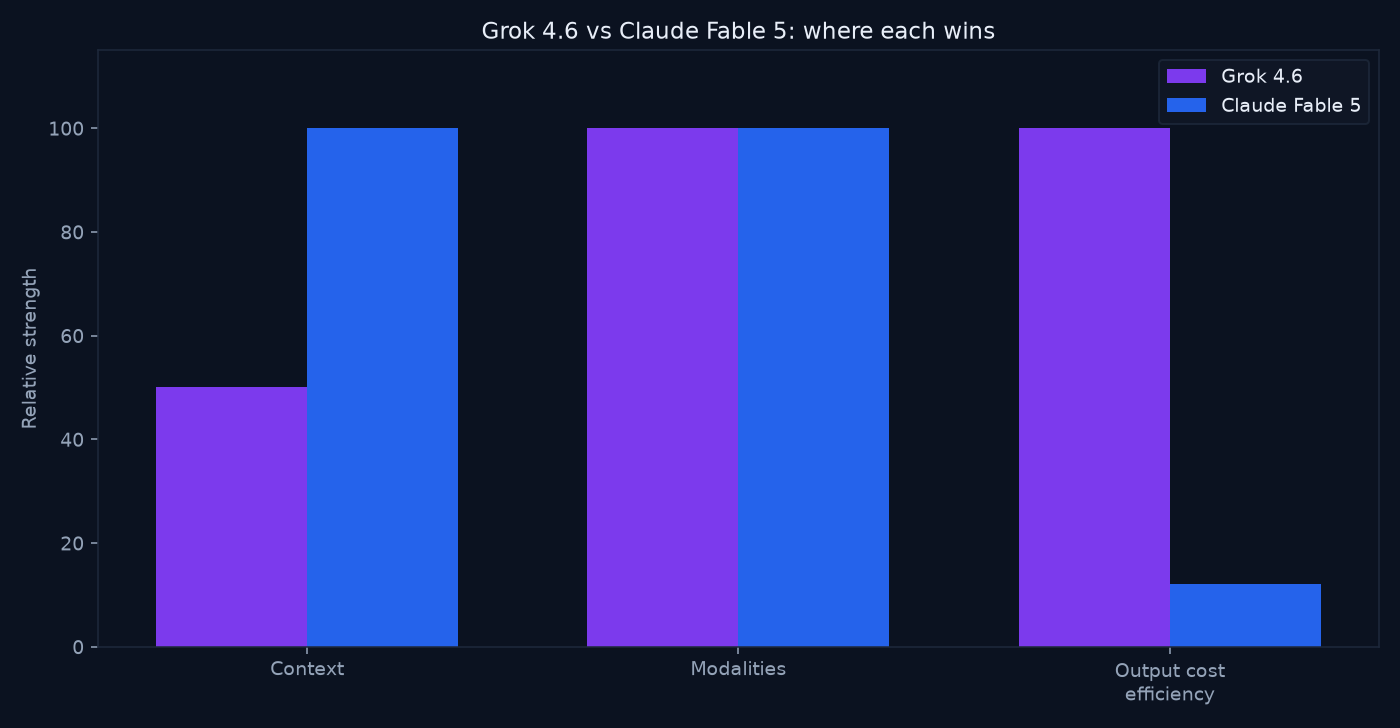
The structural split is context and price, not modality. Both take text, image, and file. Fable doubles the context window (1M vs 500K) and prices like a premium autonomous worker. Grok prices like a high-volume frontier default.
Pricing and real workload cost
List prices are easy to misread. Workload cost is what you feel. Rates below are from published API pricing on 2026-08-24. Verify live before you budget.
Price |
Grok 4.6 |
Claude Fable 5 |
|---|---|---|
Input / 1M tokens |
$2.00 |
$10.00 |
Output / 1M tokens |
$6.00 |
$50.00 |
Cache read / 1M |
$0.50 |
$1.00 |
Fable is 5× on input, about 8.3× on output, and 2× on cache reads. That is not a rounding error. It is a different product lane.
Scenario |
Assumed tokens |
Est. Grok 4.6 |
Est. Claude Fable 5 |
|---|---|---|---|
Chat turn |
1k in + 0.5k out |
$0.005 |
$0.035 |
Repo / doc review |
80k in + 4k out |
$0.184 |
$1.00 |
Agent loop |
200k in (50% cached) + 20k out |
$0.370 |
$2.10 |
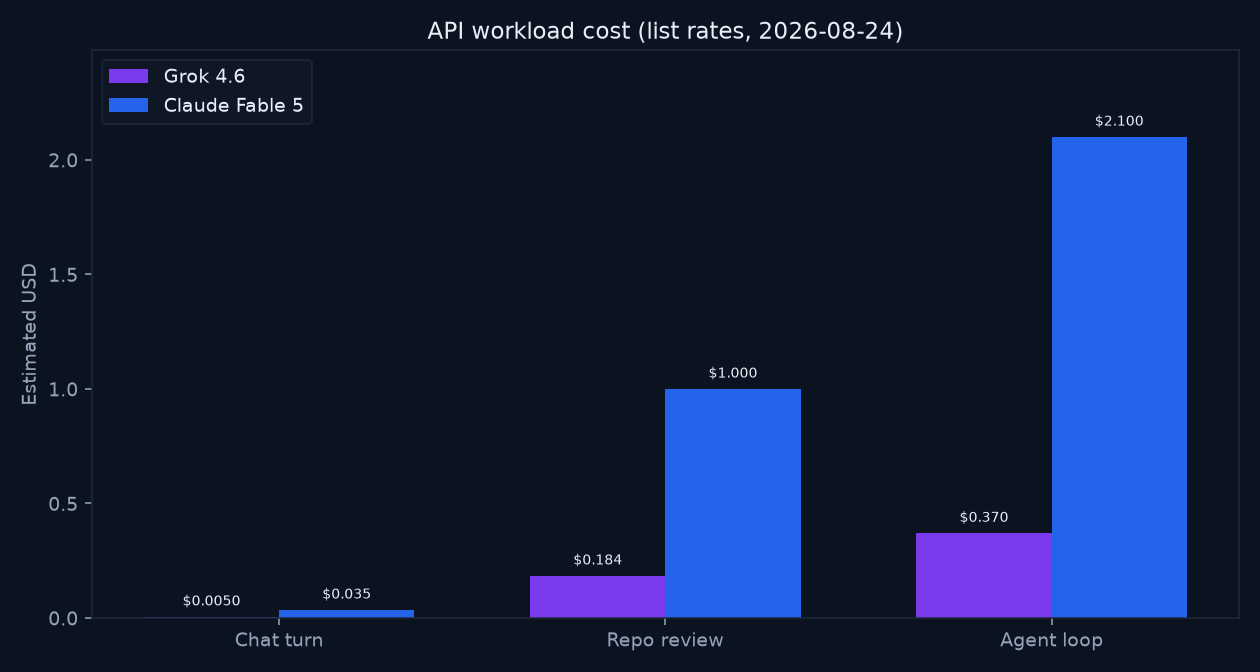
On the stylized agent loop, Fable costs about 5.7× Grok. That compounds across a week of tool calls. For subscription math across consumer plans, see AI subscription stack cost. Always verify live vendor pages before budgeting.
Performance by job (not one score)
We are not pasting third-party leaderboard numbers here. Public benches disagree by harness, effort mode, and date. This page uses the API cards, the three workload costs, and the live snippets below. Prefer your own side-by-side on your prompts. Method: side-by-side AI comparison.
Coding and agents
Vendor copy puts both in the coding and knowledge-work lane. Our empty-list micro-test was a near tie on correctness. Fable added a contract note (return 0 vs raise ValueError). For agent loops at volume, the $0.370 vs $2.10 estimate is the louder signal until you measure your own tool traces.
Writing and tone
Benchmarks barely measure voice. In the rewrite, Grok stayed tight and complete: Q3 deck from last Tuesday, finance still missing after Friday, Wednesday stakeholder ask, Acme pricing on the competitive slide. Fable opened with a subject line and softer “would you be open to moving” language, then our capture cut mid-sentence. Edge: Grok for fidelity; Fable for polished meeting tone when the full letter lands.
Research, math, reasoning
Fable’s card lists reasoning support and a 1M window. Grok’s card emphasizes STEM and knowledge work at 500K. On the false-premise prompt, both refused first. Grok was short: rock, not cheese, so no mining plan exists. Fable added composition detail and a redirect to real lunar resources. Neither invented a cheese-mining flowchart.
Multimodal and long context
Modalities match (text, image, file). Context does not: 1M vs 500K. If analysts paste 200-page decks, Fable is the structural primary. If the job is a screenshot plus a short ticket, either can take the image; pick on quality and cost. We did not run a vision eval in this pack, so do not treat Figure 1’s matched-modality bar as a quality claim.
Speed
This pack did not measure tokens per second or time-to-first-token. Do not ship a latency SLO from someone else’s screenshot. Measure p50 from your region in the same workspace you will productionize.
Job |
Edge |
Why |
|---|---|---|
Hard coding / agents |
Split: quality near-tie, cost Grok |
Same bug diagnosis in our micro-test; Fable slightly more thorough; agent-loop cost favors Grok |
Everyday writing |
Grok 4.6 (this run) |
Complete facts, no filler; Fable warmer but truncated in capture |
Long docs / 1M packs |
Claude Fable 5 |
1M vs 500K context |
Image + file input |
Split |
Same listed modalities; test on your screenshots |
Cost at volume |
Grok 4.6 |
$2/$6 vs $10/$50; agent loop $0.370 vs $2.10 |
When two models share modalities and both pass a micro-test, cost and context become the routing keys. Re-test on your repo and your brand voice. Method: side-by-side AI comparison.
Side-by-side test (live API test, 2026-08-24)
We ran the same three prompts on Grok 4.6 and Claude Fable 5 side by side. Scores are editorial 1-5 across instruction following, depth, factual caution, style, and usefulness (max 25 per prompt). This batch pack is three prompts, not five. Re-run a longer pack (long-paste summary, refuse-if-unknown research) on your own material.
Test 1: Client email rewrite
Task: Keep every fact. Warmer. Under 120 words.
Grok 4.6 (excerpt): Direct follow-up: Q3 deck from last Tuesday; finance still missing after the Friday promise; push stakeholders to next week, perhaps Wednesday; competitive slide needs Acme pricing. Short close. No invented cheer.
Claude Fable 5 (excerpt): Subject line (“Q3 Deck Update & Proposed Meeting Change”), name placeholder, “would you be open to moving” the meeting, then a competitive-slide note that our capture cut mid-sentence.
Edge: Grok for completeness and brevity. Fable for polished meeting register. If your brand voice hates filler, prefer Grok. If managers want a subject line and softer ask, prefer Fable and check the full output.
Test 2: Empty-list average bug
Both named ZeroDivisionError when len(nums) is 0 and proposed if not nums: return 0 before dividing. Fable also noted that raising ValueError("empty list") may match the intended contract better. Near tie on this micro-task; Fable slightly more thorough.
Test 3: False premise (Moon cheese)
Both refused the premise first. Grok: the Moon is a rocky silicate body, so no cheese or protein to mine, and no mining plan exists. Fable: same refusal, plus Apollo-sample composition and a redirect to real lunar extraction topics. Both pass. Grok more concise. Fable more pedagogical. For publishable claims, still add a second-model check: multi-model hallucination checks.
Prompt |
Grok 4.6 |
Claude Fable 5 |
Note |
|---|---|---|---|
Email rewrite |
23/25 |
22/25 |
Grok complete; Fable warmer, capture truncated |
Bug fix |
23/25 |
24/25 |
Both correct; Fable discusses contract |
False premise |
24/25 |
24/25 |
Both refuse; Fable adds real-resource redirect |
Total (3-prompt pack) |
70/75 |
70/75 |
Tie on this pack; jobs still split on cost and context |
A tied micro-pack is the point of routing. Quality is close enough that you should not pay Fable rates for every chat turn, and you should not force 500K Grok to swallow a 1M diligence pack.
Ecosystem and where you run them
- Grok 4.6: xAI API; consumer Grok experiences on xAI and X. Strength: cheaper frontier loop for text/image/file work.
- Claude Fable 5: Anthropic API; Claude apps and Anthropic plans. Strength: Mythos-class knowledge work and the 1M window.
- Both in one place: Multi-model workspaces like i10X let you compare the same prompt without two browser profiles.
Pros, cons, and failure modes
Grok 4.6
- Pros: $2/$6 list rates with $0.50 cache; complete factual email in our rewrite; correct empty-list fix; matched text/image/file input; 500K is enough for many tickets and files.
- Cons: Half Fable’s context; card does not list reasoning support the way Fable’s does; writing is blunter (no subject line in our sample).
- Fails when: you shove multi-hundred-page packs into a 500K window, or you need Anthropic-house tone as a brand default.
Claude Fable 5
- Pros: 1M context; reasoning support on the card; Mythos-class autonomous-work positioning; thorough coding contract note; warmer stakeholder email.
- Cons: $10/$50 list rates; agent loop about $2.10 vs $0.370; 5× to 8× the Grok bill on our scenarios.
- Fails when: you optimize for output-token burn at scale, or you treat Fable as the only model for every chat turn.
Decision guide: pick one or route both
If you need… |
Choose |
|---|---|
Output-cheap high volume text and code |
Grok 4.6 |
1M-token packs / autonomous knowledge work |
Claude Fable 5 |
Everyday email that must keep every fact |
Grok 4.6 (this run); A/B if you want Fable polish |
Empty-list / simple bug fixes |
Either; Fable if you want the contract discussion |
Mixed SaaS week |
Both: volume and everyday code → Grok; long packs and high-stakes reasoning → Fable |
Stop asking which model is “best.” Ask which model is best for the next step, then keep a second model for critique or a longer context window. That is multi-model AI.
Application walkthroughs: where each model is better
1) Customer support email
Better often: Grok 4.6 for a short, faithful rewrite. It kept Tuesday, Friday, Wednesday, and Acme. Fable added a subject line and a softer ask, which some brands want and some reject.
2) Long PDF / research pack
Better: Claude Fable 5 on structure: 1M vs 500K. Both accept files. Use Grok as a second-pass critic, not as the only window for a giant pack.
3) Everyday Python scripting
Often Grok 4.6 because the quality gap on our micro-test was small and the cost gap is not. Call Fable when you want the return-0 vs ValueError contract discussion.
4) Output-heavy generation at API scale
Better on cost: Grok 4.6. $6 vs $50 output per 1M. Agent loop $0.370 vs $2.10. That is always-on vs use-sparingly.
5) High-stakes autonomous knowledge work
Better fit on the card: Claude Fable 5. Mythos-class positioning, listed reasoning support, 1M context. Pay that lane when a miss costs more than $2.10 per loop.
Consumer plans vs API (do not mix them up)
Search pages often blur Grok / Claude subscriptions with API model cards. Keep them separate:
- API comparison (this article):
Grok 4.6vsClaude Fable 5on the API cards we pulled 2026-08-24. - Consumer apps: xAI / X Grok experiences vs Claude.ai / Anthropic plans may expose different tool defaults, rate limits, and bundled mid-tiers.
If your question is “which subscription feels better on my phone,” run a week in both apps. If your question is “which model should my agent call,” use this API page.
What this means for routing
Quality on this three-prompt pack is a tie. Cost and context are not. A practical default for many SaaS teams:
- Everyday email, tickets, and cheap agent loops → Grok 4.6
- Giant file packs and high-stakes knowledge work → Claude Fable 5
- Publishable claims → second-model check either direction
- Image/file input → either; A/B on your screenshots
For a fuller routing playbook, see AI model routing and the multi-model AI guide.
Frequently asked questions
Which is better overall, Grok 4.6 or Claude Fable 5?
Neither permanently. Our three-prompt pack tied at 70/75. Grok wins on list price and everyday completeness. Fable wins on 1M context and Mythos-class positioning. Pick by job.
Which is better for coding?
Both fixed the empty-list average. Fable added a contract note. That is not a coding championship. For volume coding agents, Grok’s $0.370 vs $2.10 loop estimate matters more than the micro-test.
Which is better for writing?
Taste. Grok stayed closer to the facts. Fable sounded more like a stakeholder email. A/B on your brand voice.
Which is cheaper?
Grok 4.6, by a lot. At published API rates (2026-08-24), input is $2 vs $10 per 1M, output $6 vs $50, cache $0.50 vs $1.00. Chat $0.005 vs $0.035; repo $0.184 vs $1.00; agent $0.370 vs $2.10.
Which has the larger context window?
Claude Fable 5 (1,000,000 tokens) vs Grok 4.6 (500,000 tokens).
Do I need both?
If your week mixes cheap agent loops with occasional 1M-token research packs, yes. That is the multi-model thesis.
Are we comparing apps or API models?
This page uses API models Grok 4.6 and Claude Fable 5. Consumer apps may wrap different defaults or tools.
How often should I re-test?
After any major version bump. Monthly is sane for production teams. Re-run your own pack, not only these three prompts.
Where can I run them side by side?
A multi-model workspace such as
i10X.
Method guide:
side-by-side AI comparison.
What about hallucinations and trust?
Both refused the Moon-cheese premise. Still use source grounding and second-model checks for publishable claims.
Multi-model hallucination checks.
Try both in one workspace
Run the three prompts above on Grok 4.6 and Claude Fable 5 yourself, then route the next step to the stronger model for that job.
- Vendor API cards for
Grok 4.6andClaude Fable 5(context, modalities, pricing, cache, short descriptions pulled 2026-08-24). Verify live. - xAI / SpaceXAI model card positioning: Grok 4.6 as frontier coding, knowledge work, and STEM.
- Anthropic model card positioning: Claude Fable 5 as a Mythos-class model for autonomous knowledge work and coding, with listed reasoning support.
- i10X workload cost estimates from published API list rates on 2026-08-24 (chat 1k in + 0.5k out; repo 80k in + 4k out; agent 200k in with 50% cache + 20k out).
- i10X live side-by-side runs on 2026-08-24 (client email rewrite, empty-list bug fix, false-premise Moon cheese).
- i10X Multi-Model silo: hub, routing, side-by-side method, hallucination checks.