Comparison · August 2026
GPT-5.6 Terra and Gemini 3.7 Flash are the mid-tier vs Flash-tier pair teams actually argue about when they do not want flagship Sol / Pro rates. This is a decision guide, not a leaderboard dump: exact API cards, three workload costs, live writing/coding/false-premise snippets, and a routing matrix you can rerun. Multi-model AI means you can keep both. Start in a multi-model AI workspace or on i10X.
Pick GPT-5.6 Terra if: you want OpenAI’s balanced GPT-5.6 tier (between Sol and Luna) for everyday coding, reasoning, and agentic work, and you can pay $2/$12 with file/image/text input.
Pick Gemini 3.7 Flash if: you need native audio/video plus file/image/text, a ~1.05M window, and a much cheaper Flash bill ($0.375/$1.875) for fast agentic workflows.
Best default for many SaaS teams: Gemini Flash as the volume multimodal worker. Terra when you specifically want the GPT-5.6 middle tier. Do not crown a permanent overall winner.
Data checked: 2026-08-24 via live side-by-side API tests. Prices and model cards change. Verify live.
1.05M |
GPT-5.6 Terra context (API) |
1.05M |
Gemini 3.7 Flash context (API) |
$2 / $12 |
GPT-5.6 Terra input/output per 1M tokens (API pricing, 2026-08-24) |
$0.375 / $1.875 |
Gemini 3.7 Flash input/output per 1M tokens (API pricing, 2026-08-24) |
Persona picker
You are… |
Start with |
Why |
|---|---|---|
Writer / CS / marketer |
GPT-5.6 Terra (this run) |
Terra stayed tighter, with a subject line and no “hope you’re having a great week.” Gemini was warmer and more templated. |
Developer / agent builder |
Terra for GPT-5.6 coding loops; Gemini for cheap multimodal agents |
Both fixed the empty-list bug. Terra used |
Researcher / analyst |
Gemini 3.7 Flash for mixed media |
Same ~1.05M window. Gemini lists audio and video. Terra lists file, image, text. |
Budget / high volume API |
Gemini 3.7 Flash |
Agent loop $0.0788 vs $0.460 at current list rates. |
Audio / video pipelines |
Gemini 3.7 Flash |
Those inputs are on Gemini’s card, not Terra’s. |
What we are comparing (exact versions)
Multi-model AI means using more than one large language model in one work system. This page compares two specific API models, not vague “ChatGPT vs Gemini” brand names and not GPT-5.6 Sol vs Gemini Pro.
Field |
GPT-5.6 Terra |
Gemini 3.7 Flash |
|---|---|---|
Provider |
OpenAI |
|
API model |
|
|
Listed API name |
OpenAI: GPT-5.6 Terra |
Google: Gemini 3.7 Flash |
Family / tier |
Balanced GPT-5.6 tier between flagship Sol and cost-efficient Luna |
Gemini 3.7 Flash: fast agentic workflows, coding, multi-step reasoning |
App vs API note |
Also in ChatGPT / OpenAI products; this article uses the API card above |
Also in Gemini app / Google AI; this article uses the API card above |
If a page still compares GPT-5.5 or Gemini 3.1 Pro without the Terra / 3.7 Flash labels, treat it as a different pair. Sibling Flash comparison: DeepSeek V4 Flash vs Gemini 3.7 Flash. Routing: AI model routing.
Spec sheet (API card, 2026-08-24)
Spec |
GPT-5.6 Terra |
Gemini 3.7 Flash |
|---|---|---|
Context window |
1,050,000 tokens |
1,048,576 tokens |
Max output (if published) |
Not published on the card we used |
Not published on the card we used |
Input modalities |
file, image, text |
text, image, video, file, audio |
Output |
text |
text |
Reasoning / effort modes |
Card: suited for everyday coding, reasoning, and agentic work |
Card: complex multi-step reasoning; responsive performance |
Open weights |
Not listed as open weights on this API card |
Not listed as open weights on this API card |
Vendor positioning (short) |
Balanced GPT-5.6 between Sol and Luna |
Fast agentic workflows, coding, multi-step reasoning |
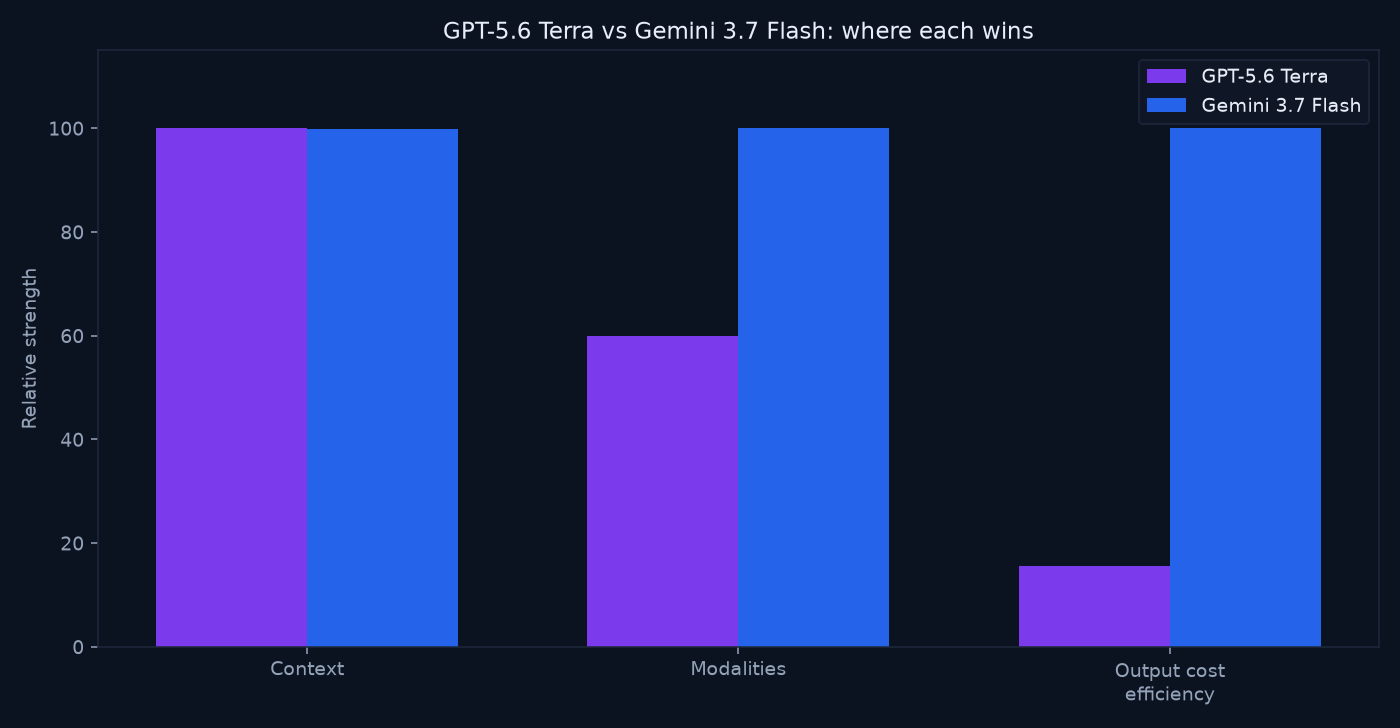
Context is a wash (~1.05M both). Gemini lists two extra input types (audio, video). Terra prices like a $2 input / $12 output mid-frontier call. Gemini Flash is the cheaper, broader-modality worker.
Pricing and real workload cost
List prices are easy to misread. Workload cost is what you feel. Rates below are from published API pricing on 2026-08-24. Verify live before you budget.
Price |
GPT-5.6 Terra |
Gemini 3.7 Flash |
|---|---|---|
Input / 1M tokens |
$2.00 |
$0.375 |
Output / 1M tokens |
$12.00 |
$1.875 |
Cache read / 1M |
$0.20 |
$0.0375 |
Gemini is cheaper on every sticker line: about 5.3× on input, 6.4× on output, and about 5.3× on cache reads.
Scenario |
Assumed tokens |
Est. GPT-5.6 Terra |
Est. Gemini 3.7 Flash |
|---|---|---|---|
Chat turn |
1k in + 0.5k out |
$0.008 |
$0.00131 |
Repo / doc review |
80k in + 4k out |
$0.208 |
$0.0375 |
Agent loop |
200k in (50% cached) + 20k out |
$0.460 |
$0.0788 |
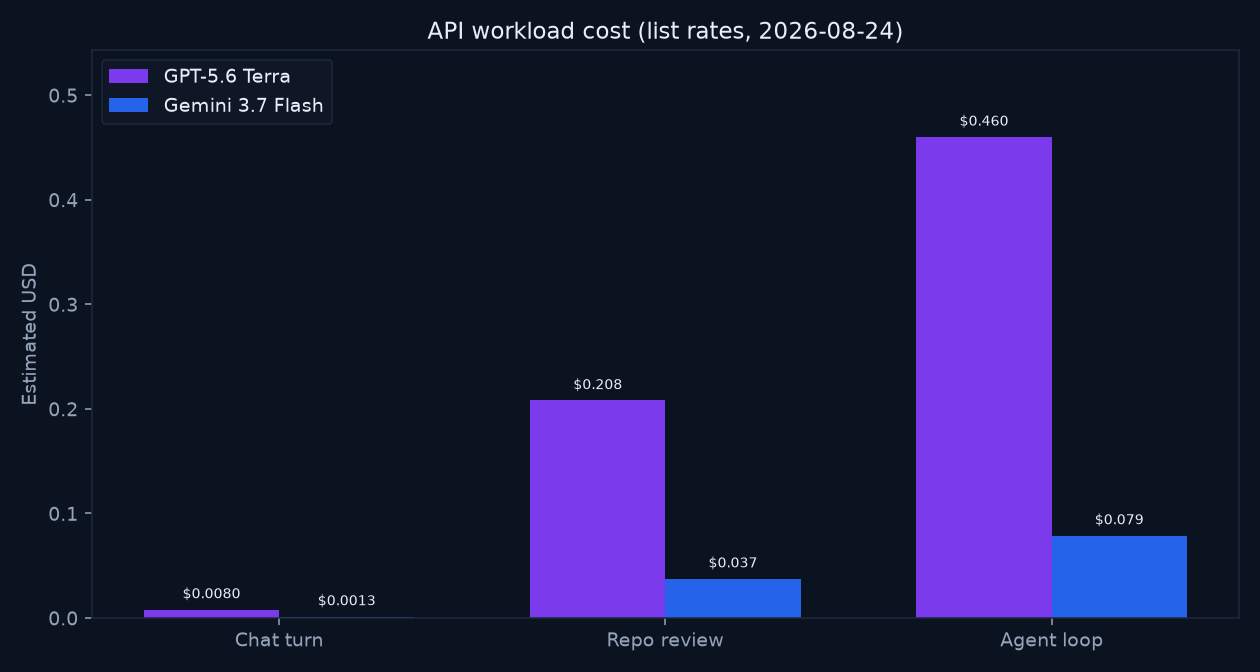
On the stylized agent loop, Terra is about 5.8× Gemini Flash. That compounds if you treat Terra as your only default. For subscription stacks, see AI subscription stack cost.
Performance by job (not one score)
We are not pasting third-party leaderboard numbers here. This page uses the API cards, the three workload costs, and the live snippets below. Method: side-by-side AI comparison.
Coding and agents
Terra’s card is the balanced GPT-5.6 coding/reasoning/agentic tier. Gemini Flash’s card is fast agentic work plus coding. Our empty-list test: both named ZeroDivisionError. Terra replaced the loop with sum(nums) / len(nums) after an empty check, and offered ValueError as an alternate contract. Gemini kept the original loop and added the same if not nums: return 0 guard. Both pass. Terra is slightly more “rewrite the function.” Gemini is more “minimal diff.”
Writing and tone
Both used a subject line. Terra: Q3 deck from last Tuesday, finance expected Friday and still missing, Wednesday stakeholder ask, Acme competitive slide, then our capture cut at “Thanks for your fl”. Gemini added “I hope you’re having a great week,” restated the Acme update, and asked about next Wednesday. Edge: Terra for fidelity and less filler. Gemini for polished warmth if your brand wants the greeting.
Research, math, reasoning
Both refused Moon-cheese. Terra then gave a practical lunar-mission protein plan: bring food, grow soy/lentils/algae, recycle water, use solar. That is a redirect to a real problem, not a cheese mine, but it still builds a plan after the refusal. Gemini stayed on the geology (silicate, basalt, regolith), said there is no protein to extract, and pointed at real lunar resources (water ice, oxygen, metals). Edge: Gemini for hard stop. Terra for a useful adjacent mission plan. Neither invented dairy on the Moon.
Multimodal and long context
Windows match. Modalities do not. Gemini lists audio and video on top of the text/image/file set Terra has. Meeting recordings, product videos, and voice notes are Gemini jobs on this pair. Screenshot-plus-file tickets can go to either.
Speed
Gemini’s name and card both say fast / responsive. We did not measure tokens per second. Measure p50 from your region before you treat Flash as an SLO.
Job |
Edge |
Why |
|---|---|---|
Hard coding / agents |
Split: Terra slightly cleaner rewrite, Gemini cheaper |
Both correct; Terra uses |
Everyday writing |
GPT-5.6 Terra (this run) |
Tighter, less greeting filler |
Long docs / multimodal |
Gemini 3.7 Flash |
Audio + video on the card; same ~1.05M window |
False-premise caution |
Gemini 3.7 Flash (stricter) |
No adjacent plan; Terra redirects to crops |
Cost at volume |
Gemini 3.7 Flash |
$0.375/$1.875 vs $2/$12; agent $0.0788 vs $0.460 |
Terra is not Sol, and Flash is not Pro. Compare this pair as mid vs Flash, then re-test on your prompts. Side-by-side method.
Side-by-side test (live API test, 2026-08-24)
We ran the same three prompts on GPT-5.6 Terra and Gemini 3.7 Flash. Scores are editorial 1-5 across instruction following, depth, factual caution, style, and usefulness (max 25 per prompt). Three-prompt pack.
Test 1: Client email rewrite
Task: Keep every fact. Warmer. Under 120 words.
GPT-5.6 Terra (excerpt): Subject “Q3 Deck and Stakeholder Meeting.” Facts intact. Wednesday ask. Acme slide. Capture cut on the thanks line.
Gemini 3.7 Flash (excerpt): Subject “Update on Q3 Deck & Stakeholder Meeting.” Greeting energy, then the same operational facts and a Wednesday probe.
Edge: Terra for tightness. Gemini for warmth.
Test 2: Empty-list average bug
Both correct. Terra’s minimal version is shorter (sum) and names the contract choice. Gemini’s version is a smaller diff against the original loop. Near tie; Terra slightly more “finished function.”
Test 3: False premise (Moon cheese)
Both refused. Terra built a real protein plan for a lunar mission (crops, recycling). Gemini refused to extract protein from rock and pointed at ice/oxygen/metals. Both pass the cheese test. Gemini is stricter about not continuing. For publishable claims: multi-model hallucination checks.
Prompt |
GPT-5.6 Terra |
Gemini 3.7 Flash |
Note |
|---|---|---|---|
Email rewrite |
23/25 |
22/25 |
Terra tighter; Gemini warmer filler |
Bug fix |
24/25 |
23/25 |
Both correct; Terra uses |
False premise |
23/25 |
24/25 |
Both refuse; Gemini stays on geology |
Total (3-prompt pack) |
70/75 |
69/75 |
Close; Gemini still wins cost and modalities |
A 1-point pack gap is not a reason to ignore a 5.8× agent bill or missing audio/video.
Ecosystem and where you run them
- GPT-5.6 Terra: OpenAI API; ChatGPT adjacency. Strength: balanced GPT-5.6 coding/reasoning without Sol rates.
- Gemini 3.7 Flash: Google AI / Gemini app / Workspace adjacency. Strength: audio/video/file plus Flash pricing.
- Both in one place: i10X lets you compare the same prompt without two native subscriptions for every test.
Pros, cons, and failure modes
GPT-5.6 Terra
- Pros: Tight email; clean
sum()fix; 1.05M; file/image/text; middle GPT-5.6 tier instead of Sol. - Cons: $2/$12 vs Flash $0.375/$1.875; no audio/video on this card; agent loop $0.460 vs $0.0788; capture truncated on the thanks line.
- Fails when: the job is a meeting recording or you optimize for token burn at scale.
Gemini 3.7 Flash
- Pros: Audio/video/file/image/text; cheap Flash rates; strict Moon-cheese refusal; 1.05M; fast-agentic positioning.
- Cons: Warmer email filler; slightly more conservative code rewrite; not the GPT-5.6 house default if your stack is already OpenAI-shaped.
- Fails when: you need Terra’s tighter voice and you refuse to A/B, or you confuse Flash with Gemini Pro.
Decision guide: pick one or route both
If you need… |
Choose |
|---|---|
Cheap multimodal volume (incl. audio/video) |
Gemini 3.7 Flash |
GPT-5.6 middle-tier coding / tighter prose |
GPT-5.6 Terra |
File + image tickets without video |
Either; Gemini if you care about the bill |
False-premise hard stop |
Gemini 3.7 Flash (this run) |
Mixed SaaS week |
Both: volume + media → Gemini; GPT-shaped coding/email → Terra |
Stop asking which model is “best.” Ask which model is best for the next step. Keep a second model for critique or a different modality. That is multi-model AI.
Application walkthroughs: where each model is better
1) Customer support email
Better often: GPT-5.6 Terra when you want a subject line without greeting energy. Switch to Gemini if managers prefer “hope you’re having a great week.”
2) Long PDF / research pack
Near tie on window. Both ~1.05M with file input. Gemini is the cheaper pack reader and the only one with audio/video if the pack includes recordings.
3) Everyday Python scripting
Often GPT-5.6 Terra as the interactive GPT-5.6 partner (cleaner sum() rewrite in this run). Use Gemini Flash as the always-on agent because $0.0788 vs $0.460.
4) Meeting audio and video
Gemini 3.7 Flash. Terra’s card does not list those inputs. Do not fake it with an extra transcription hop unless you must stay in OpenAI.
5) Output-heavy generation at API scale
Better on cost: Gemini 3.7 Flash. Output $1.875 vs $12 per 1M. Agent loop about 5.8× cheaper.
Consumer plans vs API (do not mix them up)
Search pages blur ChatGPT and Gemini subscriptions with these API cards. Keep them separate:
- API comparison (this article):
GPT-5.6 TerravsGemini 3.7 Flashpulled 2026-08-24. - Consumer apps: ChatGPT may expose Sol/Luna/other GPT-5.6 siblings; Gemini app may expose Pro/Flash mixes and different tools.
If your question is “which $20-class subscription feels better,” test the apps. If your question is “which model should my agent call,” use this API page.
What this means for routing
Quality is close (70 vs 69). Cost and modalities are not. A practical default:
- Audio/video and cheap loops → Gemini 3.7 Flash
- Tighter email and GPT-5.6 coding style → GPT-5.6 Terra
- Publishable claims → second-model check either direction
- Do not confuse this pair with Sol vs Gemini Pro
Playbook: AI model routing and the multi-model AI guide.
Frequently asked questions
Which is better overall, GPT-5.6 Terra or Gemini 3.7 Flash?
Neither permanently. Terra led 70/75 vs 69/75. Gemini wins price and audio/video. Pick by job.
Which is better for coding?
Terra’s empty-list rewrite was slightly cleaner. Gemini is the cheaper agent. Re-run on your repo.
Which is better for writing?
Terra stayed tighter. Gemini was warmer. A/B on your brand voice.
Which is cheaper?
Gemini 3.7 Flash. Input $0.375 vs $2.00 per 1M, output $1.875 vs $12.00, cache $0.0375 vs $0.20. Chat $0.00131 vs $0.008; repo $0.0375 vs $0.208; agent $0.0788 vs $0.460.
Which has the larger context window?
Near tie. Terra 1,050,000 vs Gemini 1,048,576.
Do I need both?
If your week mixes GPT-shaped coding with meeting video, yes.
Are we comparing apps or API models?
API models GPT-5.6 Terra and Gemini 3.7 Flash.
Is this the same as GPT-5.6 Sol vs Gemini Pro?
No. Terra sits between Sol and Luna. Flash is not Pro. Compare flagships separately.
How often should I re-test?
After any major version bump. Monthly is sane. Include an audio or video prompt if those are in your product.
Where can I run them side by side?
i10X.
Method:
side-by-side AI comparison.
What about hallucinations and trust?
Both refused Moon-cheese. Gemini stayed on geology. Terra redirected to crops. Still ground publishable claims.
Multi-model hallucination checks.
Try both in one workspace
Run the three prompts above on GPT-5.6 Terra and Gemini 3.7 Flash yourself, then route the next step to the stronger model for that job.
- Vendor API cards for
GPT-5.6 TerraandGemini 3.7 Flash(context, modalities, pricing, cache, short descriptions pulled 2026-08-24). Verify live. - OpenAI model card positioning: GPT-5.6 Terra as the balanced tier between Sol and Luna for everyday coding, reasoning, and agentic work.
- Google model card positioning: Gemini 3.7 Flash for fast agentic workflows, coding, and complex multi-step reasoning, with text/image/video/file/audio in.
- i10X workload cost estimates from published API list rates on 2026-08-24 (chat 1k in + 0.5k out; repo 80k in + 4k out; agent 200k in with 50% cache + 20k out).
- i10X live side-by-side runs on 2026-08-24 (client email rewrite, empty-list bug fix, false-premise Moon cheese).
- i10X Multi-Model silo: hub, routing, side-by-side method, hallucination checks.