
Comparison · September 2026
Claude Opus 5 (Anthropic API) and DeepSeek V4.1 Flash (DeepSeek API) are two models teams actually route in 2026: Anthropic Opus flagship versus DeepSeek Flash price. This is a decision guide, not a leaderboard dump: published API rates, three workload cost scenarios, live writing and coding snippets, and a pick matrix you can rerun. If you want both without juggling tabs, use a multi-model AI workspace or start on i10X.
Pick Claude Opus 5 if: you want Anthropic Opus flagship depth for hard agents, code review, and long-horizon work, and budget allows $5/$25.
Pick DeepSeek V4.1 Flash if: you want DeepSeek Flash economics with matched or better live-pack caution, ~1.05M context, and image input.
Best default for many teams: route by task and keep both available. See the decision matrix below.
Data checked: 2026-09-07. Prices and model cards change. Verify live API test and vendor pages.
1M |
Claude Opus 5 context (API) |
1.05M |
DeepSeek V4.1 Flash context (API) |
$5 / $25 |
Claude Opus 5 input/output per 1M tokens (API pricing, 2026-09-07) |
$0.3 / $1.2 |
DeepSeek V4.1 Flash input/output per 1M tokens (API pricing, 2026-09-07) |
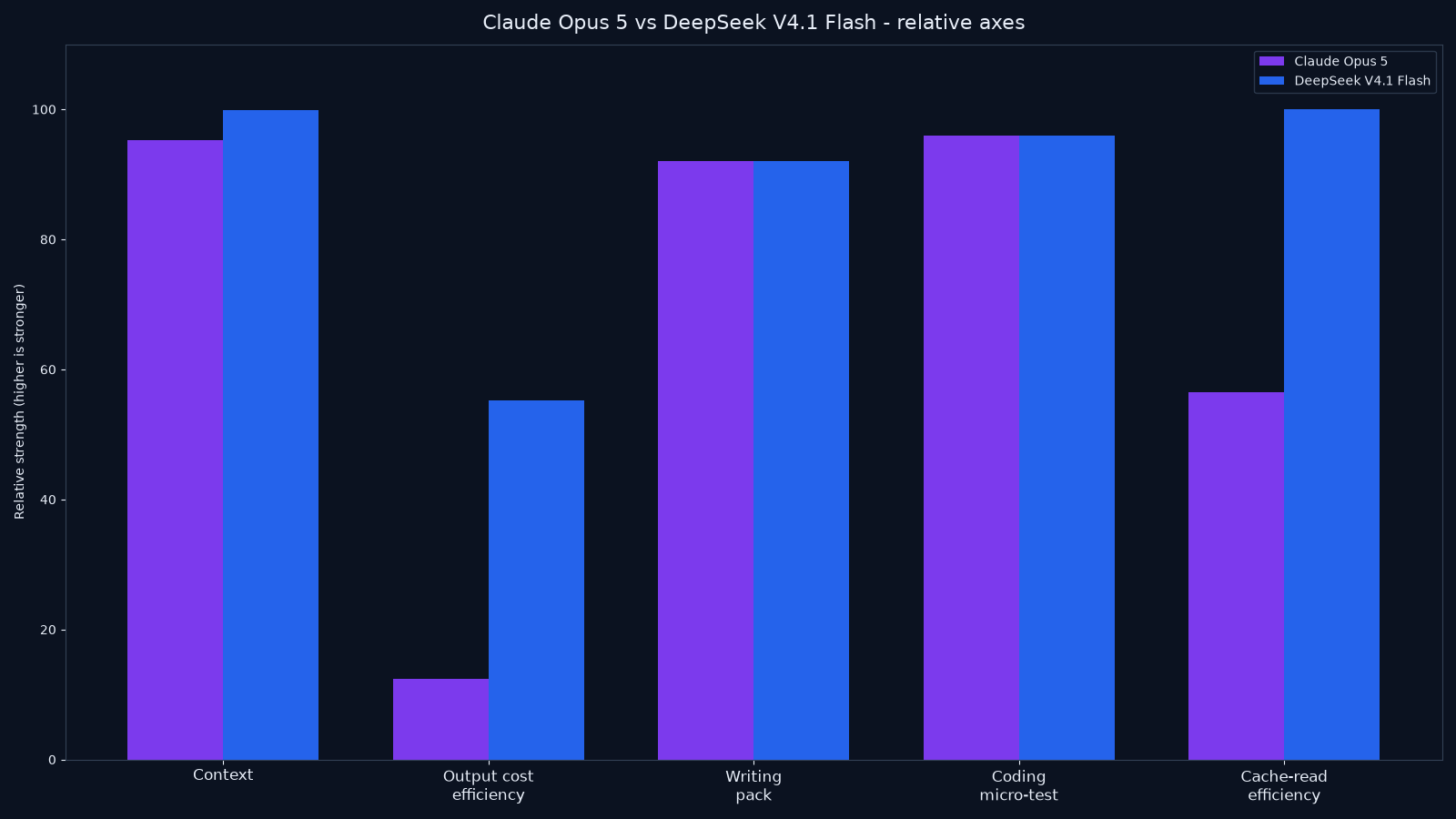
Persona picker
You are… |
Start with |
Why |
|---|---|---|
Writer / marketer |
Opus for fuller letters; DeepSeek for shorter volume notes |
Both 23/25. Opus was longer and more letter-like. DeepSeek was concise with a name slot. |
Developer / agent builder |
DeepSeek for cheap loops; Opus for flagship review |
Micro-test tie at 24/25. Opus discussed return 0 vs None. DeepSeek showed return 0 and ValueError. |
Researcher / analyst |
Opus for flagship reading; DeepSeek for cheap passes |
Context close (1M vs ~1.05M). Opus lists file. DeepSeek lists image without file on this card. |
Budget / high volume |
DeepSeek V4.1 Flash |
Chat $0.0009 vs $0.0175. Agent $0.0546 vs $1.05. |
What we are comparing (exact versions)
This page compares two specific API models, not vague brand names. Multi-model AI means using more than one LLM in your stack and routing by job. For the method, see side-by-side AI comparison.
Field |
Claude Opus 5 |
DeepSeek V4.1 Flash |
|---|---|---|
Provider |
Anthropic |
DeepSeek |
API model |
|
|
Listed card name |
Anthropic: Claude Opus 5 |
DeepSeek: DeepSeek V4.1 Flash |
Family / tier |
Anthropic flagship |
DeepSeek Flash / MoE volume tier |
App vs API note |
Also in Claude apps; this article uses the API model above |
Also in DeepSeek apps/products; this article uses the API model above |
If a page still compares older version strings as if they were these API models, treat it as historical. For routing across many models, see AI model routing.
Spec sheet (API card, 2026-09-07)
Spec |
Claude Opus 5 |
DeepSeek V4.1 Flash |
|---|---|---|
Context window |
1,000,000 tokens |
1,048,576 tokens |
Input modalities (card) |
text, image, file |
text, image |
Output |
text |
text |
Open weights |
No |
No |
Vendor positioning (card) |
Claude Opus 5 is Anthropic’s flagship model for demanding reasoning, coding, and long-horizon agentic work. It is particularly strong at end-to-end software tasks, code review and bug finding, and visual analysis. |
DeepSeek V4.1 Flash is a sparse mixture-of-experts model from DeepSeek, and the first built on the company’s Causal Encoder-Decoder (CED) architecture. |
We did not invent max-output, reasoning-mode, or realtime-search rows. Those fields were not on the cards we pulled for this pair. If your product depends on a specific tool or effort switch, confirm it on the live vendor page before you ship.
Pricing and real workload cost
List prices are easy to game. Workload cost is what you feel. Numbers below use published per-million rates as of 2026-09-07. Verify live before you budget.
Price |
Claude Opus 5 |
DeepSeek V4.1 Flash |
|---|---|---|
Input / 1M tokens |
$5.00 |
$0.3 |
Output / 1M tokens |
$25.00 |
$1.2 |
Cache read / 1M |
$0.5 |
$0.006 |
Claude Opus 5 lists $5.00 input and $25.00 output. DeepSeek V4.1 Flash lists $0.3 input and $1.2 output. Cache reads are $0.5 vs $0.006. If your agent stack actually hits cache, that gap matters. If it does not, output price dominates.
Scenario |
Assumed tokens |
Est. Claude Opus 5 |
Est. DeepSeek V4.1 Flash |
|---|---|---|---|
Chat turn |
1k in + 0.5k out |
$0.0175 |
$0.0009 |
Repo / doc review |
80k in + 4k out |
$0.5 |
$0.0288 |
Agent loop |
200k in (50% cached) + 20k out |
$1.1 |
$0.0546 |
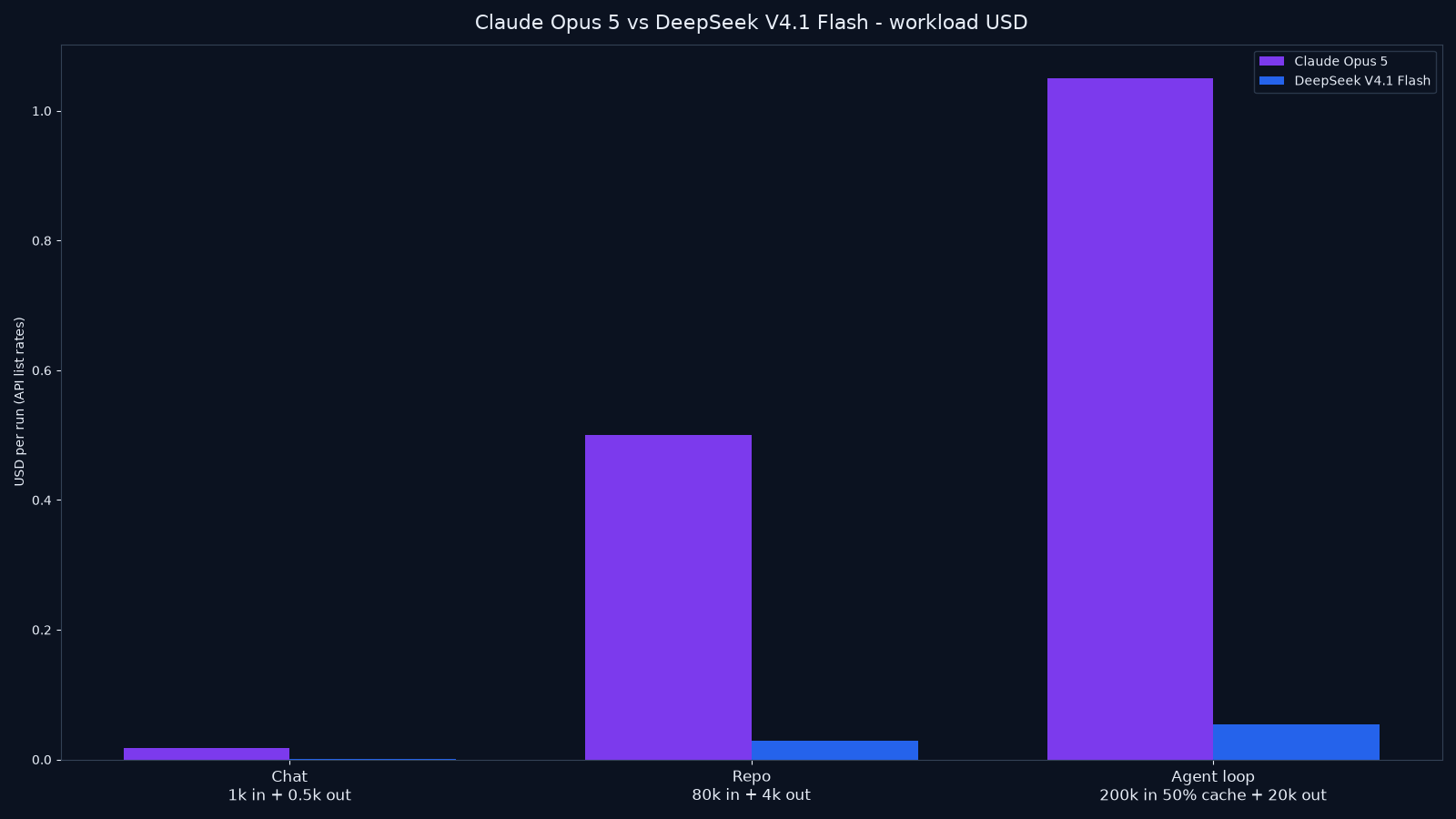
DeepSeek V4.1 Flash wins every stylized workload we priced on list rates for this pair. Re-run the math if you cache harder or emit less. For subscription stacks, see AI subscription stack cost.
Performance by job (not one score)
Public benches disagree by harness, effort mode, and date. We are not inventing index numbers we do not have for this pair. Treat vendor cards as positioning, treat our snippets as a small live pack, and prefer your own side-by-side on your prompts. Method: side-by-side AI comparison.
Coding and agents
Tie on the bug. Opus: flagship coding/agent card. DeepSeek: cheap iteration. Card lines are positioning, not benches. Our empty-list micro-test is a narrow slice. For huge repos, context and cache pricing matter more than this snippet. For volume loops, list rates matter more than flagship branding.
Writing and tone
Opus for polished longer client email. DeepSeek for shorter complete notes. Same 23/25. A writing win does not erase a cost win. Keep a second model for critique when the letter is customer-facing.
Research, math, reasoning
Opus when you want Anthropic flagship judgment on dense packs. DeepSeek when you need many cheap passes. We did not run a science-QA pack, so we will not fake one. False-premise behavior is below. For publishable work, add multi-model hallucination checks.
Multimodal and long context
Opus lists text, image, file. DeepSeek lists text, image. Slight edge to Opus on file. Context favors DeepSeek slightly. Confirm the live card before you ship a media pipeline on an assumption from an older SKU.
Speed
No tok/s in this pack. Measure p50 from your API region. Do not ship on a third-party screenshot.
Job |
Edge |
Why |
|---|---|---|
Hard coding / agents |
Split |
Tie on the bug. Opus: flagship coding/agent card. DeepSeek: cheap iteration. |
Everyday writing |
Split |
Opus for polished longer client email. DeepSeek for shorter complete notes. Same 23/25. |
Long docs / multimodal |
Claude Opus 5 |
Opus lists text, image, file. DeepSeek lists text, image. Slight edge to Opus on file. Context favors DeepSeek slightly. |
Realtime / conversational |
Product-dependent |
Product tooling and latency are app-specific. Not measured here. |
Cost at volume |
DeepSeek V4.1 Flash |
DeepSeek V4.1 Flash. Chat $0.0009 vs $0.0175. Repo $0.0288 vs $0.5. |
Leaderboards mix harnesses, tool settings, and effort modes. When we do not have a primary table for a pair, we do not invent one. Re-test on your workload.
Side-by-side test (i10X pack, 2026-09-07)
Same three prompts, scored 1-5 on instruction following, depth, factual caution, style, and usefulness (max 25). Writing, coding, and false premise only. No invented extra scores.
Test 1: Client email rewrite
Task: Keep every fact. Warmer. Under 120 words.
Claude Opus 5 (excerpt, sanitized): warmer and longer; name slot; week greeting; Q3 deck last Tuesday; Finance still missing after Friday; ask to move stakeholders to next week, perhaps Wednesday; competitive slide needs new Acme pricing; short thanks close.
DeepSeek V4.1 Flash (excerpt, sanitized): complete mid-length; name slot; week greeting; Q3 deck last Tuesday; Finance still missing after Friday; ask to move stakeholders to next week, perhaps Wednesday; competitive slide needs new Acme pricing; short thanks close.
Edge: Opus: longer letter with patience line and calendar offer. DeepSeek: shorter, same facts, name slot.
Test 2: Empty-list average bug
Claude Opus 5: names ZeroDivisionError; guards empty input; offers return 0; mentions return None; suggests sum() shortcut.
DeepSeek V4.1 Flash: names ZeroDivisionError; guards empty input; offers return 0; prefers raising ValueError; adds a print check.
Both named ZeroDivisionError and offered empty-list guards. Opus debated return 0 vs None. DeepSeek also showed ValueError. Tie.
Test 3: False premise (Moon cheese)
Claude Opus 5: opens on the premise; then sketches a hypothetical cheese-mining plan.
DeepSeek V4.1 Flash: refuses first (Moon is rock/regolith, not dairy); then sketches a hypothetical cheese-mining plan.
Opus noted rock/regolith, then built a cheese-mining thought experiment (15/25). DeepSeek refused dairy mining and only then sketched a labeled hypothetical (22/25). DeepSeek wins trust on this prompt.
Prompt type |
Claude Opus 5 |
DeepSeek V4.1 Flash |
Note |
|---|---|---|---|
Client email rewrite |
23/25 |
23/25 |
Opus: longer letter with patience line and calendar offer. DeepSeek: shorter, same facts, name slot. |
Bug explain + minimal fix |
24/25 |
24/25 |
Both named ZeroDivisionError and offered empty-list guards. Opus debated return 0 vs None. DeepSeek also showed ValueError. Tie. |
Logic + false premise |
15/25 |
22/25 |
See false-premise notes above. |
Total |
62/75 |
69/75 |
DeepSeek wins the pack (69/75 vs 62/75), driven by false-premise caution. Opus still owns flagship positioning. |
DeepSeek wins the pack (69/75 vs 62/75), driven by false-premise caution. Opus still owns flagship positioning. Route the next step.
Ecosystem and where you run them
- Claude Opus 5: Anthropic API. Claude apps differ. This page is Claude Opus 5 (Anthropic API).
- DeepSeek V4.1 Flash: DeepSeek API. CED MoE Flash SKU. Confirm tools in your app.
- Both in one place: Multi-model workspaces (including i10X) let you switch or compare without two native subscriptions for every test.
Pros, cons, and failure modes
Claude Opus 5
- Pros: Anthropic flagship for reasoning, coding, agents. File input. Strong coding depth notes. Fuller client letter.
- Cons: $5/$25 rates. Weak false-premise score in our pack. Expensive agent loops.
- Fails when: volume cost matters more than Opus branding, or you need a strict refuse without fantasy follow-through.
DeepSeek V4.1 Flash
- Pros: Flash pricing. Slightly larger context. Better false-premise score. Matched writing/coding scores.
- Cons: Not an Opus-class flagship card. No file modality listed. Hypothetical follow-on may still be too playful for some trust gates.
- Fails when: you need Anthropic flagship as the primary model, or file modality is mandatory on the same SKU.
Decision guide: pick one or route both
If you need… |
Choose |
|---|---|
Lowest API burn at volume |
DeepSeek V4.1 Flash |
Long PDF / giant repo packs |
DeepSeek V4.1 Flash |
Send-ready client email |
A/B both. Scores were close; tone differs. |
Broader multimodal inputs |
Claude Opus 5 |
Mixed week (docs + code + volume) |
Keep both. Route flagship work to the higher-priced card when needed. Route volume to DeepSeek V4.1 Flash. |
Stop asking which model is “best.” Ask which model is best for the next step, then keep a second model for critique or a different price tier. That is the point of multi-model AI.
Application walkthroughs: where each model is better
1) Customer support email
Better often: Claude Opus 5 when you want a fuller client letter. Opus was longer and more polished. Flash (or DeepSeek) wins when you send thousands of similar notes and cost compounds.
2) Long PDF / research pack
Context: 1M vs 1.05M. Opus when you want Anthropic flagship judgment on dense packs. DeepSeek when you need many cheap passes. Use the cheaper model as a second-pass critic when the first pass is flagship-priced.
3) Everyday Python scripting
Tie on the micro-test. Both caught the empty-list crash. Cheap iterative loops favor DeepSeek V4.1 Flash. Flagship positioning favors the higher-priced card when the product is hard engineering.
4) Screenshot and UI QA
Both cards list image input. We did not run a vision eval, so we will not invent a winner. A/B your actual captures.
5) Output-heavy generation at API scale
Better on cost: DeepSeek V4.1 Flash. Chat $0.0175 vs $0.0009. Repo $0.5 vs $0.0288. Cached agent $1.1 vs $0.0546.
6) False-premise and trust gates
Not a tie. Opus noted rock/regolith, then built a cheese-mining thought experiment (15/25). DeepSeek refused dairy mining and only then sketched a labeled hypothetical (22/25). DeepSeek wins trust on this prompt.
Consumer plans vs API (do not mix them up)
SERP pages often blur consumer subscriptions with API model names. Keep them separate:
- API comparison (this article):
Claude Opus 5 (Anthropic API)vsDeepSeek V4.1 Flash (DeepSeek API). - Consumer apps: vendor chat apps may expose different tool defaults, rate limits, and bundled models (including cheaper tiers).
If your question is which subscription feels better on your phone, run a week-long lived test in both apps. If your question is which model your agent should call, use this API page.
Speed notes
We did not measure tokens per second for this pair. Writeups in 2026 often disagree by region, batch size, and reasoning settings. For UX, log your own p50 and p95 from the API in the region you actually serve. Time-to-first-token and tokens per second are different feelings. Do not mix them.
Related comparisons
Nearby pages: Claude Opus 5 vs Gemini 3.8 Flash, Gemini 3.8 Flash vs GPT-5.6 Sol, DeepSeek V4.1 Flash vs GPT-6 Astra, Gemini 3.8 Flash vs GPT-6 Astra, Grok 4.6 vs GPT-6 Astra, Claude Opus 5 vs GPT-6 Astra.
Frequently asked questions
Which is better overall, Claude Opus 5 or DeepSeek V4.1 Flash?
Neither permanently. DeepSeek V4.1 Flash won our three-prompt pack (69/75 vs 62/75). Cost and modalities still split the week. Pick by job.
Which is better for coding?
Micro-test was a tie on correctness (24/25 vs 24/25). Flagship cards differ. Volume loops favor DeepSeek V4.1 Flash.
Which is better for writing?
Opus for polished longer client email. DeepSeek for shorter complete notes. Same 23/25. A/B on brand voice.
Which is cheaper?
On 2026-09-07 list rates, DeepSeek V4.1 Flash wins our three recipes (chat $0.0175 vs $0.0009, repo $0.5 vs $0.0288, agent $1.1 vs $0.0546). Verify live.
Which has the larger context window?
Claude Opus 5: 1,000,000 tokens. DeepSeek V4.1 Flash: 1,048,576 tokens.
Do I need both?
If you mix flagship-hard jobs with volume text or mixed media, yes. Route expensive steps carefully and keep a cheap model for bulk.
Are we comparing apps or API models?
API models Claude Opus 5 (Anthropic API) and DeepSeek V4.1 Flash (DeepSeek API). Apps wrap different defaults.
How often should I re-test?
After version bumps. Monthly in production. Re-price when list rates move. Do not mix these IDs with older generation names.
Where can I run them side by side?
i10X.
Method:
side-by-side AI comparison.
What about hallucinations and trust?
See the false-premise scores above. Still ground publishable claims.
Multi-model hallucination checks.
Try both in one workspace
Compare Claude Opus 5 and DeepSeek V4.1 Flash on the same prompt, then route the next step to the stronger model for that job.
- Vendor API model cards and published list pricing for Claude Opus 5 (Anthropic API) and DeepSeek V4.1 Flash (DeepSeek API), pulled 2026-09-07. Context, modalities, and per-million rates. Verify live.
- Anthropic card positioning: Claude Opus 5 is Anthropic’s flagship model for demanding reasoning, coding, and long-horizon agentic work. It is particularly strong at end-to-end software tasks, code review and bug finding, and visual analysis.
- DeepSeek card positioning: DeepSeek V4.1 Flash is a sparse mixture-of-experts model from DeepSeek, and the first built on the company’s Causal Encoder-Decoder (CED) architecture.
- i10X live side-by-side runs on 2026-09-07 (client email rewrite, empty-list average bug, false-premise Moon cheese). Snippets sanitized for punctuation.
- i10X workload estimates using the published rates above: 1k+0.5k chat, 80k+4k repo review, 200k in at 50% cache + 20k out agent loop.
- i10X Multi-Model silo: hub, routing, side-by-side method.