
Comparison · August 2026
GLM-5.3 and Claude Sonnet 5 are the pair you reach for when Opus is too expensive and a Flash SKU feels too light. GLM-5.3 is Z.ai’s large-scale text-only reasoner for software engineering and long-horizon agents. Sonnet 5 is Anthropic’s most capable Sonnet-class model, with image and file input plus selectable reasoning effort. This is a decision guide: exact versions, published API rates, three workload costs, and a live side-by-side pack. Keep both in a multi-model AI workspace or start on i10X.
Pick GLM-5.3 if: the job is text, you want a ~1M window, and you care about the meter. List output is $4.40/M vs Sonnet’s $10/M, and our agent-loop estimate is $0.254 vs $0.42.
Pick Claude Sonnet 5 if: you need image or file input, Anthropic’s effort levels (low, medium, high, max), or a cleaner email that does not announce “here is a warmer version.”
Best default for many teams: GLM for text volume, Sonnet for multimodal and brand-safe drafts. Route. Do not crown a permanent overall winner.
Data checked: 2026-08-24. Prices and model cards change. Verify live API test and vendor pages.
1,048,576 |
GLM-5.3 context (API) |
1,000,000 |
Claude Sonnet 5 context (API) |
$1.40 / $4.40 |
GLM-5.3 input/output per 1M tokens (API pricing, 2026-08-24) |
$2 / $10 |
Claude Sonnet 5 input/output per 1M tokens (API pricing, 2026-08-24) |
Persona picker
You are… |
Start with |
Why |
|---|---|---|
Writer / marketer |
Claude Sonnet 5 |
Sonnet’s rewrite was a sendable note. GLM prefaced the draft with “Here’s a warmer, clearer version,” which you would have to strip. |
Developer / agent builder |
GLM-5.3 for text agents; Sonnet when screenshots enter |
Both fixed the empty-list bug. GLM is cheaper per loop. Sonnet takes images and files. |
Researcher / analyst |
Sonnet if the pack includes PDFs/images; GLM if it is text |
Context is close. Modalities are not. GLM is text in, text out. |
Budget / high volume |
GLM-5.3 |
Lower input and much lower output. Chat $0.0036 vs $0.0070. |
Need reasoning effort knobs |
Claude Sonnet 5 |
Card lists adaptive thinking with low / medium / high / max. GLM’s card in this pull does not. |
What we are comparing (exact versions)
Multi-model AI means using more than one LLM in your stack. This page compares two specific API models, not “GLM vs Claude” as brands and not Claude Opus 5.
Field |
GLM-5.3 |
Claude Sonnet 5 |
|---|---|---|
Provider |
Z.ai |
Anthropic |
API model |
|
|
Listed API name |
Z.ai: GLM 5.3 |
Anthropic: Claude Sonnet 5 |
Family / tier |
Large-scale text reasoner |
Most capable Sonnet-class model |
App vs API note |
Also in Z.ai products; this article uses the API model above |
Also in Claude apps; this article uses the API model above, not Opus |
If a page still compares GLM-4 to Claude Sonnet 4, treat it as historical. For routing across many models, see AI model routing.
Spec sheet (API card, 2026-08-24)
Spec |
GLM-5.3 |
Claude Sonnet 5 |
|---|---|---|
Context window |
1,048,576 tokens |
1,000,000 tokens |
Max output (if published) |
Not published on this card |
Not published on this card |
Input modalities |
text |
text, image, file |
Output |
text |
text |
Reasoning / effort modes |
Positioned as a large-scale reasoning model; effort knobs not listed on this card |
Adaptive thinking with selectable effort (low, medium, high, max) |
Realtime / search |
Not listed on this card; confirm tools in your app |
Not listed on this card; confirm tools in your app |
Open weights |
Not listed as open-weight on this card |
No |
Vendor positioning (short) |
Complex software engineering and long-horizon agent tasks |
Frontier Sonnet-class coding, agents, and professional work |
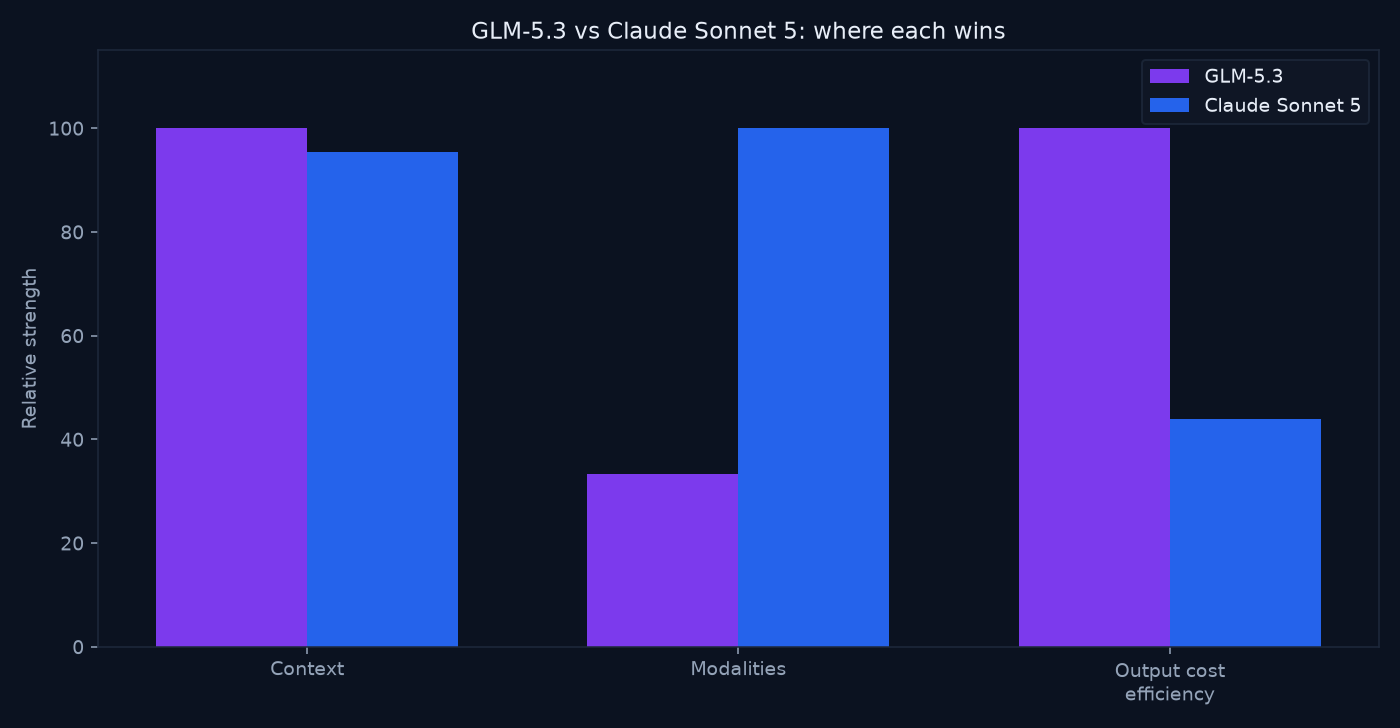
Figure 1 is the honest picture: slight GLM on context, Sonnet on modalities (GLM is text-only), GLM on output cost ($4.40 vs $10). A screenshot is the wrong GLM call unless you OCR first.
Pricing and real workload cost
List prices are easy to game. Workload cost is what you feel. Numbers below use published per-million rates as of 2026-08-24. Verify live before you budget. One nuance: GLM’s cache read ($0.26) is actually higher than Sonnet’s ($0.20). GLM still wins the agent loop because input and output dominate the formula.
Price |
GLM-5.3 |
Claude Sonnet 5 |
|---|---|---|
Input / 1M tokens |
$1.40 |
$2.00 |
Output / 1M tokens |
$4.40 |
$10.00 |
Cache read / 1M |
$0.26 |
$0.20 |
Scenario |
Assumed tokens |
Est. GLM-5.3 |
Est. Claude Sonnet 5 |
|---|---|---|---|
Chat turn |
1k in + 0.5k out |
$0.0036 |
$0.0070 |
Repo / doc review |
80k in + 4k out |
$0.1296 |
$0.20 |
Agent loop |
200k in (50% cached if available) + 20k out |
$0.254 |
$0.42 |
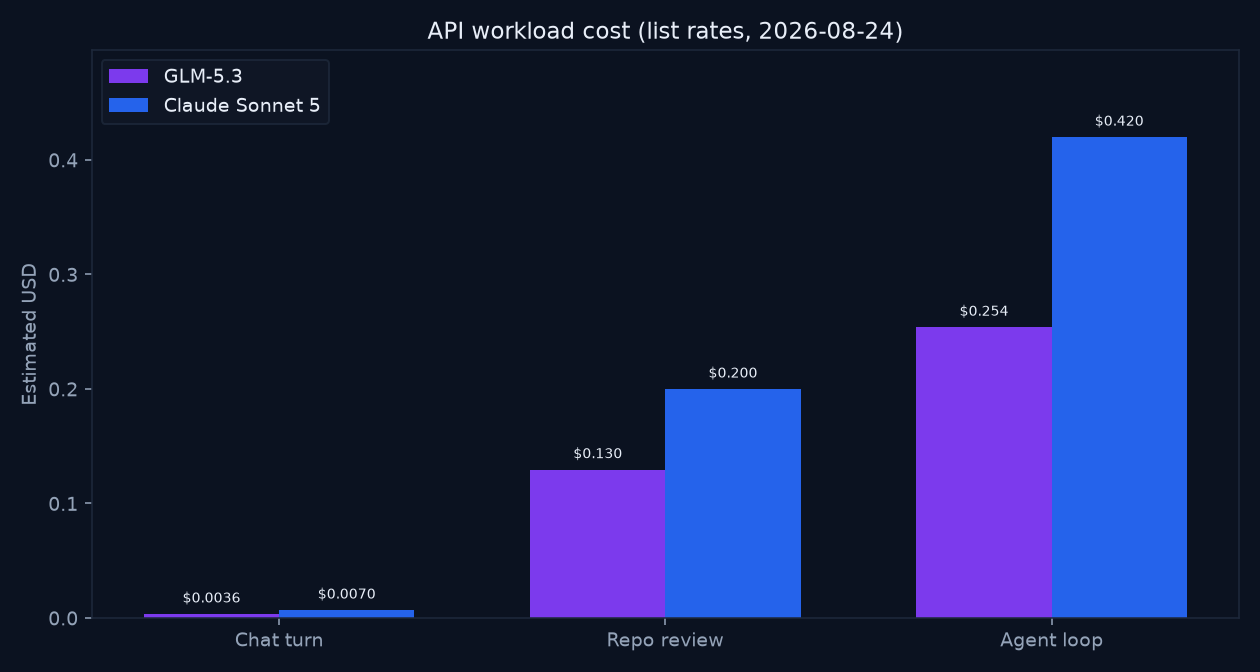
Chat is about half. The agent loop is $0.254 vs $0.42 even though GLM’s cache read is dearer. Model the whole formula. For seats vs API, see AI subscription stack cost.
Performance by job (not one score)
We are not pasting a public leaderboard. Both vendors claim software engineering and agents. Sonnet’s card also claims professional work and names effort levels. GLM’s card in this pull does not name effort knobs and does not list images. Treat that as a routing constraint, not as a quality insult. Method: side-by-side AI comparison.
Coding and agents
The live bug was a tie on the fix. Both said empty nums hits ZeroDivisionError. Both added if not nums: return 0. Sonnet mentioned raising ValueError as an alternative in a comment. That is not a SWE ranking. For text-only agents, GLM is the cheaper default until your eval says the extra Sonnet dollars buy fewer retries. For agents that see screenshots or attached files, Sonnet is the card match. Turning every PNG into text just to keep GLM in the loop is a false saving if the OCR step is wrong.
Writing and tone
This is the one live test that was not a tie. GLM opened with meta: “Here’s a warmer, clearer version,” then a subject, a “Quick status” block, and the Finance delay. Sonnet opened with a subject (“Q3 Deck Update & Meeting Reschedule Request”) and wrote the note as if it were already going to a person. If you paste GLM into Gmail as-is, the meta line ships. That is a product bug for CS automation even if the rest of the draft is fine. Strip it, or start on Sonnet for outbound copy.
Research, math, reasoning
No scored science set here. On the false-premise trap, GLM refused, cited Apollo samples (plagioclase, pyroxene, olivine), and redirected to real lunar food production. Sonnet refused, named basalt and anorthosite and a giant-impact origin, then offered a “playful take” on mining cheese anyway. Both pass the first gate (the premise is false). GLM stayed in the useful redirect. Sonnet’s playful coda is fun in a chat and noisy in a research agent. For publishable claims, still use multi-model hallucination checks.
Multimodal and long context
Context is not the decision (1,048,576 vs 1,000,000). Modalities are. GLM: text in, text out. Sonnet: text, image, file in, text out. If your analysts live in PDFs and screenshots, Sonnet is the default. If your pipeline is already text (tickets, diffs, transcripts), GLM is the cheaper ~1M window.
Speed
This pack does not publish tokens per second. Sonnet’s effort levels will change latency if you actually set them to high or max; we did not score that. Measure p50 with the effort you plan to ship, not with a demo default.
Job |
Edge |
Why |
|---|---|---|
Hard coding / agents |
GLM on cost for text; Sonnet when files/images appear |
Live bug fix tied. Cards both claim this lane. |
Everyday writing |
Claude Sonnet 5 |
No meta preface; sendable subject + body in our rewrite. |
Long docs / multimodal |
Claude Sonnet 5 |
Image + file on the card. GLM is text-only. |
Realtime / conversational |
Not scored here |
Neither card listed a realtime mode we could cite. |
Cost at volume |
GLM-5.3 |
$1.40/$4.40 vs $2/$10; agent loop $0.254 vs $0.42. |
A text-only reasoner can still win the week if your inputs are text. It cannot win a screenshot QA loop. Route on modality first, then on price. That is multi-model AI.
Side-by-side test (i10X pack, 2026-08-24)
We ran the same three prompts on GLM-5.3 and Claude Sonnet 5 and scored 1-5 on instruction following, depth, factual caution, style, and usefulness (max 25 per prompt). Excerpts are sanitized and truncated. Add a long-paste summary and a refuse-if-unknown research prompt in your workspace; those were not in this capture.
Test 1: Client email rewrite
Task: Keep every fact. Warmer. Short enough to send.
GLM-5.3 (excerpt): Opens with “Here’s a warmer, clearer version,” then subject “Q3 Deck Update & Meeting Timing.” Follow-up on last Tuesday. “Quick status” on Finance missing Friday. Push stakeholders to next week, perhaps Wednesday. Competitive slide still open when the excerpt cuts.
Claude Sonnet 5 (excerpt): Subject “Q3 Deck Update & Meeting Reschedule Request.” Direct follow-up. Finance promised Friday, nothing through. Push to next Wednesday so finance has time. Competitive slide still needs work. No meta preface.
Edge: Sonnet. Same facts, less scaffolding, nothing to delete before send.
Test 2: Empty-list average bug
Both named ZeroDivisionError and shipped the same guard. Sonnet’s comment offered ValueError as the strict alternative. Tie on the micro-task.
Test 3: False premise (Moon cheese)
Both refused. GLM stayed with real geology and a real food-on-Moon redirect. Sonnet added a playful mining coda after a clean refuse. Both pass the refuse. GLM slightly cleaner for an agent that should not entertain the joke.
Prompt type |
GLM-5.3 |
Claude Sonnet 5 |
Note |
|---|---|---|---|
Client email rewrite |
20/25 |
23/25 |
GLM meta line; Sonnet sendable |
Bug explain + minimal fix |
23/25 |
23/25 |
Tie |
Logic + false premise |
24/25 |
22/25 |
Both refuse; Sonnet then plays along |
Total |
67/75 |
68/75 |
Close; route writing to Sonnet, volume text to GLM |
One point is not a stack decision. The useful split is: Sonnet for outbound copy and multimodal, GLM for cheap text agents. If you only remember the total, you will mis-route.
Ecosystem and where you run them
- GLM-5.3: Z.ai API and Z.ai products. Strength: a ~1M text reasoner that is priced like a workhorse, not like a flagship.
- Claude Sonnet 5: Anthropic API and Claude apps. Strength: Projects, file uploads, image loops, and effort controls your team can name in a runbook.
- Both in one place: Multi-model workspaces (including i10X) let you switch without two native subscriptions for every test.
Pros, cons, and failure modes
GLM-5.3
- Pros: $1.40/$4.40 list rates; ~1.05M context; software-engineering positioning; cheaper on all three workloads we priced; stayed practical on the false premise.
- Cons: Text only; cache read ($0.26) is not the bargain line; live email included a meta preface; no effort knobs on this card.
- Fails when: the next token is a screenshot, a PDF, or a customer-facing draft you cannot edit.
Claude Sonnet 5
- Pros: Image + file + text; effort levels low/medium/high/max; sendable rewrite in our pack; familiar Claude path; cheaper cache reads than GLM.
- Cons: $10/M output vs $4.40; agent loop $0.42 vs $0.254; playful coda on the false-premise test.
- Fails when: you run high-volume text-only agents and ignore the meter, or you need a model that will never entertain a joke after refusing it.
Decision guide: pick one or route both
If you need… |
Choose |
|---|---|
Cheap ~1M text agents |
GLM-5.3 |
Screenshots, PDFs, file uploads |
Claude Sonnet 5 |
Outbound email you will not edit |
Claude Sonnet 5 |
Named reasoning effort (low to max) |
Claude Sonnet 5 |
Cache-heavy pinned projects |
Lean Sonnet on cache rate; still price the whole loop |
Mixed week (docs + code + research) |
Keep both; route by task in a multi-model workspace |
Stop asking which model is “best.” Ask which model is best for the next step. Keep a second model for critique or a different modality. That is multi-model AI.
Application walkthroughs: where each model is better
1) Customer support email
Sonnet. GLM was usable after deleting the coaching line. If a human always edits, GLM’s price can still win.
2) Text-only coding agent
GLM on cost ($0.254 vs $0.42). Keep Sonnet for tickets that attach a screenshot.
3) Screenshot and UI QA
Sonnet. Image is on the card. GLM needs an OCR sidecar you then have to eval.
4) Long PDF / research pack
Sonnet for native files. GLM is cheaper on extracted text ($0.1296 vs $0.20 for the 80k review) if you own the extractor.
5) Effort-controlled reasoning
Sonnet. Low / medium / high / max is on the card. GLM did not list those knobs in this pull.
6) High-volume text classification
GLM on the meter ($0.0036 vs $0.0070), assuming quality holds.
Consumer plans vs API (do not mix them up)
A Claude Pro-style seat is not Claude Sonnet 5 at $10/M output. A Z.ai chat app is not this GLM SKU either.
- API comparison (this article):
GLM-5.3vsClaude Sonnet 5at the list rates above. - Consumer apps: may bundle other Sonnet/Opus/Flash cousins or other GLM sizes with different rate limits and tools.
If your question is “which app feels better,” run a week in both products. If your question is “which ID should the agent call,” use this API page.
Frequently asked questions
Which is better overall, GLM-5.3 or Claude Sonnet 5?
Neither permanently. Our three-prompt card was 68-67 for Sonnet, mostly on writing. GLM wins text cost. Sonnet wins modalities and effort knobs.
Which is better for coding?
Tie on the empty-list micro-test. GLM is cheaper for text agents. Sonnet is the card for code-plus-screenshot loops. Run your repo.
Which is better for writing?
Claude Sonnet 5 in this pack. GLM’s draft needed the meta preface stripped.
Which is cheaper?
GLM-5.3 at published API rates (2026-08-24) on input and output. Sonnet has the cheaper cache read. All three workloads we priced still favor GLM.
Which has the larger context window?
GLM-5.3 (1,048,576) vs Claude Sonnet 5 (1,000,000). Practically close. Modality is the larger gap.
Do I need both?
If some jobs are text-only volume and some jobs are PDFs or screenshots, yes.
Are we comparing apps or API models?
This page uses API models GLM-5.3 and Claude Sonnet 5. Consumer apps may wrap different defaults.
How often should I re-test?
After any major version bump. Monthly is sane. Re-price when list rates move, especially if cache starts to dominate your mix.
Where can I run them side by side?
A multi-model workspace such as
i10X.
Method:
side-by-side AI comparison.
What about hallucinations and trust?
Both refused the Moon-cheese premise. Sonnet then offered a playful coda. Still ground publishable claims. See
multi-model hallucination checks.
Is this Claude Opus 5?
No. Opus 5 is the dearer Anthropic flagship. This page is Sonnet 5.
Try both in one workspace
Compare GLM-5.3 and Claude Sonnet 5 on the same prompt, then route the next step to the stronger model for that job.
- Vendor / API model cards / pricing for
GLM-5.3andClaude Sonnet 5(checked 2026-08-24). Verify live. - Z.ai positioning for GLM-5.3: large-scale reasoning model for complex software engineering and long-horizon agent tasks; text in / text out; ~1M context.
- Anthropic positioning for Claude Sonnet 5: most capable Sonnet-class model for coding, agents, and professional work; adaptive thinking with low/medium/high/max effort; input text/image/file.
- i10X live side-by-side pack on 2026-08-24: client email rewrite, empty-list average bug, false-premise Moon cheese. Editorial scores, not a public benchmark.
- Workload cost model: 1k in + 0.5k out chat; 80k in + 4k out repo; 200k in (50% cache read) + 20k out agent, using published per-million rates from the same date.
- i10X Multi-Model silo: hub, routing, side-by-side method.