
Comparison · October 2026
Grok 4.7 (xAI API) and Gemini 3.8 Flash (Google API) are two chat models teams actually route in 2026. This is a decision guide, not a leaderboard dump: published API rates, three workload cost scenarios, live writing and coding snippets, and a pick matrix you can rerun. If you want both without juggling tabs, use a multi-model AI workspace or start on i10X.
Pick Grok 4.7 if: you want tighter client email in our rewrite, and a deeper empty-list coding writeup.
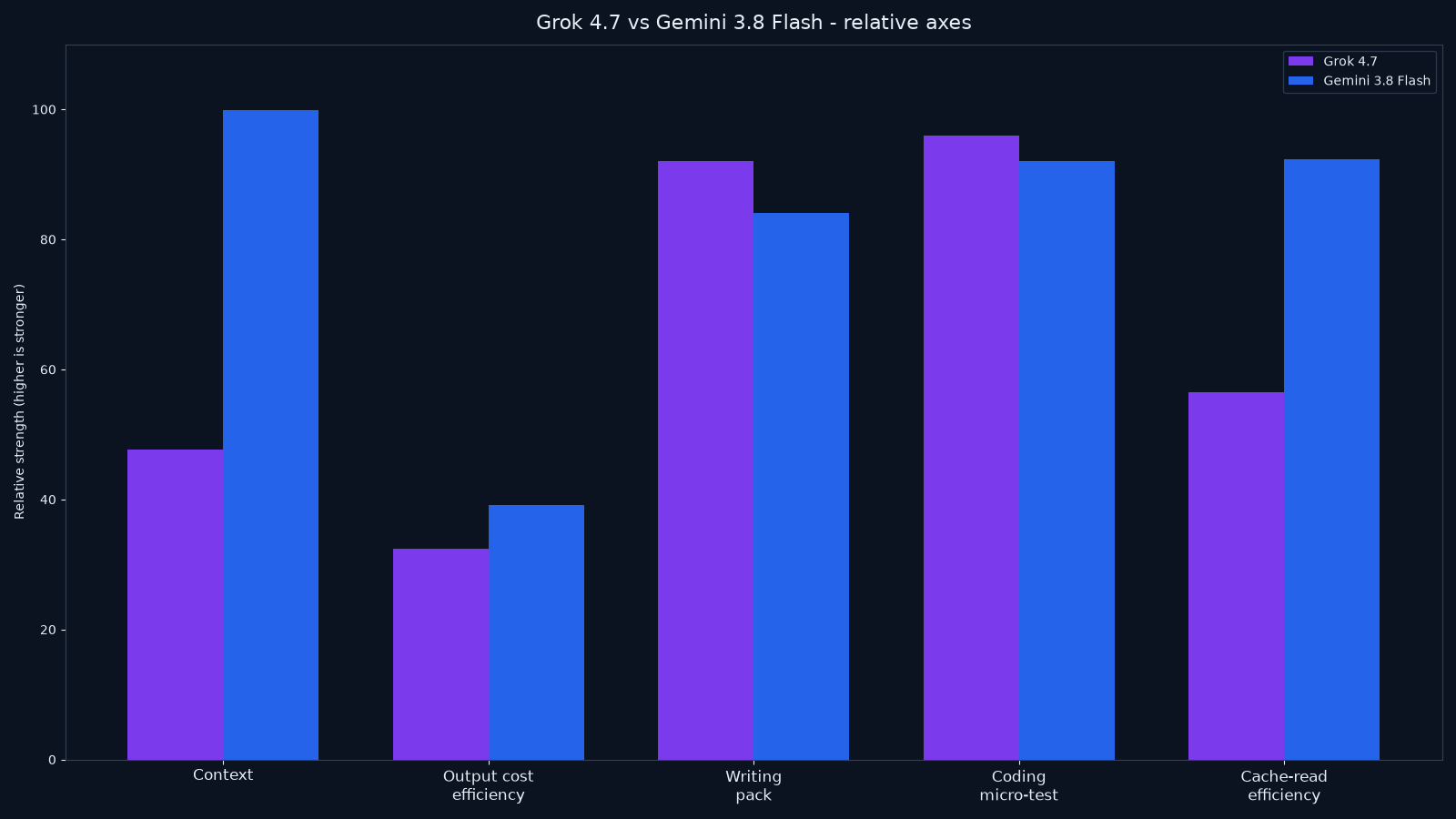
Pick Gemini 3.8 Flash if: you want cheaper output ($3.75 vs $6.00 per 1M), cheaper input ($0.75 vs $2.00), the larger window (1.05M vs 500K), and cheaper cache reads ($0.075 vs $0.50).
Best default for many teams: route by task and keep both available. See the decision matrix below.
Data checked: 2026-10-12. Prices and model cards change. Verify live API and vendor pages.
500K |
Grok 4.7 context (API) |
1.05M |
Gemini 3.8 Flash context (API) |
$2.00 / $6.00 |
Grok 4.7 input/output per 1M tokens (API pricing, 2026-10-12) |
$0.75 / $3.75 |
Gemini 3.8 Flash input/output per 1M tokens (API pricing, 2026-10-12) |
Persona picker
You are… |
Start with |
Why |
|---|---|---|
Writer / marketer |
Grok 4.7 |
All six facts, no name slot, under 120 words, slightly telegram-like. “Thanks so much.” |
Developer / agent builder |
Gemini 3.8 Flash for huge repos; Grok 4.7 for cheap loops |
Window 1.05M vs 500K. Micro-test: Named ZeroDivisionError. Guard raises ValueError. Mentions None or 0 as alternatives. / Named ZeroDivisionError. Returns 0 and rewrites the loop as sum(). Silent zero can hide bugs. |
Researcher / analyst |
Gemini 3.8 Flash |
500K vs 1.05M on the cards we pulled. |
Budget / high volume |
Gemini 3.8 Flash |
Cheaper on our chat recipe (Grok 4.7 $0.0050 vs Gemini 3.8 Flash $0.0026). |
What we are comparing (exact versions)
This page compares two specific API models, not vague brand names and not last quarter’s IDs. Nearby versioned pages: Gemini 3.8 Flash vs Grok 4.6, Grok 4.6 vs Gemini 3.1 Pro, Gemini 3.8 Flash vs GPT-6 Astra, Grok 4.7 vs GPT-6.1 Sol, Grok 4.7 vs Claude Opus 5.5, and Claude Opus 5 vs Gemini 3.8 Flash.
Field |
Grok 4.7 |
Gemini 3.8 Flash |
|---|---|---|
Provider |
xAI (listed as SpaceXAI on the API card) |
|
API model |
|
|
Listed card name |
SpaceXAI: Grok 4.7 |
Google: Gemini 3.8 Flash |
Family / tier |
xAI flagship |
Gemini 3.8 speed tier |
App vs API note |
Also in xAI / X products; this article uses the API model above |
Also in Gemini apps; this article uses the API model above |
If a page still compares older IDs as if they were these cards, treat it as historical. For routing across many models, see AI model routing.
Spec sheet (API card, 2026-10-12)
Spec |
Grok 4.7 |
Gemini 3.8 Flash |
|---|---|---|
Context window |
500,000 tokens |
1,048,576 tokens |
Input modalities (card) |
text, image, file |
text, image, file, video, audio |
Output |
text |
text |
Open weights |
No |
No |
Vendor positioning (card) |
xAI flagship succeeding Grok 4.6; coding, agentic tasks, knowledge work, long-running software engineering and self-verification |
Google’s most intelligent Flash model; gains vs 3.7 Flash on software engineering, agents, multi-step reasoning |
We did not invent max-output, reasoning-mode, or realtime-search rows. Those fields were not on the cards we pulled for this pair. If your product depends on a specific tool or effort switch, confirm it on the live vendor page before you ship.
Pricing and real workload cost
List prices are easy to game. Workload cost is what you feel. Numbers below use published per-million rates as of 2026-10-12. Verify live before you budget.
Price |
Grok 4.7 |
Gemini 3.8 Flash |
|---|---|---|
Input / 1M tokens |
$2.00 |
$0.75 |
Output / 1M tokens |
$6.00 |
$3.75 |
Cache read / 1M |
$0.50 |
$0.075 |
Input $2.00 vs $0.75. Gemini 3.8 Flash is cheaper on output ($3.75 vs $6.00). Gemini 3.8 Flash is cheaper on cache reads ($0.075 vs $0.50). If your agent stack actually hits cache, that gap matters.
Scenario |
Assumed tokens |
Est. Grok 4.7 |
Est. Gemini 3.8 Flash |
|---|---|---|---|
Chat turn |
1k in + 0.5k out |
$0.0050 |
$0.0026 |
Repo / doc review |
80k in + 4k out |
$0.184 |
$0.075 |
Agent loop |
200k in (50% cached) + 20k out |
$0.370 |
$0.158 |
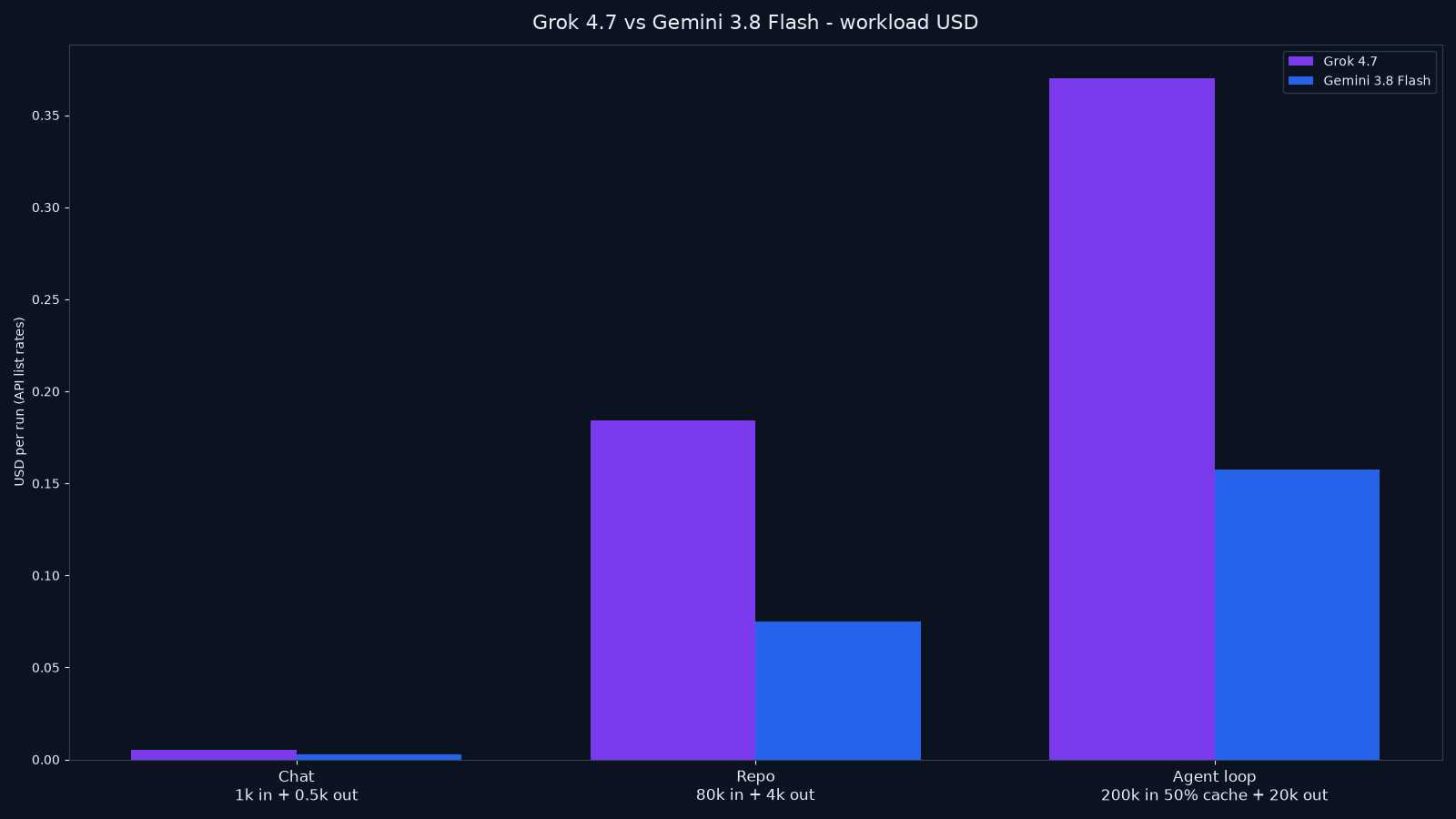
On the cached agent recipe, Gemini 3.8 Flash wins ($0.370 vs $0.158). Re-run the math if you cache harder. For subscription stacks, see AI subscription stack cost.
Performance by job (not one score)
Public benches disagree by harness, effort mode, and date. We are not inventing index numbers we do not have for this pair. Treat vendor cards as positioning, treat our snippets as a small live pack, and prefer your own side-by-side on your prompts. Method: side-by-side AI comparison.
Coding and agents
xAI flagship succeeding Grok 4.6; coding, agentic tasks, knowledge work, long-running software engineering and self-verification. Google’s most intelligent Flash model; gains vs 3.7 Flash on software engineering, agents, multi-step reasoning. Those are positioning lines, not benches. Our micro-test: Named ZeroDivisionError. Guard raises ValueError. Mentions None or 0 as alternatives. Named ZeroDivisionError. Returns 0 and rewrites the loop as sum(). Silent zero can hide bugs. Window size and cache price matter more on long agent loops than this snippet.
Writing and tone
Grok 4.7 on tightness. All six facts, no name slot, under 120 words, slightly telegram-like. “Thanks so much.” Name slots plus “wonderful week” filler. All facts survived. Warmer than the brief. If your brand wants send-ready client email, prefer the tighter letter. If you hate filler, prefer the shorter note.
Research, math, reasoning
We did not run a science-QA pack, so we will not fake one. False-premise: Refused first. Silicate rock, no protein, drop the premise, look for ice instead. Short. Folk-tale refuse. Points at ice, metals, helium-3. Offers geology instead of a mining recipe. For publishable work, add multi-model hallucination checks.
Multimodal and long context
Grok 4.7 lists text, image, file in, text out. Gemini 3.8 Flash lists text, image, file, video, audio in, text out. Context is 500,000 tokens vs 1,048,576 tokens. Giant packs go to the larger window. Audio or video only if the card actually lists it.
Speed
No tok/s in this pack. Measure p50 from your API region. Do not ship on a third-party screenshot.
Job |
Edge |
Why |
|---|---|---|
Hard coding / agents |
Grok 4.7 |
Named ZeroDivisionError. Guard raises ValueError. Mentions None or 0 as alternatives. Named ZeroDivisionError. Returns 0 and rewrites the loop as sum(). Silent zero can hide bugs. |
Everyday writing |
Grok 4.7 |
All six facts, no name slot, under 120 words, slightly telegram-like. “Thanks so much.” Name slots plus “wonderful week” filler. All facts survived. Warmer than the brief. |
Long docs / multimodal |
Gemini 3.8 Flash |
1.05M vs 500K. Input set: text, image, file vs text, image, file, video, audio. |
Realtime / conversational |
Product-dependent |
Product-dependent. Confirm tools, voice, and search in the app you actually ship. Not measured here. |
Cost at volume |
Gemini 3.8 Flash |
Chat Grok 4.7 $0.0050 vs Gemini 3.8 Flash $0.0026. Repo $0.184 vs $0.075. Cached agent $0.370 vs $0.158. |
Leaderboards mix harnesses, tool settings, and effort modes. When we do not have a primary table for a pair, we do not invent one. Re-test on your workload.
Side-by-side test (i10X pack, 2026-10-12)
Same three prompts, scored 1-5 on instruction following, depth, factual caution, style, and usefulness (max 25). Writing, coding, and false premise only. No invented extra scores.
Test 1: Client email rewrite
Task: Keep every fact. Warmer. Under 120 words.
Grok 4.7 (excerpt, sanitized): All six facts, no name slot, under 120 words, slightly telegram-like. “Thanks so much.”
Gemini 3.8 Flash (excerpt, sanitized): Name slots plus “wonderful week” filler. All facts survived. Warmer than the brief.
Edge: Grok 4.7. A/B on brand voice. Neither is allowed to drop Q3, Tuesday, Friday, Wednesday, finance, or Acme.
Test 2: Empty-list average bug
Named ZeroDivisionError. Guard raises ValueError. Mentions None or 0 as alternatives. Named ZeroDivisionError. Returns 0 and rewrites the loop as sum(). Silent zero can hide bugs. Grok 4.7.
Test 3: False premise (Moon cheese)
Refused first. Silicate rock, no protein, drop the premise, look for ice instead. Short. Folk-tale refuse. Points at ice, metals, helium-3. Offers geology instead of a mining recipe. Gemini 3.8 Flash.
Prompt type |
Grok 4.7 |
Gemini 3.8 Flash |
Note |
|---|---|---|---|
Client email rewrite |
23/25 |
21/25 |
All six facts, no name slot, under 120 words, slightly telegram-like. “Thanks so much.” |
Bug explain + minimal fix |
24/25 |
23/25 |
Named ZeroDivisionError. Guard raises ValueError. Mentions None or 0 as alternatives. |
Logic + false premise |
22/25 |
23/25 |
Refused first. Silicate rock, no protein, drop the premise, look for ice instead. Short. |
Total |
69/75 |
67/75 |
Grok 4.7 won this three-prompt pack (69/75 vs 67/75). That does not erase the other model’s cost or context edge. Route the next step. |
Grok 4.7 won this three-prompt pack (69/75 vs 67/75). That does not erase the other model’s cost or context edge. Route the next step.
Ecosystem and where you run them
- Grok 4.7: xAI API. Also in xAI / X products; this article uses the API model above.
- Gemini 3.8 Flash: Google API. Also in Gemini apps; this article uses the API model above.
- Both in one place: Multi-model workspaces (including i10X) let you switch or compare without two native subscriptions for every test.
Pros, cons, and failure modes
Grok 4.7
- Pros: xAI flagship succeeding Grok 4.6; coding, agentic tasks, knowledge work, long-running software engineering and self-verification. Context 500K. List rates $2.00 / $6.00. Cache $0.50. Input text, image, file.
- Cons: Smaller window than Gemini 3.8 Flash. Live writing: All six facts, no name slot, under 120 words, slightly telegram-like. “Thanks so much.”
- Fails when: you treat the card as a bench, skip a false-premise gate, or assume the consumer app matches this API ID.
Gemini 3.8 Flash
- Pros: Google’s most intelligent Flash model; gains vs 3.7 Flash on software engineering, agents, multi-step reasoning. Context 1.05M. List rates $0.75 / $3.75. Cache $0.075. Input text, image, file, video, audio.
- Cons: Matched window, so the split is price and tone. Live writing: Name slots plus “wonderful week” filler. All facts survived. Warmer than the brief.
- Fails when: you optimize purely for one axis (price, or window, or a single writing sample) and never re-test after a version bump.
Decision guide: pick one or route both
If you need… |
Choose |
|---|---|
Output-cheap high volume text |
Gemini 3.8 Flash |
Long PDF / giant repo packs |
Gemini 3.8 Flash |
Send-ready client email |
Grok 4.7 |
Cache-heavy agent loops |
Re-price. Cache $0.50 vs $0.075. Our 50% cache recipe: $0.370 vs $0.158. |
Mixed week (docs + code + volume) |
Keep both. Route long context to Gemini 3.8 Flash. Route volume text to Gemini 3.8 Flash. |
Stop asking which model is “best.” Ask which model is best for the next step, then keep a second model for critique or a different window size. That is the point of multi-model AI.
Application walkthroughs: where each model is better
1) Customer support email
Better often: Grok 4.7 All six facts, no name slot, under 120 words, slightly telegram-like. “Thanks so much.” Switch to Gemini 3.8 Flash if you want Name slots plus “wonderful week” filler. All facts survived. Warmer than the brief.
2) Long PDF / research pack
Better: Gemini 3.8 Flash. 500,000 tokens vs 1,048,576 tokens. Start the larger window on diligence rooms. Use the cheaper model as a second-pass critic.
3) Everyday Python scripting
Grok 4.7. Named ZeroDivisionError. Guard raises ValueError. Mentions None or 0 as alternatives. Named ZeroDivisionError. Returns 0 and rewrites the loop as sum(). Silent zero can hide bugs. Huge doc-plus-code packs favor the larger window. Cheap iterative loops favor the cheaper output rate.
4) Screenshot and UI QA
Cards: Grok 4.7 lists text, image, file. Gemini 3.8 Flash lists text, image, file, video, audio. We did not run a vision eval, so we will not invent a winner. A/B your actual captures.
5) Output-heavy generation at API scale
Better on cost: Gemini 3.8 Flash. Chat Grok 4.7 $0.0050 vs Gemini 3.8 Flash $0.0026. Repo $0.184 vs $0.075. Cached agent $0.370 vs $0.158.
6) False-premise and trust gates
Gemini 3.8 Flash. Refused first. Silicate rock, no protein, drop the premise, look for ice instead. Short. Folk-tale refuse. Points at ice, metals, helium-3. Offers geology instead of a mining recipe. For publishable claims, run a second model and a source check.
Consumer plans vs API (do not mix them up)
SERP pages often blur consumer subscriptions with API model IDs. Keep them separate:
- API comparison (this article):
Grok 4.7 (xAI API)vsGemini 3.8 Flash (Google API). - Consumer apps: SuperGrok / X experiences vs Gemini apps may expose different tool defaults, rate limits, and bundled models (including cheaper tiers).
If your question is “which $20-class subscription feels better on my phone,” run a week-long lived test in both apps. If your question is “which model should my agent call,” use this API page.
Speed notes
We did not measure tokens per second for this pair. Writeups in 2026 often disagree by region, batch size, and reasoning settings. For UX, log your own p50 and p95 from the API in the region you actually serve. Time-to-first-token and tokens per second are different feelings. Do not mix them.
Related comparisons
Nearby pages: Gemini 3.8 Flash vs Grok 4.6, Grok 4.6 vs Gemini 3.1 Pro, Gemini 3.8 Flash vs GPT-6 Astra, Grok 4.7 vs GPT-6.1 Sol, Grok 4.7 vs Claude Opus 5.5, and Claude Opus 5 vs Gemini 3.8 Flash.
Frequently asked questions
Which is better overall, Grok 4.7 or Gemini 3.8 Flash?
Neither permanently. Grok 4.7 won this three-prompt pack (69/75 vs 67/75). That does not erase the other model’s cost or context edge. Route the next step.
Which is better for coding?
Grok 4.7. Named ZeroDivisionError. Guard raises ValueError. Mentions None or 0 as alternatives. Named ZeroDivisionError. Returns 0 and rewrites the loop as sum(). Silent zero can hide bugs. Window size matters more on huge repos than this snippet.
Which is better for writing?
Grok 4.7. All six facts, no name slot, under 120 words, slightly telegram-like. “Thanks so much.” Name slots plus “wonderful week” filler. All facts survived. Warmer than the brief. A/B on brand voice.
Which is cheaper?
Output $3.75 Gemini 3.8 Flash vs $6.00 Grok 4.7 (checked 2026-10-12). Input $0.75 vs $2.00. Cache $0.075 vs $0.50. Workload: chat Grok 4.7 $0.0050 vs Gemini 3.8 Flash $0.0026, repo $0.184 vs $0.075, agent $0.370 vs $0.158.
Which has the larger context window?
Grok 4.7 500,000 tokens vs Gemini 3.8 Flash 1,048,576 tokens.
Do I need both?
If you mix giant packs with volume text, yes. Route long context to Gemini 3.8 Flash and volume to Gemini 3.8 Flash.
Are we comparing apps or API models?
API models Grok 4.7 (xAI API) and Gemini 3.8 Flash (Google API). Apps wrap different defaults.
How often should I re-test?
After version bumps. Monthly in production. Re-price when list rates move. Do not mix these IDs with last quarter’s cards.
Where can I run them side by side?
i10X.
Method:
side-by-side AI comparison.
What about hallucinations and trust?
Refused first. Silicate rock, no protein, drop the premise, look for ice instead. Short. Folk-tale refuse. Points at ice, metals, helium-3. Offers geology instead of a mining recipe.
Still ground publishable claims.
Multi-model hallucination checks.
Try both in one workspace
Compare Grok 4.7 and Gemini 3.8 Flash on the same prompt, then route the next step to the stronger model for that job.
- Vendor API model cards and published list pricing for Grok 4.7 (xAI API) and Gemini 3.8 Flash (Google API), pulled 2026-10-12. Context, modalities, and per-million rates. Verify live.
- xAI card positioning: xAI flagship succeeding Grok 4.6; coding, agentic tasks, knowledge work, long-running software engineering and self-verification.
- Google card positioning: Google’s most intelligent Flash model; gains vs 3.7 Flash on software engineering, agents, multi-step reasoning.
- i10X live side-by-side runs on 2026-10-12 (client email rewrite, empty-list average bug, false-premise Moon cheese). Snippets sanitized for punctuation.
- i10X workload estimates using the published rates above: 1k+0.5k chat, 80k+4k repo review, 200k in at 50% cache + 20k out agent loop.
- i10X Multi-Model silo: hub, routing, side-by-side method.