Comparison · January 2026
The News
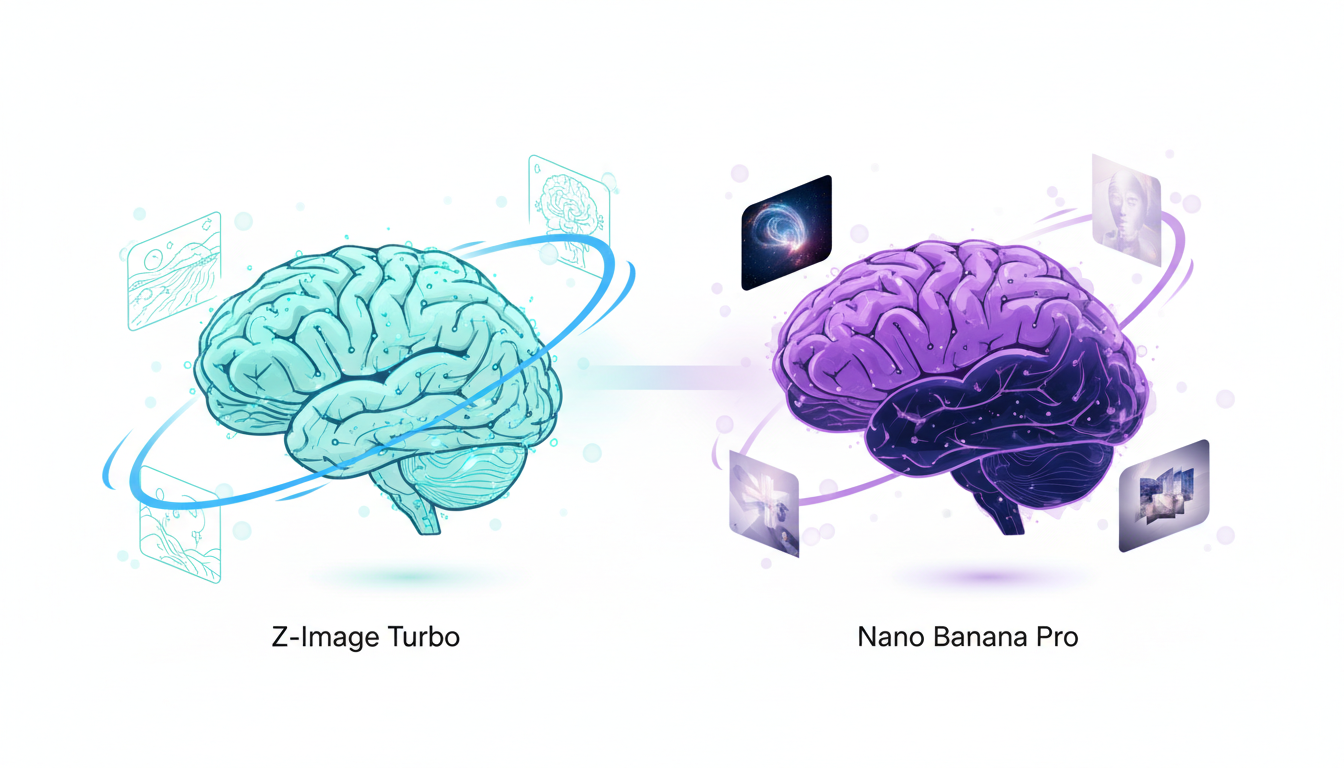
Ever wondered if you could squeeze high-end AI image creation onto your everyday laptop without breaking a sweat? That's where Z-Image Turbo comes in – a 6B parameter model from Alibaba's Tongyi MAI team, built for sheer efficiency with sub-second inference on consumer-grade 16GB VRAM setups. Just to clarify, VRAM means Video Random Access Memory, the kind of specialized graphics card memory that handles image rendering and those heavy AI calculations without a hitch. On the flip side, Nano Banana Pro (Gemini 3 Pro Image) plays in a more upscale league, delivering smoother, higher-quality results that outshine Z-Image Turbo overall. What tips the scales for Z-Image Turbo, though, is its open-source vibe and the option to run it right on your own hardware – a stark contrast to Nano Banana Pro's closed API setup. And an API? That's basically Application Programming Interface, a bridge of rules letting software tap into services, usually via the web.
Short Analysis of Both Models / AI Systems
Z-Image Turbo
Have you ever needed an AI tool that doesn't demand a data center to get going? Z-Image Turbo fits that bill perfectly – an open-source, 6B parameter model all about speed, efficiency, and running locally without fuss. (Parameters, by the way, are those tweakable elements in an AI that let it pick up on data patterns over time.) It's tailored for folks who want quick outputs and the flexibility to customize via LoRA training. LoRA stands for Low-Rank Adaptation, a smart way to fine-tune models without overhauling everything from scratch – efficient, right?
Nano Banana Pro (Gemini 3 Pro Image)
What if quality trumped everything else, no matter the trade-offs? Nano Banana Pro (Gemini 3 Pro Image) embodies that – a closed-source, premium powerhouse zeroed in on top-notch image quality and that final polished touch. It's aimed at users who crave elite results and don't mind skipping the local hosting part.
Detailed Comparison
Feature | Z-Image Turbo | Nano Banana Pro (Gemini 3 Pro Image) |
|---|---|---|
Performance/Quality | Solid for its compact size, though it doesn't quite match Nano Banana Pro's refined edge. | Top-shelf polish and quality across the board. |
Speed / Latency | Blazing sub-second inference using just 8 NFEs (Number of Function Evaluations). NFEs track the computational steps in diffusion-based AI image generation processes. | Details aren't out there, but expect it to lag a bit from its bigger footprint. |
Accuracy / Reasoning | Impressive at sticking to prompts and drawing on real-world knowledge. | Outstanding – it's in the elite tier for sure. |
Feature Differences | Open-source freedom, LoRA training support, and spot-on bilingual (English/Chinese) text rendering. | Locked-down API with exceptionally clean, final outputs. |
Ideal Use Cases | Quick, streamlined image creation, local runs, and tailored LoRA tweaks. | Scenarios where peak quality can't be compromised. |
Limitations | Doesn't hit the same quality heights as Nano Banana Pro. | No open access, can't deploy locally, and customization feels limited. |
Pros & Cons
Z-Image Turbo Pros and Cons
Pros
- Lightning-fast sub-second inference times
- Works seamlessly on everyday hardware like 16GB VRAM cards
- Fully open-source with easy local deployment options
- Handles bilingual (English/Chinese) text rendering like a pro
- LoRA training built-in for those personal customizations
- Keeps costs down – way more budget-friendly to operate
Cons
- Image quality and finesse fall short of Nano Banana Pro's level
- At 6B parameters, it might stumble in super intricate scenes now and then
Nano Banana Pro Pros and Cons
Pros
- Unmatched image quality with that professional polish
- A leader in the pack for photorealistic outputs
- Powered by Google's robust Gemini 3 Pro backbone
Cons
- Stuck behind a closed-source API
- No chance for local setup
- Probably pricier and slower to generate (though not spelled out, it's a fair guess from the scale)
Comparison Table
Aspect | Z-Image Turbo | Nano Banana Pro (Gemini 3 Pro Image) |
|---|---|---|
Performance | Reliable quality geared toward efficient workflows | Elevated polish and lifelike photorealism |
Speed | Sub-second results on 16GB VRAM hardware | Tends to take longer, thanks to its heftier build |
Features | Open-source perks, LoRA compatibility, bilingual text handling | API-only access with premium, refined results |
Ideal Use Cases | On-site, bulk production, or fine-tuned custom work | High-profile gigs demanding flawless visuals |
Expert Opinion from i10x.ai
From what I've seen in the trenches of AI tools, go for Z-Image Turbo if you're a developer or running a lean operation that craves speed, affordability, and the control of local runs – it's a game-changer for churning out volumes or tweaking with custom apps. That said, if you're in creative fields or handling big-league projects where every pixel counts, Nano Banana Pro is your pick; its crisp, professional finish really elevates things like marketing visuals, leaving little room for anything less than perfect. It's about matching the tool to your real-world needs, after all.
Compare models in one workspace
Run ChatGPT, Claude, Gemini, and Grok side by side in i10X — from $20/month.
Open Chat Arena →