Quick Take
- Summary: AI Studio from Reallusion leverages ByteDance’s SeeDance and multi-model workflows to transition 3D animation away from text-based “prompt roulette” toward deliberate, spatial AI directing.
- What happened: Rather than relying on simple text-to-video generation, this new integration allows creators to use professional 3D pipeline tools to dictate camera angles, character motion, and staging. AI steps in as a rendering and acceleration engine, not a slot machine.
- Why it matters now: Zero-shot generative video models (like Sora or Runway Gen-3) are hitting a ceiling in professional utility. They still struggle with sequence continuity and spatial control. “AI Directing” bridges the gap by showing that actual production needs deterministic multi-modal pipelines, not just better LLM prompt interpretation.
- Who is most affected: 3D artists, indie studios, and virtual production teams will see pre-visualization costs plummet. At the same time, foundational model builders are being served notice that enterprise value lies in granular API integration, not purely web-based chat interfaces.
- The under-reported angle: This signals a fundamental shift in AI compute infrastructure. Moving from cloud-based text-to-video to real-time, human-in-the-loop AI rendering nested within engines like Unreal and Blender shifts the demand curve back toward massive, localized GPU workstations and specialized render farms.
Deep Dive
Have you ever typed a promising prompt into a text-to-video tool and watched it fall apart on frame three? The initial era of generative AI video was defined by that kind of serendipity. Typing “a cinematic tracking shot” into an engine and hoping for the best is an awe-inspiring party trick, but it is a fundamental failure for commercial production. Professional pipelines cannot budget for serendipity; they run on continuity, persistent assets, and exact spatial control.
The emergence of 3D AI Directing, spearheaded by platforms like Reallusion’s AI Studio in partnership with ByteDance’s SeeDance, marks the maturation of generative video from a prompt-first lottery to a director-first workflow. By integrating multi-model AI logic directly into established 3D and animation ecosystems (like iClone, Character Creator, or Blender), developers are solving the most painful bottleneck of AI video: the lack of statefulness. In a multi-model workflow, the AI does not have to guess what a character looks like from a different angle or hallucinate the physics of a walk cycle. The human director provides the precise blocking, geometry, and camera metadata, and the AI acts as a sophisticated, real-time texture, lighting, and motion-enhancement engine. It is the evolution of AI from a chaotic standalone creator to a compliant co-pilot in the prevailing virtual production tech stack.
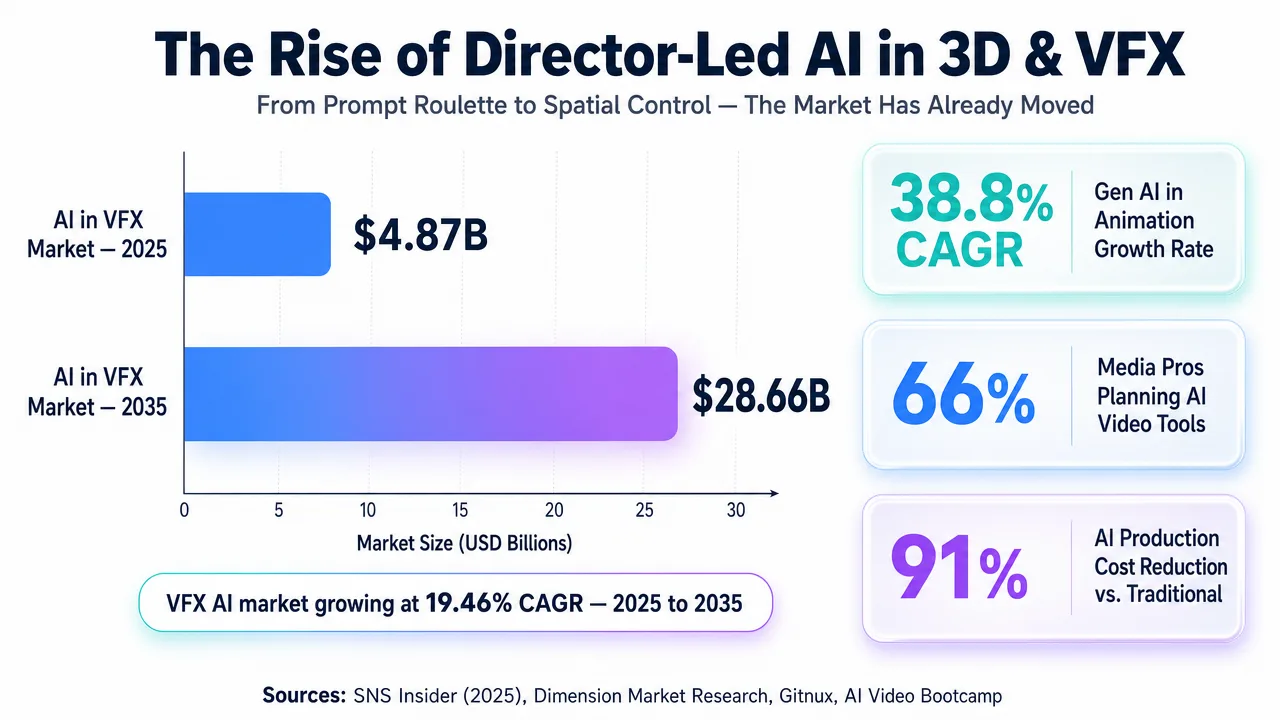
This shift alters the trajectory of AI tooling in a meaningful way. While foundational vendors like OpenAI and Google have focused on scaling model parameters to improve raw video realism, the professional market is demanding “steerability.” A smaller, highly responsive model that seamlessly ingests spatial coordinates and rigid motion data from Unreal Engine is infinitely more valuable to an indie VFX studio than a massive, unsteerable black-box generator. That operational reality elevates the importance of human-in-the-loop software design, establishing a new standard where “prompt engineering” gives way to AI-assisted cinematography.
Furthermore, this multi-model integration creates ripples in both AI infrastructure and compliance policy. On the hardware front, bridging real-time 3D environments with heavy diffusion models requires specialized compute orchestration—often forcing studios to hybridize local high-end GPU workstations with burst-capable cloud-rendering solutions. Legally, deterministic AI workflows introduce new nuances into copyright and model safety. When an artist dictates the geometry, camera movement, and timing, and merely relies on the AI to interpolate the pixels, the resulting output holds a much stronger claim to human authorship than raw text-to-video generations.
Stakeholders & Impact
- AI Foundational Makers — Impact: High. Insight: Exposed to the reality that pure text-to-video models lack professional utility without middleware for spatial metadata integration.
- VFX & Indie Studios — Impact: High. Insight: Massive reduction in pre-visualization and block-out costs. Replaces unpredictable prompt generation with manageable, director-led output.
- Infrastructure & Compute — Impact: Medium. Insight: Shifts inference demand. Driving AI rendering directly inside intensive 3D pipelines requires extreme local network throughput or potent local GPUs.
- Legal & IP Regulators — Impact: Significant. Insight: Tests the boundaries of copyright. AI utilized as an interpolation tool for human-directed 3D blocking strengthens the argument for human authorship.
About the analysis
Researched and written with AI assistance under the editorial responsibility of the i10X News team. The title image is an AI-generated illustration. Read our AI Use Policy. Spotted an error? Request a correction.
This is an independent, research-based analysis synthesizing market signals on 3D AI pipelines, multi-model video generation, and the transition from prompt-driven to director-driven interfaces. It is designed to help CTOs, creative technologists, and AI infrastructure planners understand the next wave of professional generative integration.
i10x Perspective
The transition to 3D AI directing proves that the future of applied generative AI is not “zero shot” but “high control.” From what I’ve seen, as the hype cycle surrounding text-to-video cools, the enterprise winners will not necessarily be the companies that train the largest foundational models. The real advantage will go to middleware players who successfully bind those models to deterministic physics engines. Moving forward, observers should watch how giants like Meta, Google, and OpenAI adapt their APIs. If they cannot securely ingest complex 3D metadata natively, they will be relegated to the bottom of the stack—serving only as the dumb rendering engines for a new class of intelligent spatial software.