Quick Take
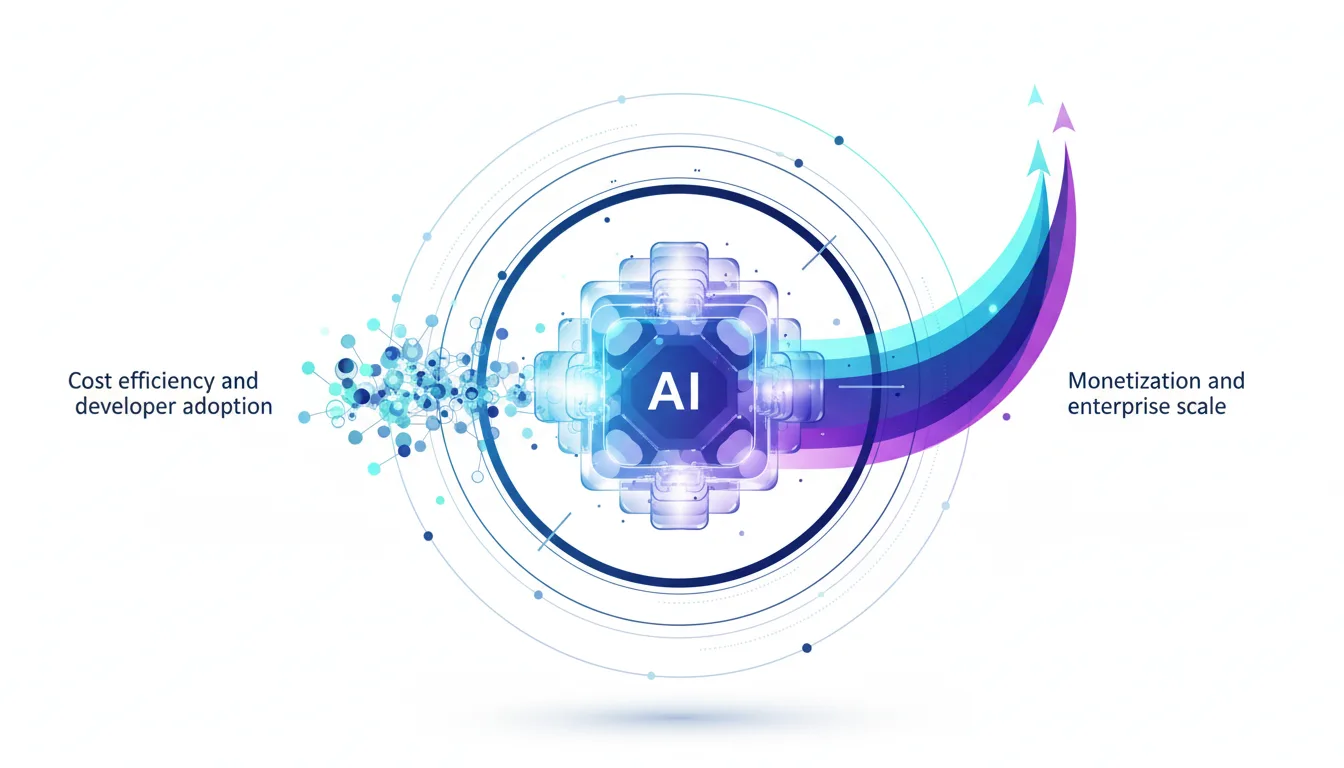
DeepSeek just cleared a $1 billion annualized revenue run rate after lifting its API prices. The move shows the efficiency-obsessed Chinese lab shifting from chasing users to actually getting paid.
Summary: DeepSeek’s run rate has roughly doubled in a few months, and reports point to a $7.5 billion funding round on the horizon. Much of the jump traces back to those recent price increases rather than pure volume growth.
What happened: The Information broke the story first. DeepSeek’s forward revenue metric crossed the billion-dollar line thanks to the hikes plus steady enterprise interest in its lean models.
Why it matters now: Even the poster child for cheap inference is testing how much customers will tolerate. As the company eyes an IPO, the real question is whether it can charge more without losing the developers who made it popular.
Who is most affected: Enterprise CTOs recalculating inference budgets, rival labs like OpenAI and Anthropic, and investors sizing up that $7.5 billion round.
The under-reported angle: Headlines blur “run rate” with actual revenue. A billion-dollar run rate often just multiplies one strong month by twelve. Real cash booked is probably far lower, so valuations rest on the bet that higher prices won’t send developers elsewhere.
Deep Dive
DeepSeek reaching a $1 billion ARR (annualized revenue run rate) stands out in the broader AI race. The figure has climbed from around $500 million just months earlier, lining up with talk of that big funding round and possible IPO plans. Unlike the early volume plays from other labs, this latest leap comes from a straightforward decision: the company raised API prices.
Retail briefs and big outlets ran with the “$1 billion revenue” line as proof of explosive growth. Private-market watchers, though, are looking harder at the numbers. There’s a real gap between an annualized run rate—stretching one good month across a year—and the revenue actually recognized, which sat closer to $70 million earlier in 2024. That gap shows how much AI valuations still lean on narrative and momentum instead of audited cash flow.
The price-hike math fills in the rest. DeepSeek first won over developers by delivering strong performance at a fraction of what GPT-4 or Claude 3.5 cost to run. Raising rates now is a direct test of pricing power. The key issue is whether the company can lift average revenue per user and margins without losing the high-volume usage that built its reputation.
This goes beyond a simple update. It marks a shift in how open-weights models try to compete. If these efficient models can hold higher prices, it supports a different path from the heavy datacenter bets of US hyperscalers. It also shows DeepSeek turning global interest in its work into real enterprise commitments, even with export controls still in place.
The harder test will be keeping that run rate once budgets get scrutinized. Procurement teams will compare the new pricing against running Meta’s Llama on their own hardware. If usage holds up, DeepSeek moves from interesting research project to a commercial player that can influence market terms.
Stakeholders & Impact
| Stakeholder / Aspect | Impact | Insight |
|---|---|---|
| AI / LLM Providers | High | Shows cost-efficient models can move toward higher margins, pressuring OpenAI and Anthropic’s premium approach. |
| Enterprise CTOs & Devs | High | Inference budgets need fresh math; the low-price phase is giving way to standard commercial rates. |
| Private Market Investors | High | The $1B ARR story helps justify the $7.5B round and sets expectations for any IPO. |
| AI Infrastructure & Cloud | Medium | Stronger monetization by smaller labs keeps hardware demand alive, but pushes focus toward efficient inference rather than raw scale. |
About the analysis
Researched and written with AI assistance under the editorial responsibility of the i10X News team. The title image is an AI-generated illustration. Read our AI Use Policy. Spotted an error? Request a correction.
This independent review pulls from financial reports, investor notes, and market data to break down what sits behind DeepSeek’s latest metrics. It’s meant for CTOs, AI strategists, and analysts watching how these models actually make money and compete.
i10x Perspective
DeepSeek’s decision to raise prices marks the close of the “growth at any cost” chapter in AI. The sector is moving toward protecting margins and watching unit economics more closely. When a lab known for efficiency can charge more and keep users, it strengthens the case for lean, open-weights work over massive capital spending by the big cloud players. In the next few years, the real question is whether this pricing holds up against smaller, highly optimized models running locally or at the edge.