Quick Take
- Summary: Enterprise tech giants and AI startups are aggressively pivoting their product messaging toward “AI agents,” sparking an industry-wide race to define and capture the future of autonomous AI workflows.
- What happened: Major players like Google Cloud, Oracle, IBM, and Meta are rolling out heavily integrated agentic architectures – systems capable of reasoning, planning, memory, and autonomous tool execution – pushing the market far beyond the limits of basic text-generation chatbots.
- Why it matters now: As foundational LLMs rapidly commoditize, the real economic value in AI is shifting from pure model intelligence to the workflow execution layer. Whoever controls the “agent runtime” that orchestrates real-world business actions will secure the next decade of enterprise budgets.
- Who is most affected: CIOs, enterprise developers, and cloud infrastructure providers who must build, govern, and supply the massive inference compute required to power these continuous, multi-step autonomous workflows.
- The under-reported angle: The industry is deliberately blurring the line between a simple tool-using LLM and a true AI agent. Real agents require sophisticated state management and stopping criteria. Without them, enterprises face catastrophic failure modes like infinite logic loops, hallucinated API calls, and degraded context limits.
Deep Dive
Have you ever watched a vendor presentation and wondered if the word “agent” still means what it did six months ago? Every major software vendor is now aggressively rebranding their AI offerings under the banner of “AI agents.” Yet as recent strategic pushes from Meta, Google Cloud, and IBM reveal, the definition itself has become a heavily contested enterprise battleground. We are witnessing a fundamental shift: the move from conversational assistants that generate answers to autonomous systems designed to pursue user-defined goals, break them into executable steps, and take approved actions across external software.
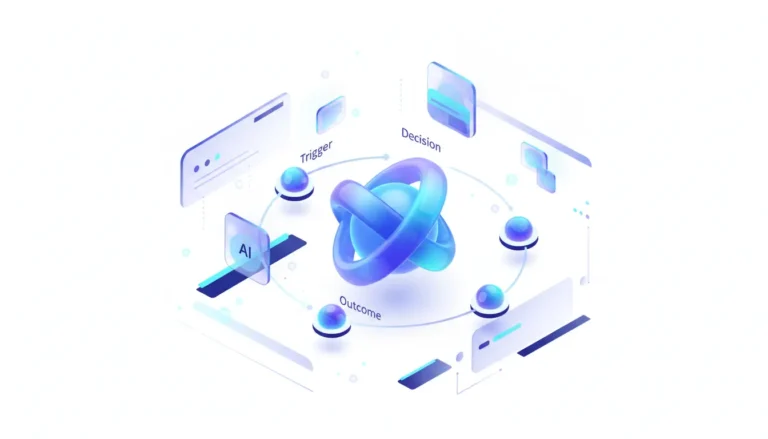
From what I’ve seen, a critical myth still lingers in the market – bolting a web-search API onto a Large Language Model does not magically create an AI agent. A true agentic system relies on a complex architecture built around reasoning, planning, and memory. It needs an orchestrator capable of managing short-term task state, conducting dynamic retrieval-augmented generation (RAG) against long-term enterprise knowledge bases, and executing function calls without losing context. A chatbot responds to a prompt. An AI agent monitors its own output, evaluates success against a goal, and adapts its plan if a tool fails.
This is exactly why cloud and infrastructure behemoths like Google and Oracle are embedding agent creation studios natively into their ecosystems. They recognize that the agent itself is becoming the new operating system. By integrating agentic runtimes directly into enterprise resource planning (ERP) databases and cloud workloads, these providers are not just selling AI – they are locking in the orchestration layer. In this model, an AI agent acts as a unified translation layer between a company’s raw data, its API ecosystem, and its human workforce.
That said, the glossy enterprise marketing glosses over the friction of production-grade autonomy. As organizations move from single-agent workflows to complex multi-agent systems – where specialized models collaborate, debate, and pass data to one another – the risk of failure modes multiplies. Without rigorous evaluation metrics like tool-call accuracy and explicit stopping criteria, autonomous workflows are prone to brittle execution, unsafe data exposure, and infinite loops. This reality is forcing the industry to rapidly mature its governance frameworks, elevating the importance of “human-in-the-loop” approval points, strict permission boundaries, and verifiable AI safety layers.
The rise of agentic AI will dramatically reshape global AI infrastructure in the years ahead. Unlike a one-off query to a chatbot, an autonomous agent pursuing a complex goal requires continuous, multi-step inference. This shift from “bursty” text generation to sustained “background execution” will exert unprecedented strain on data center capacity, driving an urgent need for low-latency chipsets, advanced memory architectures, and grid-scale energy solutions capable of supporting an automated, always-on AI workforce.
Stakeholders & Impact
| Stakeholder / Aspect | Impact | Insight |
|---|---|---|
| AI / LLM Providers | High | Shifting from chat interfaces to API-driven “agentic runtimes,” forcing a focus on reasoning and tool-calling benchmarks rather than just raw conversational fluency. |
| Cloud & Infrastructure | High | Multi-agent workflows will drive explosive, continuous inference demand, requiring lower-latency chipsets and fundamentally altering how cloud compute is provisioned. |
| Enterprise IT & CIOs | High | Must navigate the severe governance and security nightmare of deploying autonomous software that has live read/write access to proprietary company databases. |
| Knowledge Workers | Medium–High | Transitioning rapidly from “prompt engineers” to “agent supervisors” whose primary role is to define goals, configure guardrails, and audit automated execution loops. |
About the analysis
Researched and written with AI assistance under the editorial responsibility of the i10X News team. The title image is an AI-generated illustration. Read our AI Use Policy. Spotted an error? Request a correction.
This independent, research-based analysis synthesizes enterprise vendor positioning, AI capability frameworks, and search intent data to demystify the rapidly evolving agentic AI landscape. It is engineered for CTOs, product leaders, and developers looking to look past the marketing hype and architect resilient, true AI agent ecosystems.
i10x Perspective
The race to build and deploy AI agents is ultimately a battle for the next enterprise operating system. As models evolve from passive intelligence to active execution layers, the compute strain and security risks placed on underlying AI infrastructure will multiply exponentially. Over the next five years, the reliability of the memory architecture, the low-latency orchestration of the cloud, and the ironclad safety guardrails of the agents built on top of them will form the defining competitive moat.