Opera’s launch of WebAI marks a clear shift in how artificial intelligence reaches users, moving the core work of LLM inference away from distant cloud servers and onto the browser itself. By baking local models such as Google Gemma and Apple’s on-device foundation models into Opera One, the company is pushing to make browser-level AI compute a standard practice, which in turn changes both the cost structure and the privacy picture for developers and users.
Quick Take
- The infrastructure shift: Opera WebAI bypasses centralized cloud APIs, allowing websites and extensions to query small, open-weight language models running entirely on the user’s local hardware.
- The developer unlock: The feature introduces built-in AI endpoints—specifically the Prompt, Decision, and Semantic Embeddings APIs—letting developers build AI web features without incurring cloud inference costs.
- The model agnostic approach: Rather than locking into one provider, WebAI supports multiple architectures, natively leveraging Apple’s foundation models on Apple Silicon and Google’s Gemma on supported Windows PCs.
- The cloud vs. edge divide: This highlights a growing bifurcation in the Opera ecosystem: Aria remains the cloud-connected, heavy-compute assistant, while WebAI acts as a zero-latency, highly private runtime for daily web interactions.
What happened
Opera has officially rolled out an early preview of WebAI, a feature that allows its browser to download, host, and run AI models locally. Initially available on Opera One—with plans to expand to the gaming-focused Opera GX and the experimental Opera Neon—the opt-in feature turns the browser into an on-device AI inference engine.
Once enabled, WebAI downloads the necessary model weights directly to the user’s machine. Supported models at launch include Google Gemma and, for Mac users on Apple Silicon, Apple’s own on-device foundation models. The system stays entirely opt-in and works under a site-specific permission model, so users keep tight control over which sites can trigger local processing.
Crucially, Opera is offering this not just as a browser feature but as a proposed web standard. It introduces three developer interfaces: the Prompt API for text generation, the Decision API for content classification and clickbait detection, and the Semantic Embeddings API for mapping relationships between data points.
Why it matters now
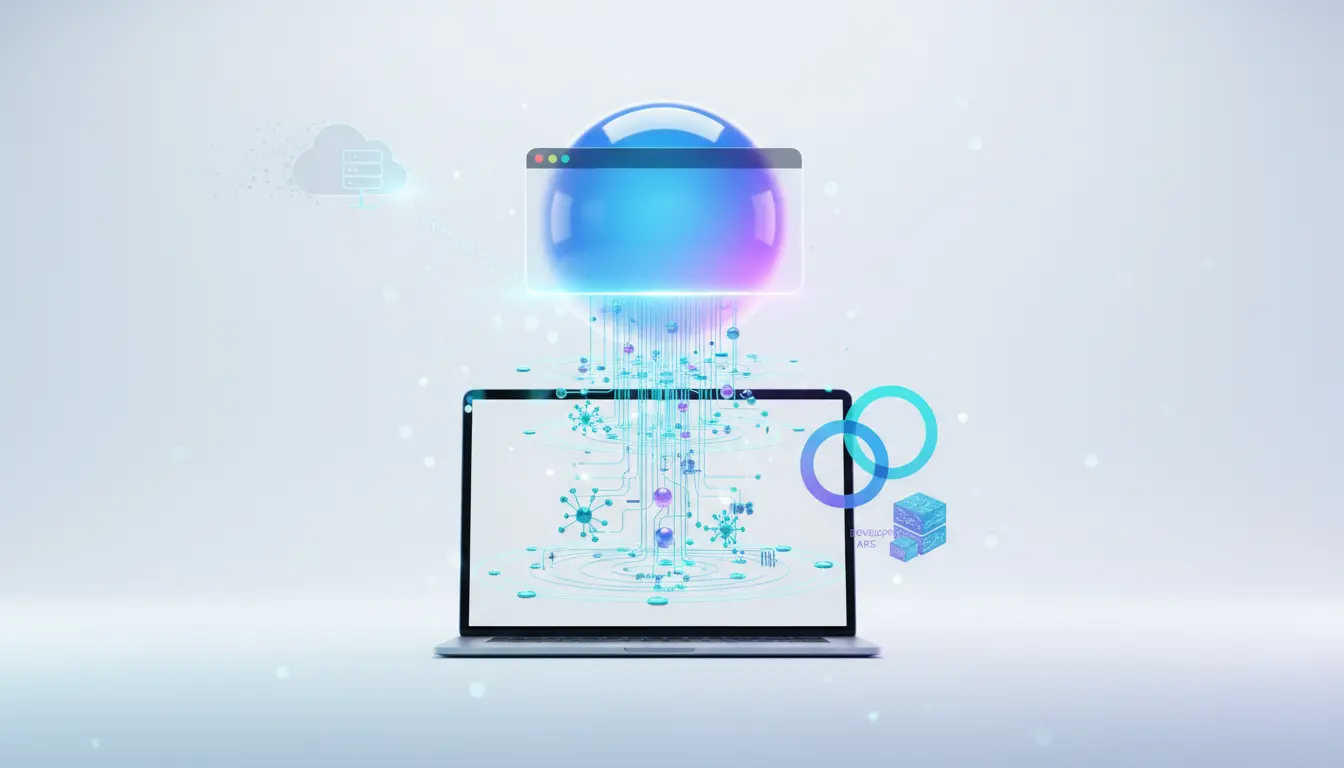
Today’s web AI setup depends almost entirely on cloud infrastructure. When a site wants to summarize text or sort data, it usually calls an external server via API, which adds cost for the developer, draws power in data centers, and sends user data to a third party. Opera WebAI rewires that flow by moving inference to the edge and turning the browser into a lightweight AI platform.
For developers this lowers the bar. Someone building a tab organizer or a job-matching tool no longer needs an OpenAI or Anthropic key; they can call Opera’s native Semantic Embeddings API and let the user’s own hardware handle the work. The launch also spotlights the hardware side of the AI race. It skips older Intel Macs and Windows on Arm devices for now, showing that modern edge AI increasingly needs specialized chips such as Apple’s M-series or newer AI-PC silicon. As these capabilities spread, the hardware baseline for ordinary browsing is quietly rising.
Who is most affected
The immediate impact of WebAI falls on web developers, privacy-conscious consumers, and the cloud AI providers that depend on high volumes of API calls. Because WebAI runs without a subscription or mandatory cloud account, it lowers the barrier for local AI use.
| Stakeholder | Impact | Why |
|---|---|---|
| Web & Extension Developers | High | Gain free, standardized access to AI classification and text generation without managing backend infrastructure or API costs. |
| Privacy-focused Consumers | High | Can leverage LLM capabilities locally. No data leaves the laptop, bypassing privacy concerns tied to cloud inference. |
| Cloud AI API Providers | Moderate | As basic tasks (classification, summarization) move to the browser edge, API providers may lose low-level inference volume. |
| Legacy Hardware Users | Negative | Users on older Intel Macs or Arm-based Windows devices are excluded from the initial preview due to hardware constraints. |
About the analysis
Researched and written with AI assistance under the editorial responsibility of the i10X News team. The title image is an AI-generated illustration. Read our AI Use Policy. Spotted an error? Request a correction.
This is an independent i10x analysis built for developers, AI founders, and infrastructure strategists tracking the shift from cloud-dependent LLMs to local, edge-based AI compute. It synthesizes official company announcements, API documentation, and industry reporting to map the commercial and technical impact of browser-native AI.
- Opera Launches WebAI, Bringing Local AI Models to Its Browsers
- WebAI: Local AI for the web, now in Opera
- Opera doubles down on local AI, shipping models directly in its browsers
- Opera One now lets Mac users run Apple’s AI model directly in the browser
- Opera wants websites to run AI on your laptop instead of sending your data to the cloud
i10x Perspective
The browser is no longer just a window to the internet; it is rapidly becoming an AI runtime environment. By championing local AI as a proposed web standard, Opera is testing a decentralized future where the billions of edge devices connected to the web act as a massive, distributed intelligence grid. If WebAI’s API structures are adopted industry-wide, we will see a profound decoupling: massive, reasoning-heavy models will stay in the cloud, while the daily, operational intelligence of the web runs silently, privately, and for free directly on your laptop.