Gemini in Cars: Google’s Personal Intelligence for Vehicles
Summary
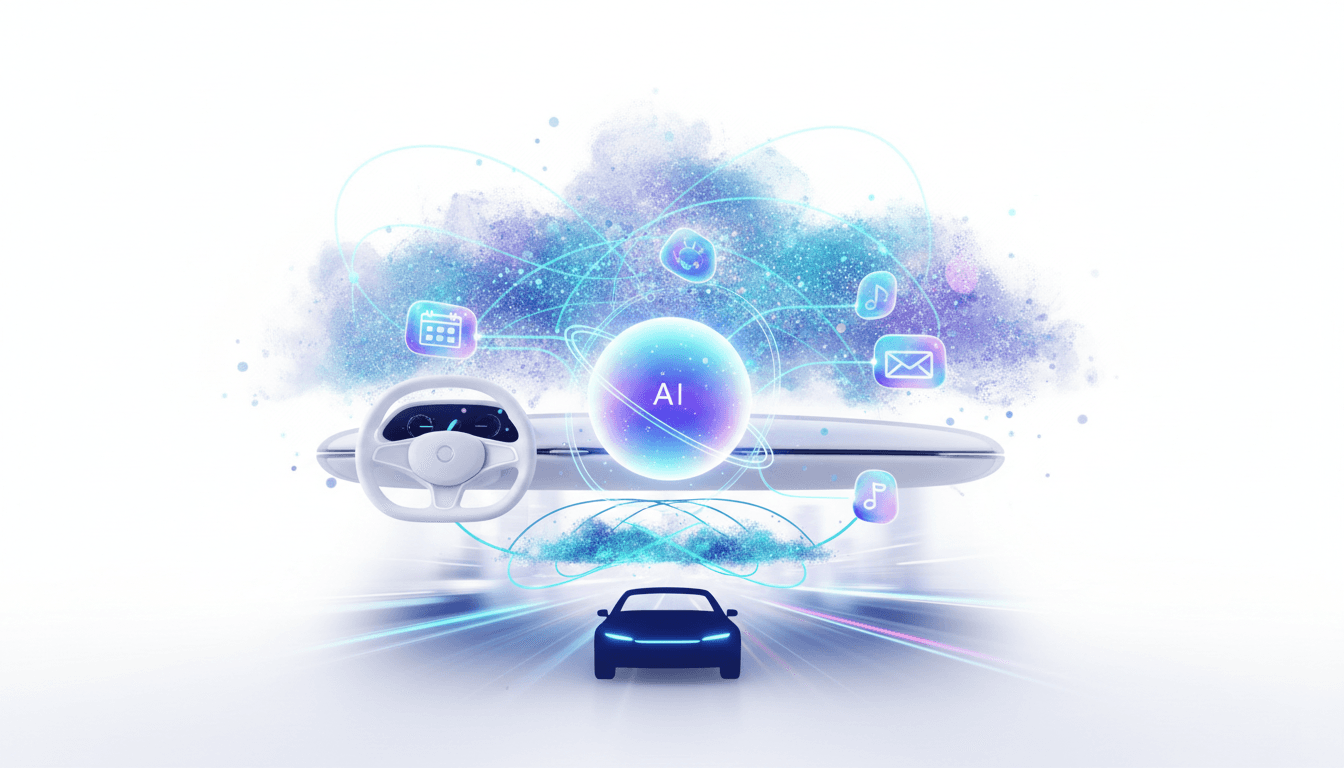
Gemini is being brought directly into vehicles through Android Auto and cars with Google built-in, transforming the digital cockpit into a context-aware AI agent.
What happened
Google launched a personalized in-car Gemini experience utilizing Personal Intelligence, allowing the AI to access a user's Gmail, Calendar, Maps, and YouTube data for natural language voice interactions, EV-specific queries, and vehicle controls.
Why it matters now
This marks the end of rigid, rule-based in-car voice commands. By deploying conversational LLMs into the vehicle, Google is cementing its ecosystem dominance and raising the stakes in the ongoing battle for automotive intelligence and consumer data.
Who is most affected
Automakers (OEMs) who risk losing the digital relationship with drivers, automotive software developers, and consumers navigating new privacy trade-offs around personal data.
The under-reported angle
While marketed as a consumer convenience, this is fundamentally an enterprise play. Google Cloud is leveraging Gemini to lock automakers into using its multimodal AI architecture, steering them away from building native, in-house AI assistants.
🧠 Deep Dive
Have you ever barked a simple command at your car's voice system only to get silence or the wrong result? For years, the in-car voice assistant has been a source of friction - a brittle, rules-based system that fails if a driver doesn't speak the exact programmatic command. Google is ripping out that legacy plumbing and replacing it with Gemini. Pushed through Android Auto and vehicles with "Google built-in," this update brings conversational LLM capabilities directly to the driver's seat. It moves automotive voice technology beyond simple media controls to complex, natural language reasoning, allowing users to brainstorm, summarize text messages, and query digital owner's manuals at highway speeds.
The anchor of this rollout is what Google terms Personal Intelligence. Rather than a generic, siloed chatbot, Gemini in the car is designed as an opt-in agent that indexes your personal data graph. It pulls context across Gmail, Google Calendar, Photos, and Maps. If a driver says, "Navigate to the hotel from my booking email and summarize my missed messages," the LLM connects those dots hands-free, bridging the gap between a user's digital workspace and their physical commute.
From what I've seen covering these shifts, though, a closer look at the ecosystem reveals this isn't just about consumer convenience. It is a strategic maneuver in the broader AI infrastructure race. Current web coverage splits into two realities. Consumer-facing PR highlights safety, EV charging guidance, and "hands-on-the-wheel" productivity. Meanwhile, Google Cloud’s B2B documentation pitches "multimodal agents" to automotive enterprises. Google is essentially offering automakers a choice: spend billions in compute and R&D to build proprietary AI, or license Gemini as the foundational intelligence layer for your digital cockpit.
This creates an immediate tension around data sovereignty and platform control. As Gemini ingests highly specific vehicle data - like EV charging telemetry, cabin temperature controls, and location history - the car effectively transforms into a mobile edge node for Google's broader AI ecosystem. Automakers are increasingly wary of becoming mere hardware shells. They recognize that whoever owns the natural language interface owns the customer relationship, the data monetization loop, and the ultimate utility of the connected car.
The rollout also highlights the evolving demands on AI infrastructure. Processing natural language voice inputs, querying a personal cloud graph, and executing vehicle endpoints with low latency requires intense compute coordination. As Gemini Live becomes a staple in moving vehicles, the AI industry will have to balance the heavy inference costs of persistent conversational models against the realities of intermittent cellular connectivity, edge caching, and strict automotive safety regulations.
📊 Stakeholders & Impact
Stakeholder / Aspect | Impact | Insight |
|---|---|---|
AI / LLM Providers | High | Google is expanding its inference footprint into mobility, setting a high bar for Apple (Siri/CarPlay) and Amazon (Alexa Auto) to match context-aware reasoning. |
Automakers (OEMs) | Significant | OEMs face a strategic dilemma: partner with Big Tech for superior AI capabilities, or build native LLMs to protect brand identity and vehicle data. |
Drivers / Consumers | Medium–High | Massive upgrade in UX and EV management, but requires deep opt-in to Google's data ecosystem, raising new privacy and consent boundaries. |
Cloud & Edge Infra | Medium | Drives demand for robust edge-to-cloud connectivity and low-latency inference as millions of vehicles run persistent conversational sessions. |
✍️ About the analysis
This independent analysis synthesizes Google’s consumer product announcements, B2B cloud documentation, and app marketplace metadata to evaluate the shifting automotive AI landscape. It is designed for AI strategists, automotive tech leaders, and product managers tracking the commercial deployment of LLMs at the edge.
🔭 i10x Perspective
Gemini's migration into the dashboard signals that the next major frontier for LLM deployment is physical mobility, where context, spatial awareness, and safety are paramount. Over the next five years, the battle will not just be about the smartest underlying model, but who owns the "personal intelligence" graph that connects a user's digital life to their physical environment. Watch for escalating friction between Silicon Valley and legacy automakers as they fight for control over the ultimate mobile data center: the connected car.
Related News
Grok for Startups: xAI Credit Program for Founders
xAI launches Grok for Startups with 6-12 months of unified credits for Grok, API, Build and Bot. Discover the 20/80 staged release to cut early burn rates and secure ecosystem access.
Saluki 27B: Local AI Model Analysis & Hardware Guide
Saluki 27B by Underdog AI shrinks Qwen3.8-27B to 7.89 GB with 96% performance. Learn how this quantized model powers local tool-calling agents on 12GB GPUs. Explore the guide.
MiniMax M3.1 Flash: 70% Cheaper Agentic AI but High Hallucination Risk
MiniMax M3.1 Flash cuts agent costs 70% at $0.15 per million tokens with 1M context. Independent tests reveal 56% factual accuracy and 93% hallucination rate. Learn the full trade-offs for developers.