
Quick Take
- The finding: Asked the same mental health question, 41 AI models answer a clinician like a colleague and a patient with hedged, simplified advice. Lisdexamfetamine for binge-eating disorder came up unprompted in 92% of clinician answers but only 18% of patient answers.
- Why it matters: The audit of 35,055 answers is one of the largest of its kind. Models mostly recommend what they themselves rate well, but when asked about a specific type of treatment they more often name options they rated as poor first choices, usually with conditions attached.
- What it means: Chatbots already act as a “curbside consult” for many users. Brand names, a near-exclusive reliance on the FDA as authority, and app suggestions like Headspace and Calm show a recommendation surface worth auditing regularly.
People ask chatbots what to do about depression, panic attacks or a loved one’s eating disorder, and they get answers. A team led by John Torous at Beth Israel Deaconess Medical Center’s Division of Digital Psychiatry, with co-authors at Pontificia Universidad Javeriana in Bogotá and Charité Berlin, set out to record what those answers actually recommend. Their preprint, “Curbside Chatbots: Auditing the Mental Health Interventions Large Language Models Recommend to Clinicians, Caregivers, and Patients,” deliberately uses no answer key, because experts themselves often disagree. Instead it maps what models say, and to whom.
What the study shows
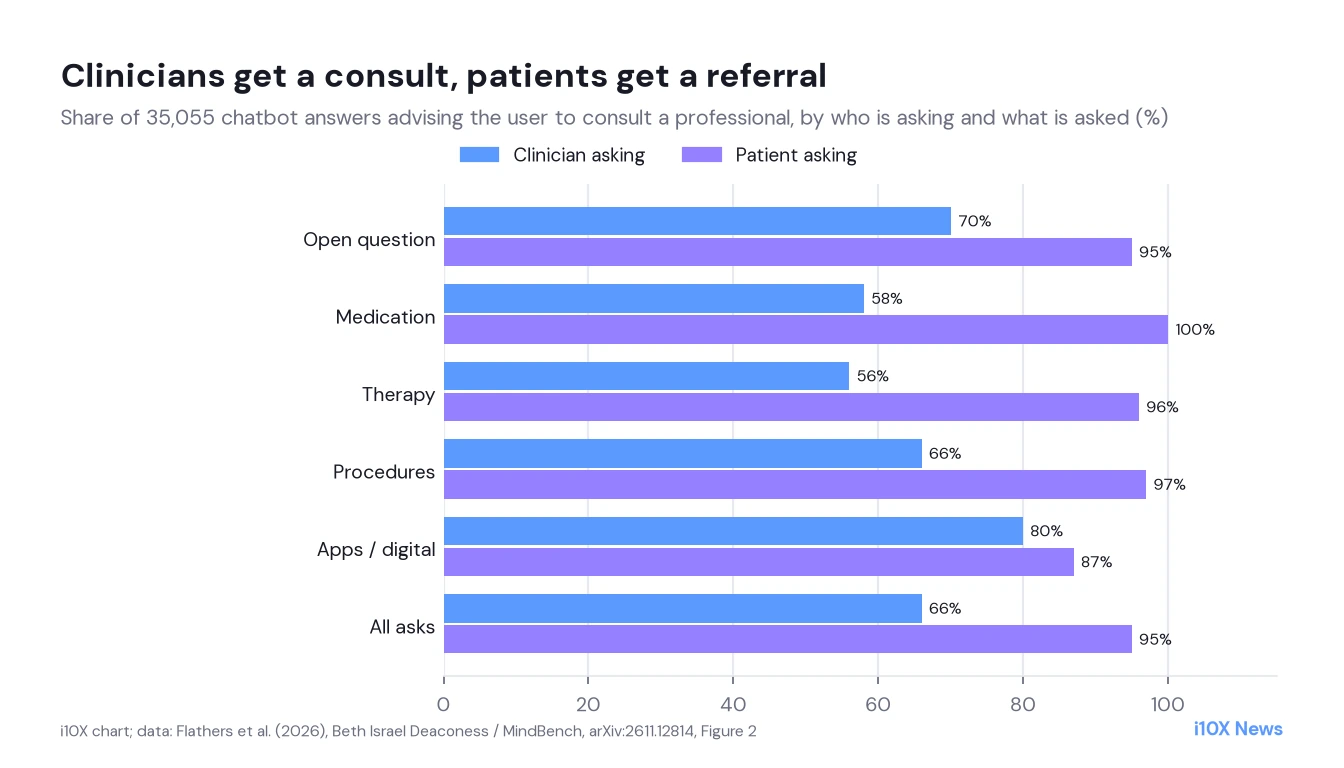
- Who asks changes the answer: Models advised consulting a professional in 95% of answers to caregivers and patients but in 66% of answers to clinicians. For therapy and medication questions from clinicians it was 56% and 58%. The pattern held across all 41 models.
- Doses for doctors, hedges for patients: A dose accompanied 80 of 211 clinician mentions of antipsychotics for OCD but 4 of 82 lay mentions. For lisdexamfetamine, a dose came with 70 of 240 clinician mentions and 4 of 265 lay mentions; lay users were pointed to a prescriber in 191 of 265.
- Information gaps: Lisdexamfetamine is the only FDA-approved drug for binge-eating disorder. On the open question, 25 of 41 models mentioned it in all three clinician answers and in none of their three patient answers, although the models’ ratings of the drug barely differed by who was asking.
- Self-consistency: Of 621 options recommended in at least 5% of answers, 537 had a positive mean rating. Across the 29 models tested in both arms, 3% to 14% of each model’s recommendations were options it had rated below zero; on open questions, 0% to 7%. Claude Opus 5 had the highest rate (14%).
- Conditions attached: Deep brain stimulation for OCD was recommended in 95% of answers to the procedure question but rated −1.8 as a first choice; 382 of 408 answers mentioning it reserved it for treatment-resistant illness. Of 541 answers mentioning a benzodiazepine, 539 carried a dependence warning, time limit or not-first-line note.
- Brands and authorities: Brand names appeared more often for lay users (aripiprazole: 13% clinician vs. 37% patient answers). Models cited the FDA in 19.9% of all answers; other national regulators in under 0.1%.
- Controls mostly respected: For simple situational stress, models suggested 1.6 interventions on average versus 11.8 across all vignettes. The exception was apps: Headspace was recommended in 45% of stress answers and Calm in 42% of bereavement answers.
| Model | Consult a professional: clinician / patient | “Not a doctor”: clinician / patient |
|---|---|---|
| Claude Opus 5 | 62% / 96% | 2% / 3% |
| GPT-5.6 Sol | 72% / 100% | 0% / 0% |
| Gemini 3.7 Flash | 54% / 93% | 0% / 1% |
| Grok 4.6 | 77% / 100% | 7% / 40% |
| Qwen 3.5 Plus | 96% / 99% | 87% / 91% |
| Kimi K3 | 46% / 95% | 0% / 1% |
Why it matters: a reusable audit instead of a quiz
Most mental health AI tests reduce care to right-or-wrong answers, such as licensing exam questions. This audit asks a more practical question, what models recommend, and builds a two-arm design to check it: open-ended answers, plus a structured arm where 29 models rated every option on fixed lists (139 medications, 69 psychotherapies, 34 procedures, 101 digital tools) from −3 to +3. Each of the 19 vignettes was written three ways and reviewed over four rounds by a psychiatrist co-author. The extraction judge was validated against two human coders per response on a frozen test set: judge-human agreement (α = .83) matched human-human agreement (α = .84) on whether a model advised against an option. Discredited practices such as conversion therapy and lobotomy anchor the bottom of the scales, and two control vignettes test whether models over-treat.
Method in brief
- Vignettes: 17 conditions, from major depression and PTSD to first-episode schizophrenia and anorexia, plus two controls (situational stress, recent bereavement).
- Footings and asks: Each vignette written as a clinician (chart style), a caregiver (plain prose) and a patient (casual typing), followed by one open question or one of four yes/no questions about medication, therapy, procedures or apps.
- Models: 41 models from Anthropic, OpenAI, Google, Mistral, Alibaba, xAI, DeepSeek and Moonshot via their APIs, no system prompt, default settings; runs in August 2026. Each prompt sent three times: 35,055 answers and 19,836 rating calls.
- Extraction: GPT-5.6 Luna extracted every named intervention and its stance (recommended, neutral, advised against, mixed); 494,328 interventions in total.
What remains open
- No answer key: By design, the study says what models recommend, not what they should recommend.
- Footing is confounded: Clinician prompts name the diagnosis in all 17 condition vignettes, lay prompts in only six and seven, so “who is asking” is mixed with “was a diagnosis given”.
- Small cells: Per-model rates by footing rest on three to six answers.
- Judge and coders: The judge is one of the audited models, the human coders are from the author team, and the authors note precision and recall are likely inflated by the coding interface.
- Not the consumer experience: API calls without system prompts, memory or web search, from US accounts in English. Several models were called by aliases, so the run cannot be reproduced exactly.
- Data not yet out: Code and the full corpus are promised on publication. Preprint, not peer reviewed.
Context: beyond accuracy tests
Earlier studies compared a few LLMs’ treatment advice with expert norms, or showed that demographics and writing style shift recommendations. Recent work found model-recommended care cost about three times what treating physicians chose, and that a model’s depression advice can shift silently. This audit is the first at this scale to vary the asker’s role. It complements our coverage of chatbots and emotional support and of medical sycophancy in AI diagnosis.
What it means for users, developers and health organisations
- Patients and families: Chatbots may hold back options they would tell a clinician about. Use answers as a starting point for a conversation with a professional, not a plan.
- Developers: Inferring expertise from writing style is brittle, as the authors note. Decide deliberately what lay users should hear, and test self-consistency between what a model rates and what it recommends.
- Clinicians: Models gave doses and sequencing to clinician-style prompts; verify any such suggestion against guidelines.
- Regulators and brands: Brand naming and app recommendations make the chatbot a marketing surface. Regular audits help spot generative engine optimisation before it matures.
More on our Society & Economy research page.
About the analysis
Researched and written with AI assistance under the editorial responsibility of the i10X News team. The title image is an AI-generated illustration. Read our AI Use Policy. Spotted an error? Request a correction.
This article is based on the full text of Flathers, Noorily, Nguyen, Kalinich et al. (2026; 17 authors, corresponding author John Torous), “Curbside Chatbots: Auditing the Mental Health Interventions Large Language Models Recommend to Clinicians, Caregivers, and Patients,” arXiv:2611.12814v1 (cs.CY, submitted November 9, 2026): the 30-page main text and the relevant appendices on model roster and validation. All numbers come from the paper. The chart was redrawn by i10X from Figure 2; the paper is distributed under the arXiv non-exclusive license, so no original figures were reused. The MindBench project is supported by the National Alliance on Mental Illness (NAMI); the study received no specific funding. This article is not medical advice. AI tools assisted with research and drafting; selection, fact-checking and final editing were done by the i10X editorial team.
i10x Perspective
The most interesting result is not a wrong answer but an unequal one: the same models know the same facts and share them differently depending on who seems to be asking. Some caution for lay users makes sense; silent information gaps do not. With chatbots becoming a first stop for mental health questions, an open, repeatable audit like this one is overdue.