Quick Take
- The finding: Most people did not set out to use a chatbot for emotional support. It grew gradually out of practical use, often at moments when therapists, friends or family were not available.
- Updates hurt: Routines users built around a chatbot were disrupted by model updates, public debate about AI harms and changes in their own lives. One participant who lost an AI companion rebuilt it on another platform and refused to rebuild it on the original one.
- What it means: Developers control the models people come to rely on. The authors argue that changes to a chatbot’s behavior should account for the adjustments users will have to make.
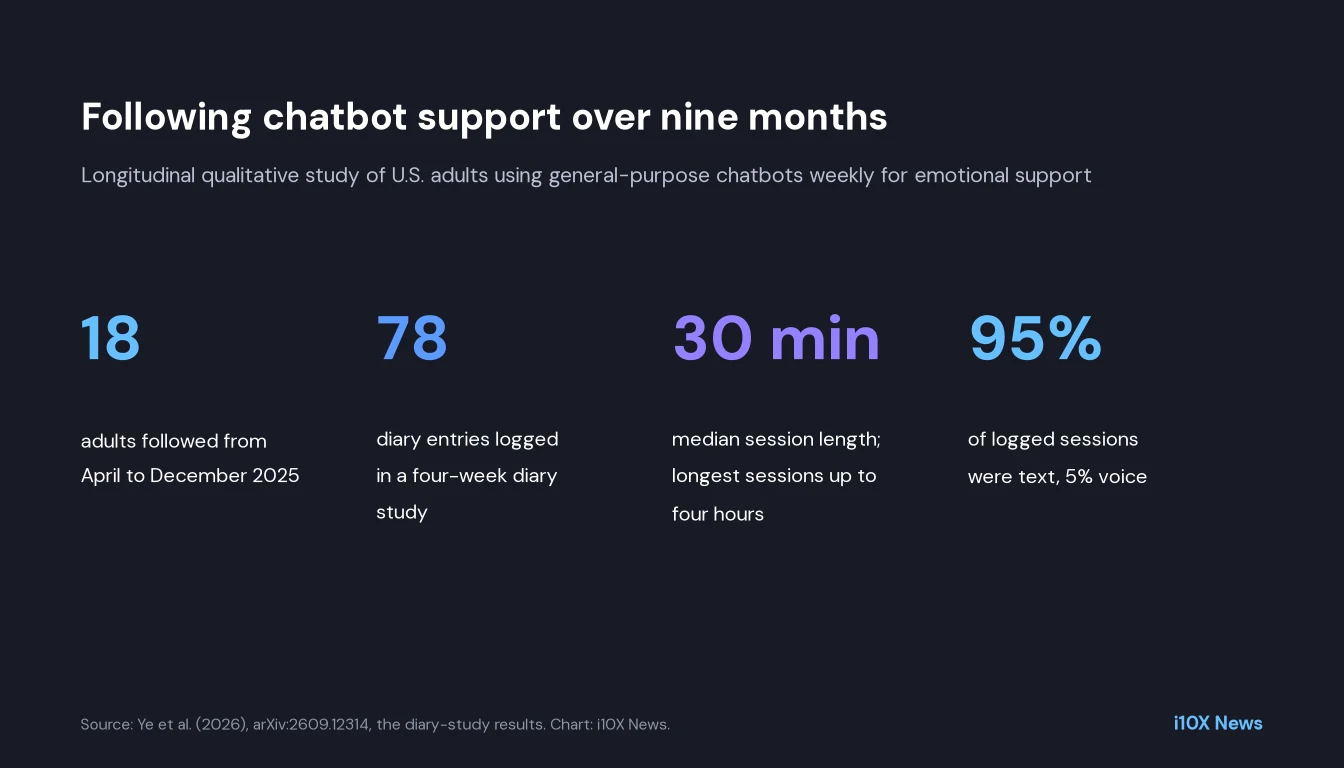
General-purpose chatbots such as ChatGPT, Claude and Gemini were not designed as mental-health tools, yet many people use them that way. Most studies capture this in a snapshot. Researchers from Carnegie Mellon University and the Data & Society Research Institute instead followed 18 U.S. adults from April to December 2025, a period in which OpenAI replaced GPT-4o with GPT-5 as ChatGPT’s default and described the new model as better at avoiding “unhealthy levels of emotional reliance”.
What the study shows
The multi-stage qualitative study combined initial interviews, a four-week diary study, focus groups and exit interviews. Eligibility required using a chatbot for mental or emotional health at least weekly. The authors describe trajectories rather than averages: how a chatbot comes to occupy a socioemotional role in someone’s life, and what changes that role.
- It starts with emails: Participants typically met chatbots through work or productivity tasks. One used ChatGPT to polish professional emails before asking it whether to leave his job; another began after a layoff. Most could not say when personal use began.
- It fills gaps: The chatbot became useful when other support was unavailable, for example when therapy was unaffordable, and took a place alongside therapists, friends, family and self-care.
- Routines and boundaries: Participants built routines and limits around their use and often stayed critical of the systems. In 78 diary entries, the median session lasted about 30 minutes; per-person medians ranged from 11 minutes to two and a half hours, and the longest sessions lasted up to four hours. Nearly all use was alone and at home, and 95% of sessions were text-based.
- Disruption from outside: Model changes, news about AI harms and changes in employment, therapy or relationships repeatedly forced participants to renegotiate how they used the chatbot.
- Reliance can persist: Some participants took their needs elsewhere; others kept using the chatbot even after deciding they should use it less, depending on what other support they had.
Why it matters: support depends on product decisions
Users invest effort in shaping a chatbot to meet their needs, but the company decides which model and features they get. A safety-motivated update, such as reducing emotional reliance, can still remove an established source of support overnight. The study shows that this is not a hypothetical: it happened during the research period.
The longitudinal design also captures factors that one-off evaluations of a single conversation miss: the person’s history with the chatbot, their access to care and what is happening around them.
Method in brief
Participants took part in initial interviews, a four-week structured diary study (recording chatbot, model, subscription, modality, duration and purpose after each relevant interaction), focus groups and exit interviews; some shared chat logs. Diary participants received $200 and interview and focus group participants $50 per session. Two coders independently coded each transcript using grounded theory and triangulated across data sources.
What remains open
- Small, self-selected sample: Eighteen people who use chatbots weekly for emotional health, and who are likely more reflective than average. The authors make no claims of representativeness.
- U.S. context: All participants live in the U.S., so experiences reflect its healthcare system and norms about seeking care.
- A moving target: The models changed during the study. The findings describe a particular moment in the technology’s development.
- No clinical outcomes: The study describes experiences, not whether chatbot use improved or harmed mental health.
Context
Surveys suggest nearly one in five U.S. adolescents and young adults have used AI chatbots for mental-health advice, and platform-scale analyses show affective use is concentrated among a minority of heavy users. This study adds the time dimension. Related work on AI and wellbeing is collected in our Society & Economy and Safety & Alignment sections.
What it means for chatbot developers
- Plan for established reliance: When changing model behavior in sensitive conversations, consider how existing users will adjust, not just how new conversations will look.
- Evaluate over time: Single-session safety tests miss how use develops. Longitudinal evaluation catches routines, dependence and disruption.
- Support changing roles: Good design helps users shift the role a chatbot plays in their life, including using it less, rather than locking it in.
About the analysis
Researched and written with AI assistance under the editorial responsibility of the i10X News team. The title image is an AI-generated illustration. Read our AI Use Policy. Spotted an error? Request a correction.
This article is based on the full text of the preprint “”I Felt Very Seen, But Still Very Alone”: Longitudinal Trajectories of General-Purpose LLM Use for Socioemotional Support” (arXiv:2609.12314v1, submitted September 11, 2026). All numbers are taken from the paper’s text, tables and figures; i10X did not rerun the experiments. The chart was redrawn by i10X from the diary-study results of the paper, which is published under a CC BY-NC-ND 4.0 license.
i10x Perspective
The title quote captures the tension well: a chatbot can make someone feel understood without replacing human connection. What makes this study valuable is its timing. It caught a real model transition in the middle of people’s routines and showed that even well-meant safety changes land on users who have built habits, sometimes relationships, around a product. As AI companies tighten how their models handle emotional conversations, this is a strong argument for treating continuity of support as part of the design brief.