Quick Take
- The finding: In a multinational company with 12,040 employees, workers who started using Microsoft 365 Copilot initiated about 1.4 more hours of collaboration per month in the first three months than comparable colleagues who never adopted it.
- Wider networks: Adopters reached about 2.2 more distinct colleagues, mostly through meetings and calls, and their personal networks became less clustered, i.e. they reached beyond their usual circle.
- The explanation offered: The authors argue that people use colleagues to check and validate AI-assisted work. That mechanism is inferred, not observed: the study sees who met whom, not what was discussed.
A common fear about generative AI at work is that it replaces the colleague: why ask someone when the assistant answers instantly? A new preprint by Giuseppe Soda and Alessandro Iorio (Bocconi University) and Daniele Rizzo (SDA Bocconi School of Management) tests this with behavioral data from a real company rather than surveys. Over 13 months, they tracked how Copilot adoption changed whom employees contacted and how much time they spent collaborating. The result points the other way: AI users became more connected, not less.
What the study shows
The data cover one business unit of a large multinational consumer-products company from September 2024 to September 2025. Collaboration and Copilot use were both recorded passively in Microsoft Viva Insights, from separate systems. After excluding 172 people who already used Copilot at the start, the sample had 1,992 adopters and 9,876 never-adopters. The main outcome, “generated collaboration hours”, counts meeting, call, email and chat time that a worker initiates, not time spent in meetings others called.
| Outcome (per worker and month) | Average effect, first 3 months after adoption | p-value |
|---|---|---|
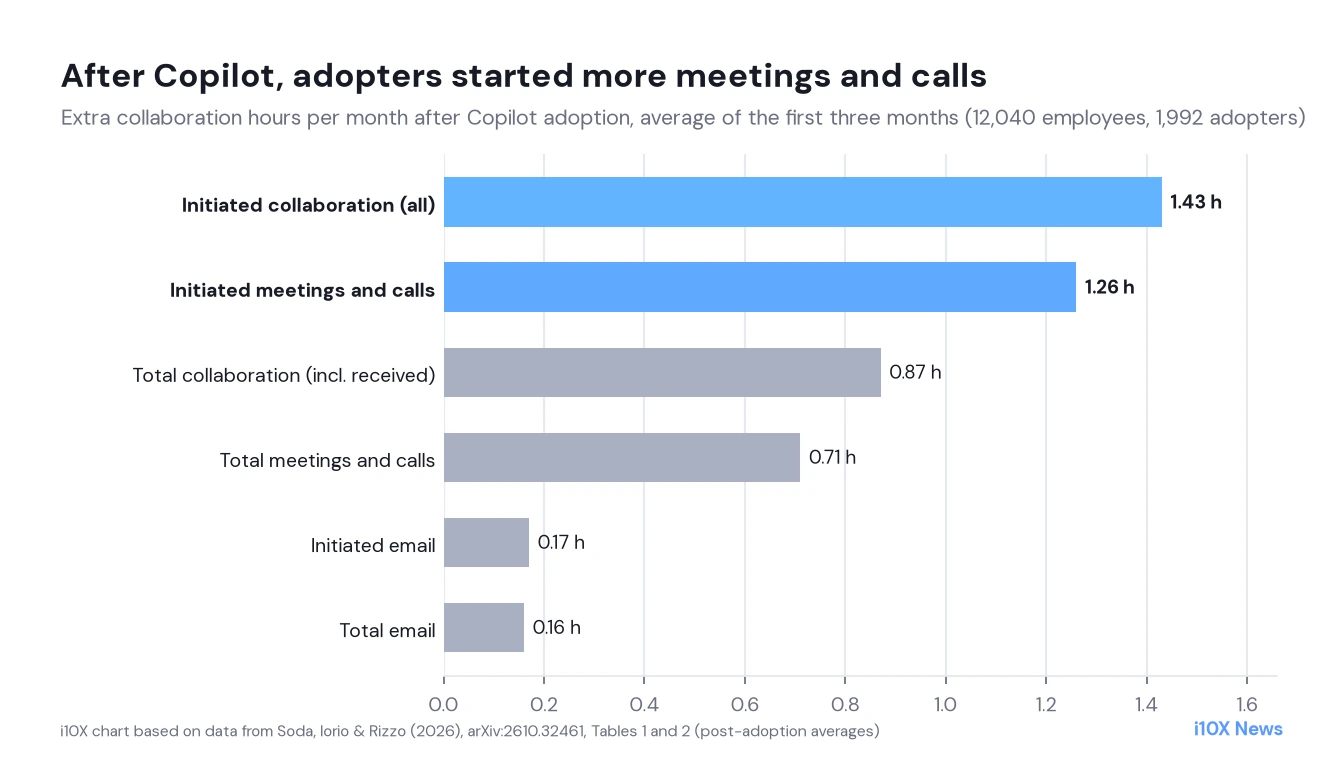
| Initiated collaboration hours | +1.43 h (95% CI 0.45 to 2.41) | 0.004 |
| Total collaboration hours (incl. received) | +0.87 h | <0.001 |
| Initiated meetings and calls | +1.26 h | 0.010 |
| Initiated email | +0.17 h | <0.001 |
| Distinct collaborators (out-degree) | +2.85 | 0.001 |
| Local clustering of own network | −0.014 | <0.001 |
- Effect grows after adoption: Initiated collaboration rose by 1.26 hours in the month of adoption and by 1.80 hours one month later. Before adoption, adopters and never-adopters moved in parallel (pre-trend estimate 0.074, p = 0.889).
- Not every summary is significant: The overall average treatment effect on initiated hours, which also weights cohorts with shorter follow-up, was +0.95 hours and not statistically significant (p = 0.102). For total collaboration it was +0.63 hours and significant.
- More people, less closed circles: The overall effect on distinct collaborators was about +2.2 (p = 0.037). Clustering fell (−0.009, p = 0.009), meaning adopters’ contacts were less often connected with each other. Ties to already strong contacts also grew slightly (p = 0.016 for the post-adoption average).
- Company-wide shift: At network level, connections grew faster than the number of people, average path lengths and diameter shrank, and global efficiency rose over the period.
Why it matters: behavior, not surveys
- Real logs at scale: Most evidence on AI and teamwork comes from surveys, lab tasks or short experiments. Here, collaboration and Copilot use come from passively recorded activity of more than 12,000 people over 13 months.
- Two independent designs agree: Besides the difference-in-differences comparison, the authors use an instrument built from Microsoft’s Copilot feature releases combined with how many of a worker’s colleagues already used Copilot (first-stage F = 80.4). This second approach also finds more total collaboration (p < 0.001), more initiated email, more distinct collaborators and lower clustering.
- Spillover checked: Never-adopters who work closely with adopters could themselves be affected. Dropping them from the control group gave consistent, somewhat larger effects.
Method in brief
Data: Microsoft Viva Insights records for 12,040 employees of one business unit, monthly, September 2024 to September 2025; ties counted only above the monthly median (roughly one hour). Treatment: a worker counts as an adopter from the first month in which Copilot activity exceeded the 25th percentile for two consecutive months. Estimation: staggered difference-in-differences with doubly robust weighting, controlling for sex, age group, tenure, office location and hierarchical level, observed from three months before to two months after adoption. Complement: a fixed-effects instrumental-variable model using Copilot usage intensity, with placebo tests. The study had institutional ethics approval.
What remains open
- Why people reach out: The authors interpret the extra contact as validation-seeking, but they do not observe the content of meetings. Time saved by Copilot, more coordination work, or simply talking about the new tool could also explain the pattern, as they acknowledge.
- One firm, one unit: All data come from a single business unit of one consumer-products company. Other industries, roles or AI tools may behave differently.
- Short horizon: Effects are measured for the first three months after adoption. Whether the extra outreach persists, fades or turns into a lasting network change is unknown.
- Assumptions and status: Adoption was not randomized; the causal reading rests on parallel trends and on the instrument’s validity. The paper is a version 1 preprint, not peer reviewed, and the data are not public.
Context: the opposite of the remote-work effect
The paper positions itself against earlier evidence that firm-wide remote work made collaboration networks more siloed and static (Yang et al., Nature Human Behaviour, 2022), and against concerns that AI coding tools reduce collaboration among software developers. Experimental studies such as Noy and Zhang (Science, 2023) and Brynjolfsson and colleagues (QJE, 2025) showed productivity gains from generative AI for individual tasks. This study adds the social side: in this company, AI adoption came with more outreach and less closed networks. More i10X coverage of these questions is collected under Society & Economy.
What it means for managers and HR teams
- Plan for more meetings, not fewer: If AI-assisted work triggers more checking with colleagues, the time saved on drafting may partly move into coordination. Measure both.
- Make validation cheap: Clear review routines and known experts for AI-assisted outputs may serve the need the authors describe better than ad-hoc calls.
- Use your own data: Companies running Copilot already have the same kind of collaboration logs and can check whether the pattern holds for their teams.
For more on the vendor behind the tool, see the Microsoft hub or all studies on i10X.
About the analysis
Researched and written with AI assistance under the editorial responsibility of the i10X News team. The title image is an AI-generated illustration. Read our AI Use Policy. Spotted an error? Request a correction.
This article is based on the full text of the preprint “The Effects of Generative AI on Collaboration and Social Networks Among Knowledge Workers” (arXiv:2610.32461v1, submitted October 23, 2026), including its robustness checks and limitations. All numbers come from the paper; i10X did not have access to the data. The paper states no funding source or conflicts of interest. It is distributed under CC BY-NC-ND 4.0, so no original figures are reproduced; the chart was redrawn by i10X from the reported estimates. AI tools assisted with research, drafting and the title illustration; the selection, fact-checking and final editing were done by the i10X editorial team.
i10x Perspective
The “AI makes us lonely at work” story does not hold in this dataset. Copilot users convened more meetings and reached more people outside their usual circle. That fits a simple observation: an assistant that drafts faster also produces more things someone has to check, agree on or decide. Whether that is a cost or a benefit depends on the meeting. The open question is what happens after the novelty fades. Three months is enough to see a reaction, not a new normal, and the next useful study would follow the same networks for a year or more.