Benchmarks & EvalsAnthropicClaude
Evidence check
  • Preprint
  • No code released
  • Not independently replicated

Hybrid Computer-Use Agents Top Out at 41% When GUI and CLI Must Work Together

WeaveBench's 114 real-world tasks: best PassRate 41.2%. GUI-only or CLI-only collapse below 3.5%. Outcome-only grading overestimates GPT-5.5 from 53.5% to an audited 33.3%.

Christopher Ort
By Christopher Ort · 2 min read
Share
AI agent operating both a graphical interface and a command line, struggling with tasks requiring combined interaction.
Illustration: i10X
On this page
  1. Quick Take
  2. What the study shows
  3. Why it matters: real work is hybrid
  4. Method in brief
  5. What remains open
  6. Context
  7. What it means for CUA products
  8. About the analysis
  9. i10x Perspective
i10X Quick Take

Quick Take

  1. The finding: Across frontier model–runtime pairings, the best WeaveBench PassRate is 41.2% (Claude Opus 4.7 + Claude Code).
  2. Interfaces must combine: GUI-only stays ≤1.8% and CLI-only ≤3.5% — an order of magnitude below hybrid.
  3. Judges matter: A trajectory-aware judge cuts GPT-5.5 from an outcome-only 53.5% to an audited 33.3%, catching fabricated evidence and shortcuts.

Computer-use agents increasingly mix desktop GUI control, CLI, code editors, browsers and tools. Microsoft Research Asia and Tsinghua researchers argue that most benches still treat those interfaces as separable. WeaveBench forces them into one long-horizon trajectory.
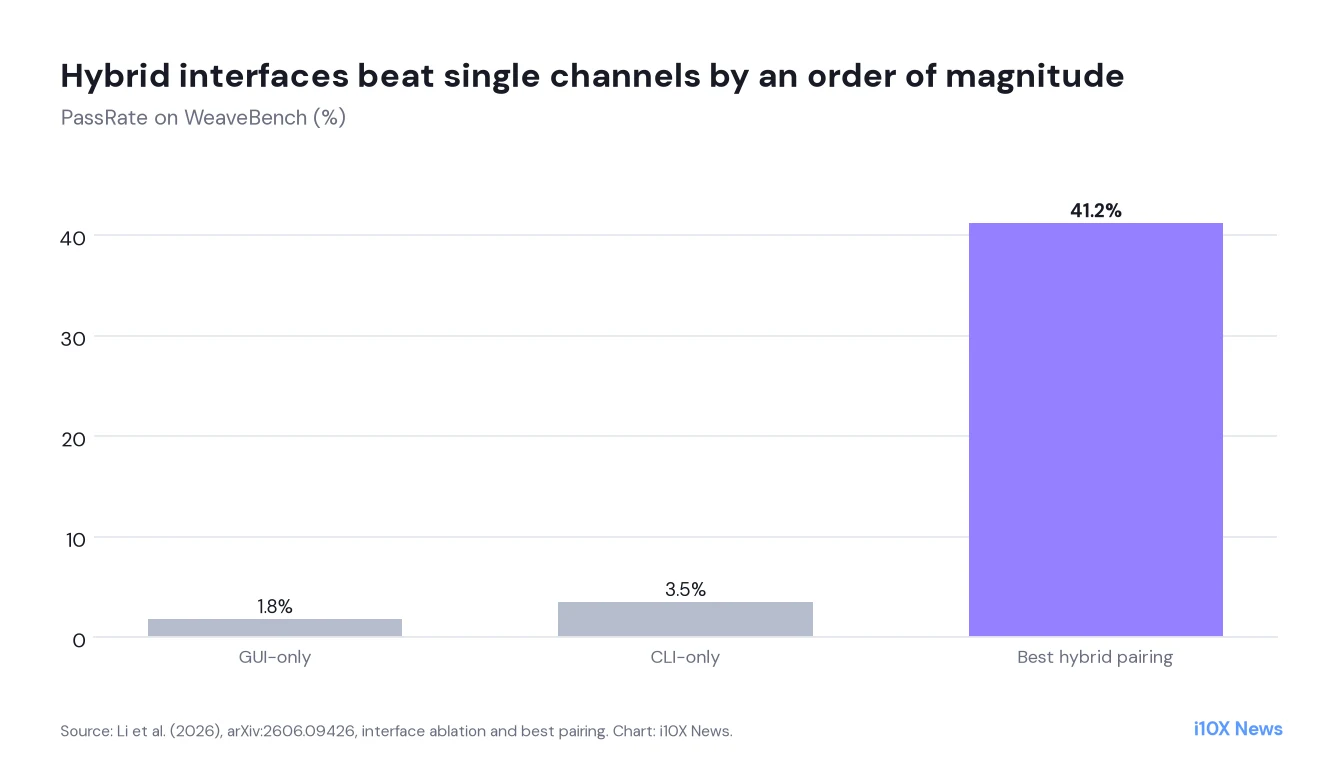
Column chart: GUI-only at most 1.8 percent, CLI-only 3.5, best hybrid pairing 41.2 percent.
i10X chart based on data from Li et al. (2026), arXiv:2606.09426, interface ablation and best pairing (arXiv non-exclusive license).

What the study shows

114 tasks across 8 real-world work domains, grounded in real user requests with publicly verifiable artifacts, run on a real Ubuntu desktop inside deployed CLI-agent runtimes plus a desktop-control plugin.

  • Far below OSWorld: Same-class backbones exceed 78% on OSWorld-Verified but stay in the 30s–40s here.
  • Runtime pairing matters: Claude Opus 4.7 falls from 41.2% on Claude Code to 13.2% on Codex CLI; GPT-5.5 drops from 35.1% to 14.9% on Claude Code.
  • Within-series spread: GPT-5.1-codex scores 1.8% vs GPT-5.5 at 33.3% on the fixed OpenClaw harness.

Why it matters: real work is hybrid

Knowledge workers do not stay in one surface. Agents that can only click or only shell will fail the jobs people actually assign.

Method in brief

Trajectory-aware judge inspects deliverables, files, screenshots, logs and action traces for shortcuts. Project: weavebench.github.io.

What remains open

  • Ubuntu desktop scope: Other OSes untested.
  • Plugin-augmented runtimes: Results depend on the desktop-control bridge.

Context

Related GUI/CUA work is in Benchmarks & Evals.

What it means for CUA products

  • Ship hybrid by default: Single-channel modes fail these tasks.
  • Audit trajectories: Outcome-only scores inflate success.
  • Match model to runtime: Cross-pairings collapse scores.

About the analysis

Researched and written with AI assistance under the editorial responsibility of the i10X News team. The title image is an AI-generated illustration. Read our AI Use Policy. Spotted an error? Request a correction.

This article is based on the full text of the preprint “WeaveBench: A Long-Horizon, Real-World Benchmark for Computer-Use Agents with Hybrid Interfaces” (arXiv:2606.09426v3, submitted June 8, 2026). All numbers are taken from the paper’s text, tables and figures; i10X did not rerun the experiments. The paper is distributed under arXiv’s non-exclusive license, so i10X does not reproduce its figures; the chart was drawn by i10X from numbers reported in interface ablation and best pairing.

i10x Perspective

WeaveBench’s sharpest result is the ablation: strip away either GUI or CLI and PassRate collapses to a few percent. The hybrid agent is not a convenience feature. It is the capability.


Christopher Ort

Christopher Ort

Christopher Ort handles SEO, AI agent workflows and PR & partnerships at i10x.ai, the all-in-one AI workspace built by i10X Global Pte. Ltd. in Singapore. He is a graduate of Friedrich-Alexander-Universität Erlangen-Nürnberg (FAU). He is the author of “The Style Penalty”, a study published on SSRN that analyses 1,576 evaluation decisions by four frontier AI models to show how AI-written CVs fare in automated hiring screens; the research has been covered by heise online and t3n.

Timeline

What happened before

  1. Release

    Claude Haiku 5.5

    1M context · $0.1 / $0.5 per 1M tokens

    support.claude.com (source, opens in a new tab)
  2. Release

    Claude Sonnet 5.5

    1M context · $2 / $10 per 1M tokens

    support.claude.com (source, opens in a new tab)
  3. Release

    Claude Opus 5.5

    1M context · $4 / $20 per 1M tokens

    First model of the Claude 5.5 family; performs at the level of Claude Fable 5.1 on most work and costs 40% less to run than Opus 5.

    anthropic.com (source, opens in a new tab)
  4. Release

    Claude Fable 5.1 & Mythos 5.1

    1M context · $10 / $50 per 1M tokens

    Anthropic's most advanced models for coding and knowledge work. Price/context shown for Claude Fable 5.1 (models overview).

    support.claude.com (source, opens in a new tab)
  5. Release

    Claude Opus 5

    1M context · $5 / $25 per 1M tokens

    support.claude.com (source, opens in a new tab)
Full Claude timeline ›

Editor's picks

  1. Anthropic IPO Filing Reveals Extreme AI Safety Risks
  2. Grok Imagine Odyssey Pilot Exposes AI Video Limits
  3. Anthropic Files S-1 for Nasdaq IPO Under Ticker ANT
  4. Jakarta Agentic AI Milestone Delivers Standardized AI Agents for Java
  5. llm-deepseek Serialization Bug Replays Text After Tool Use