Summary: The ad-tech industry is quietly transitioning from predictive machine learning to multi-agent LLM architectures to conquer the highly fragmented Connected TV (CTV) ecosystem.
Overview
What happened
Engineering and ML teams at major DSPs, agencies, and ad-tech vendors are deploying agentic AI to autonomously navigate the entire CTV ad lifecycle—from dynamic media planning and creative versioning via Retrieval-Augmented Generation (RAG) to complex pacing adjustments across clean rooms and ad servers.
Why it matters now
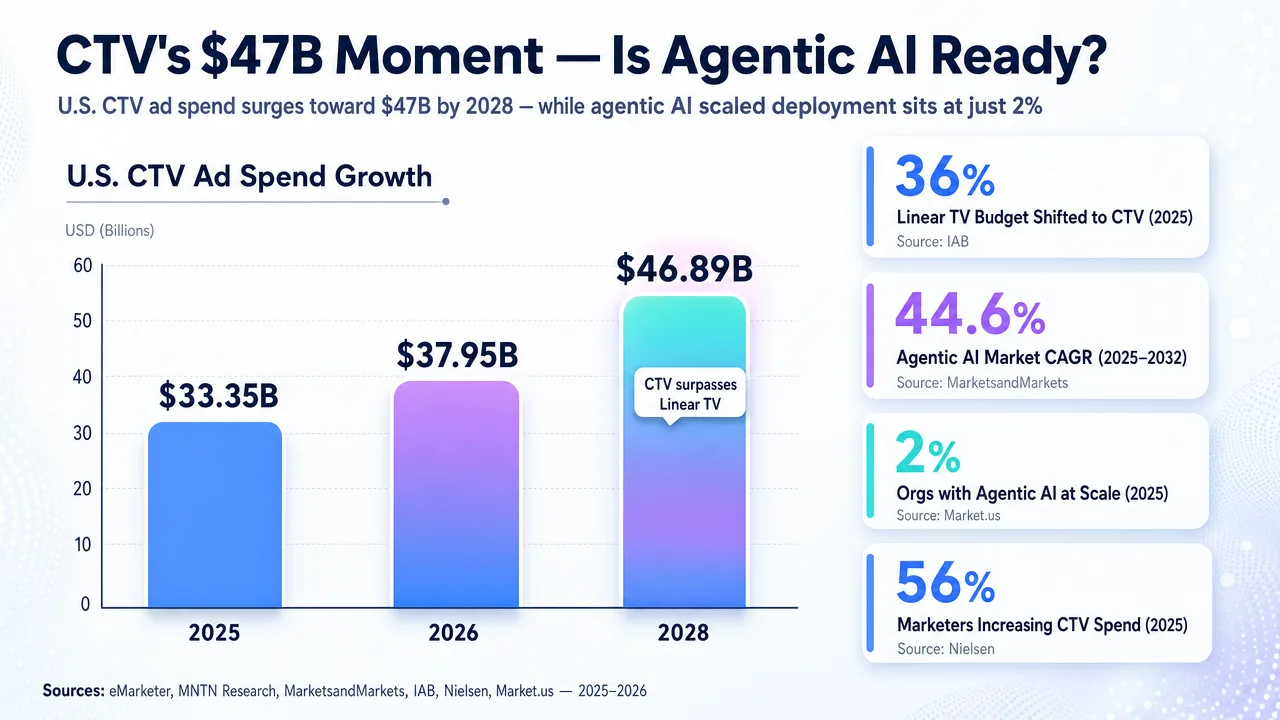
Connected TV (CTV) is notoriously rigid. It features strict publisher rules, complex ad podding, competitive separation mandates, and high cross-device identity limits. While traditional ML efficiently optimizes bids, agentic AI can read, reason through, and orchestrate these disparate constraints by acting as a digital workforce using external software tools.
Who is most affected
Ad-tech product managers, ML/engineering teams building programmatic infrastructure, and enterprise media buyers looking for incremental lift beyond legacy programmatic trading.
The under-reported angle
The true bottleneck isn’t getting an LLM to generate creative copy—it’s surviving the latency budget. Bidding relies on OpenRTB 2.6 frameworks that require millisecond responses, forcing engineers to isolate slow-thinking LLM agents to asynchronous tasks like budget orchestration and policy setting, while deterministic systems handle the real-time execution.
Deep Dive
Have you ever wondered why Connected TV (CTV) still feels like the wild west for automation? For years, machine learning in advertising meant predictive modeling: propensity scoring, lookalike targeting, and bid shading. Now, large language models (LLMs) equipped with tool-use and function-calling capabilities are being deployed as multi-agent systems. CTV—with its fragmented inventory, complex podding structures, and strict publisher constraints—has emerged as the perfect, high-stakes proving ground.
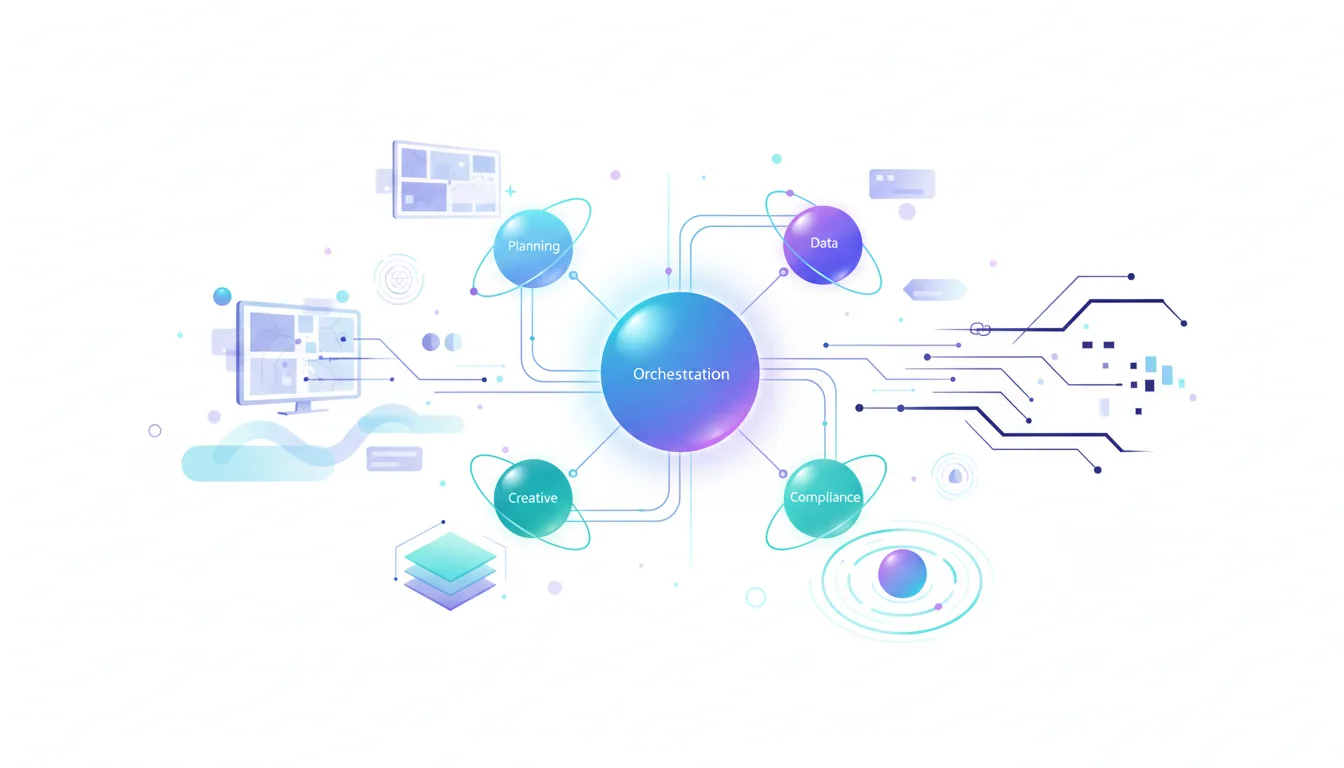
From what I’ve seen, deploying agentic AI here means translating the traditional ad ops lifecycle into something more concrete. In practice, this looks like a swarm of specialized agents. A “data agent” uses SQL-generating LLMs to query clean rooms (like AWS or Snowflake) for overlapping identity graphs. A “planning agent” leans on RAG to synthesize campaign briefs, parse brand safety policies, and map them against publisher-specific rules for competitive separation in an ad pod. Then a “creative agent” handles VAST 4.3 video asset versioning, orchestrating the setup without someone manually trafficking hundreds of permutations.
Yet mixing LLMs with real-time bidding creates real infrastructure tension. Media buying via the OpenRTB 2.6 specification happens in milliseconds. Current LLMs, bounded by token generation speeds and API rate limits, simply cannot participate in the auction path. So teams are adopting an asynchronous SRE approach: agents handle high-level reasoning, budget pacing analysis, and A/B test setup (such as generating ghost bids to measure incrementality), which they compile into strict parameters for deterministic bidding engines to execute at low latency.
The biggest barrier to adoption is not technology alone—it’s trust and governance. The risk of an LLM hallucination when millions of dollars are moving is too high. An unanchored agent could over-pace a budget or place a family-friendly brand inside a violently mature drama. Developers are wrapping agent logic in heavy compliance templates, often using secondary LLMs as safety classifiers, maintaining strict model cards, and employing reinforcement learning and multi-armed bandits to explore creative effectiveness safely.
This trend ultimately forces a “build vs. buy” decision. Enterprise brands might procure vendor-wrapped agent UI tools, while DSPs and SSPs must build native agentic pipelines that tie deeply into their proprietary data exhaust. As measurement standards evolve through MMM and geo-experiments, the teams that successfully merge generative reasoning with sub-second CTV infrastructure will shape the next era.
Stakeholders & Impact
| Stakeholder / Aspect | Impact | Insight |
|---|---|---|
| Ad-Tech ML & Data Teams | High | Forced to merge predictive ML pipelines with generative multi-agent architectures, prioritizing asynchronous reasoning to respect RTB latency budgets. |
| DSPs & SSPs (Infra) | High | Must upgrade data architectures to support function calling, RAG over publisher policies, and seamless clean room integrations for AI agents. |
| Media Buyers & Brands | Medium | Significant reduction in manual trafficking and SLA timelines. Focus shifts from campaign setup to defining objective functions and brand-safety guardrails. |
| Publishers & Networks | Medium | Agentic buyers will ruthlessly optimize for incrementality; publishers must ensure their OpenRTB 2.6 signals (like podding and contextual data) are perfectly machine-readable. |
About the analysis
Researched and written with AI assistance under the editorial responsibility of the i10X News team. The title image is an AI-generated illustration. Read our AI Use Policy. Spotted an error? Request a correction.
This analysis draws from independent research into emerging AI applications in programmatic advertising. It triangulates search intent data, ad-tech infrastructure requirements such as OpenRTB 2.6 and VAST 4.3 specs, and current agentic LLM capabilities. It is intended for CTOs, ad-tech product managers, and ML engineering teams navigating generative AI in high-compliance, high-latency markets.
i10x Perspective
The deployment of agentic AI in Connected TV (CTV) previews a larger shift: the rise of autonomous machine-to-machine economies. When LLMs move beyond conversational roles and begin to programmatically negotiate, bid, and purchase across thousands of APIs, the foundations of digital trust and financial auditing come under real stress. The ultimate winners in the AI race will be the infrastructure players who safely bridge probabilistic reasoning with deterministic, high-speed transactional environments. Over the next decade, regulatory focus will likely move from how models are trained to how autonomous agents handle client money in real-time markets.