The era of conversational AI is ending. We are now entering the age of agentic AI, where large language models are being decoupled from the chat window and wired directly into the operational workflows of the enterprise.
Quick Take
- Summary: Tech giants and nimble startups are aggressively redefining AI from passive chatbots to autonomous “agents” capable of reasoning, planning, and executing multi-step workflows. Platforms from Google, Meta, and IBM are actively attempting to standardize how these systems access enterprise tools and consumer data to complete complex tasks.
- What happened: AI vendors are upgrading base LLMs with external cognitive architectures – including memory, tool-calling APIs, and autonomous task decomposition – creating software entities that can independently navigate applications to achieve user-defined goals.
- Why it matters now: This transition turns AI from an advisory layer into an execution engine, fundamentally altering how enterprise automation is built and dramatically increasing the baseline inference demand on AI infrastructure as tasks move from human-prompted bursts to continuous background execution.
- Who is most affected: Enterprise architects and CTOs tasked with deploying these systems, AI infra providers preparing for new compute workloads, and knowledge workers whose roles will shift from task execution to agent supervision.
- The under-reported angle: While the market fixates on capabilities and multi-agent workflows, there is a massive governance void regarding external communication, consent, and liability when autonomous software acts on a company’s behalf without explicit human-in-the-loop validation.
Deep Dive
The definition of an “AI agent” has become the ultimate strategic battleground for the next generation of computing. Scanning the landscape reveals fragmented PR narratives: IBM frames agents as the ultimate enterprise automation engine, Google emphasizes cloud-native reasoning and memory architecture, and Meta pitches consumer-friendly digital surrogates. Yet beneath the marketing, a unified technical reality is emerging. We are witnessing the industrialization of “agentic AI” – systems that do not just generate text, but act.
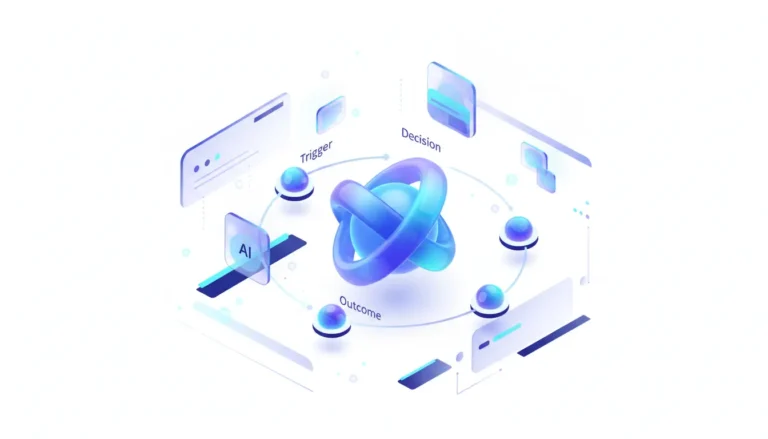
At its core, an AI agent transforms a LLM (Large Language Model) from a stateless respondent into the reasoning engine of a continuous cognitive loop. Unlike a traditional chatbot that waits for a prompt, an agent receives a high-level goal, breaks it into a multi-step execution plan, selects the appropriate tools (APIs, web browsers, SQL databases), acts, and evaluates its own success. This requires an entirely new architecture layer comprising memory state, grounding, and orchestration frameworks like LangChain or LlamaIndex.
From what I’ve seen, the race to deploy these autonomous systems is exposing a severe “blast radius” vulnerability in enterprise IT. While platforms tout productivity gains, they largely gloss over the risks of hallucinated actions. A hallucinating chatbot gives bad advice; a hallucinating agent might delete a production database, send unauthorized outreach to a client, or execute a flawed trade. Sandboxing, strict tool allowlists, and automated rollback mechanisms are no longer theoretical best practices – they are the mandatory prerequisites for any serious agent deployment.
Furthermore, the industry is severely underestimating the governance required for external agent communication. If an agent autonomously negotiates a software license or emails a vendor for scientific research data, who holds the legal liability? Establishing consent protocols, permission scopes, and rigid human-in-the-loop escalation rules for external outreach represents a massive, currently unfilled gap in the enterprise adoption playbook.
Ultimately, the shift from single-prompt chatbots to multi-agent systems – where specialized digital workers collaborate to solve complex problems – is sending a shockwave down the AI infrastructure stack. Agentic workflows require continuous, background execution. As agents begin researching, evaluating, and interacting with one another autonomously, AI data centers will see a fundamental shift from bursty, synchronous human-driven inference to a massive, sustained base-load of machine-to-machine compute.
Stakeholders & Impact
| Stakeholder / Aspect | Impact | Insight |
|---|---|---|
| AI / LLM Providers | High | The battle is shifting from raw model size to orchestration: who provides the best tooling, memory, and API integrations for agentic workflows. |
| Enterprise IT & CTOs | High | Forced to rethink security. Must implement complex audit trails, sandboxed environments, and rigid permissions for tool-using AI. |
| Infrastructure & Cloud | Significant | Multi-agent systems running autonomous background tasks will radically increase continuous inference demand, straining GPU capacity and data center power grids. |
| Regulators & Legal | Medium–High | New frameworks will be urgently needed to define liability when an AI agent executes a harmful action, breaks a contract, or violates external consent norms. |
About the analysis
Researched and written with AI assistance under the editorial responsibility of the i10X News team. The title image is an AI-generated illustration. Read our AI Use Policy. Spotted an error? Request a correction.
This independent, research-based analysis synthesizes current market definitions, vendor frameworks, and technical gaps in agentic AI by analyzing strategies from Google, IBM, Meta, and the broader tech sector. It is designed for CTOs, developers, and AI strategists navigating the critical transition from conversational LLMs to autonomous, tool-using infrastructure.
i10x Perspective
The transition to agentic AI is the definitive bridge to true digital labor. Over the next five years, the competitive moat will shift dramatically; having the smartest foundational model will matter less than having the most reliable, secure, and auditable orchestration framework for autonomous execution. Watch closely as the market fractures into “safe, sandboxed” enterprise agents and wild-west open-source swarms, forcing regulators and infra providers alike to urgently redefine the physical and legal boundaries of machine autonomy.