The era of the chatbot is fading; the era of the autonomous agent has arrived, turning large language models from passive conversationalists into active digital workers.
Summary: Enterprise giants like IBM, Google, AWS, and Oracle have aggressively aligned their AI messaging around “AI Agents,” signaling a mass industry pivot from conversational AI to autonomous workflow orchestration.
- What happened: Cloud providers and AI labs are redefining AI from simple prompt-and-response interfaces into agentic systems that can reason, plan, retain memory, and execute multi-step tool calls across complex environments.
- Why it matters now: This marks the transition from AI as a drafting assistant to AI as an active software operator, radically changing enterprise automation, compute demands, and cloud infrastructure requirements.
- Who is most affected: Enterprise CTOs, software developers, and SecOps teams who must now navigate the shift from simple API integrations to building and securing multi-agent systems.
- The under-reported angle: While the hype focuses heavily on autonomy and multi-step planning, the real bottleneck is governance—how to secure, permission, and audit AI agents before they break enterprise workflows or hallucinate complex API calls.
Deep Dive
Have you ever watched a polished demo of an AI agent glide through a task, only to wonder how it would hold up once real stakes enter the picture? The AI market has collectively decided on its next frontier. Looking at the strategic positioning across IBM, Google Cloud, AWS, and Oracle, the consensus is clear: the industry is rapidly moving beyond the chat box. Enter the AI Agent—a system that doesn’t just generate text, but receives a high-level goal, breaks it into actionable steps, and autonomously uses external tools and APIs to achieve it. From what I’ve seen, this represents a fundamental shift from human-driven prompting to agentic workflow automation.
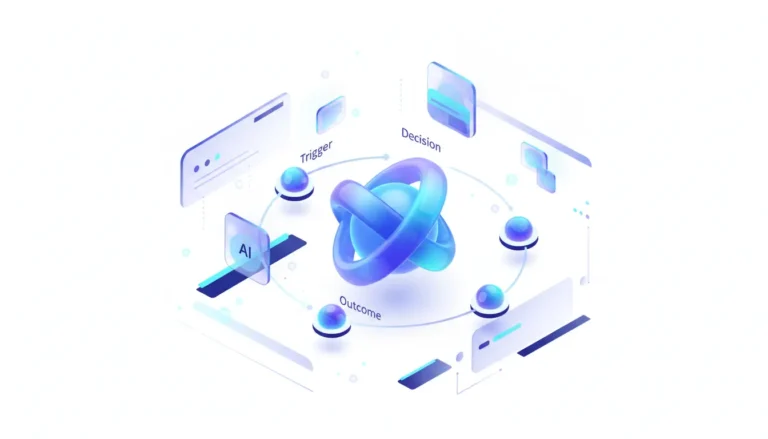
The architecture of intelligence is expanding. To understand agents, one must look past the foundational LLM. Today’s top-tier agentic systems combine reasoning and planning with persistent memory and, crucially, tool-calling capabilities. Whether it’s an Amazon Bedrock agent querying a proprietary database or a Google Cloud multi-agent system executing an enterprise data workflow, the foundational model is no longer the entire product. Instead, the LLM has become the cognitive engine driving a broader, interconnected software ecosystem.
Yet the way vendors pitch these systems reveals a deep tension between enterprise capability and human control. IBM and Oracle frame agents as the ultimate workflow orchestrators, pushing them as hard-ROI solutions for deep business process automation and cross-platform execution. In contrast, players targeting end-consumers, like Meta, take a more cautious approach, emphasizing user oversight, step-by-step approvals, and tightly constrained tools to assuage fears of runaway autonomy.
The missing piece in the current market enthusiasm is the harsh reality of agentic failure modes. It is relatively easy to build a demo of an AI agent routing a customer ticket or analyzing a spreadsheet, but deploying these systems at scale exposes massive governance gaps. Hallucinated plans, incorrect tool calls, stale data retrieval, and over-permissioning are the new operational hazards for IT departments. Enterprises are quickly realizing they need a new maturity ladder: moving carefully from AI assistants, to single constrained agents, and eventually to autonomous multi-agent business processes.
Ultimately, the transition to agentic AI is arguably the most significant architectural shift since the transformer model itself. As these agents begin communicating with one another—and executing code in live environments—the infrastructure focus will inevitably shift. The conversation is moving from purely scaling model parameters to building secure, audit-friendly orchestration layers where agents can operate safely, effectively, and transparently.
Stakeholders & Impact
- AI / LLM ProvidersImpact: High
Insight: Models are now being optimized for function calling, reasoning traces, and tool use rather than just conversational fluency. - Cloud Infrastructure (AWS, GCP)Impact: High
Insight: Massive opportunity to lock enterprises into proprietary ecosystems by offering pre-built orchestration layers (e.g., Bedrock, watsonx). - Enterprise IT & SecOpsImpact: Significant
Insight: Forced to develop new governance frameworks to monitor agent permissions, audit logs, and API access boundaries. - Knowledge WorkersImpact: Medium–High
Insight: Shift from using AI to brainstorm ideas to supervising AI as it autonomously executes repetitive, multi-step tasks.
About the analysis
Researched and written with AI assistance under the editorial responsibility of the i10X News team. The title image is an AI-generated illustration. Read our AI Use Policy. Spotted an error? Request a correction.
This independent, research-based analysis synthesizes current search intent, enterprise vendor positioning, and structural market gaps regarding the shift to AI Agents. Drawing on competitive data from major cloud providers and AI leaders, it is designed for technical leaders, CTOs, and AI product managers tracking the evolution of agentic architectures and workflow automation.
i10x Perspective
The pivot to AI agents signals that the “app layer” of AI is finally materializing as an action layer. As models spend more time planning, routing, and self-correcting, we will see a massive shift in compute demand toward agentic inference—where models “think” longer before acting. The defining battle of the next five years won’t just be who has the smartest foundation model, but who provides the most secure, reliable infrastructure for autonomous systems to operate without human hand-holding.