
AI for Climate Action Award — Analysis
⚡ Quick Take
- Summary: The UN Framework Convention on Climate Change (UNFCCC) has launched the AI for Climate Action Award (AICA), issuing a global call for open-source artificial intelligence systems that actively fight climate change.
- What happened: The UN has opened nominations for an award mechanism designed to identify and elevate open-source AI projects focused on climate mitigation and adaptation, requiring strict documentation around model cards, dataset transparency, and licensing.
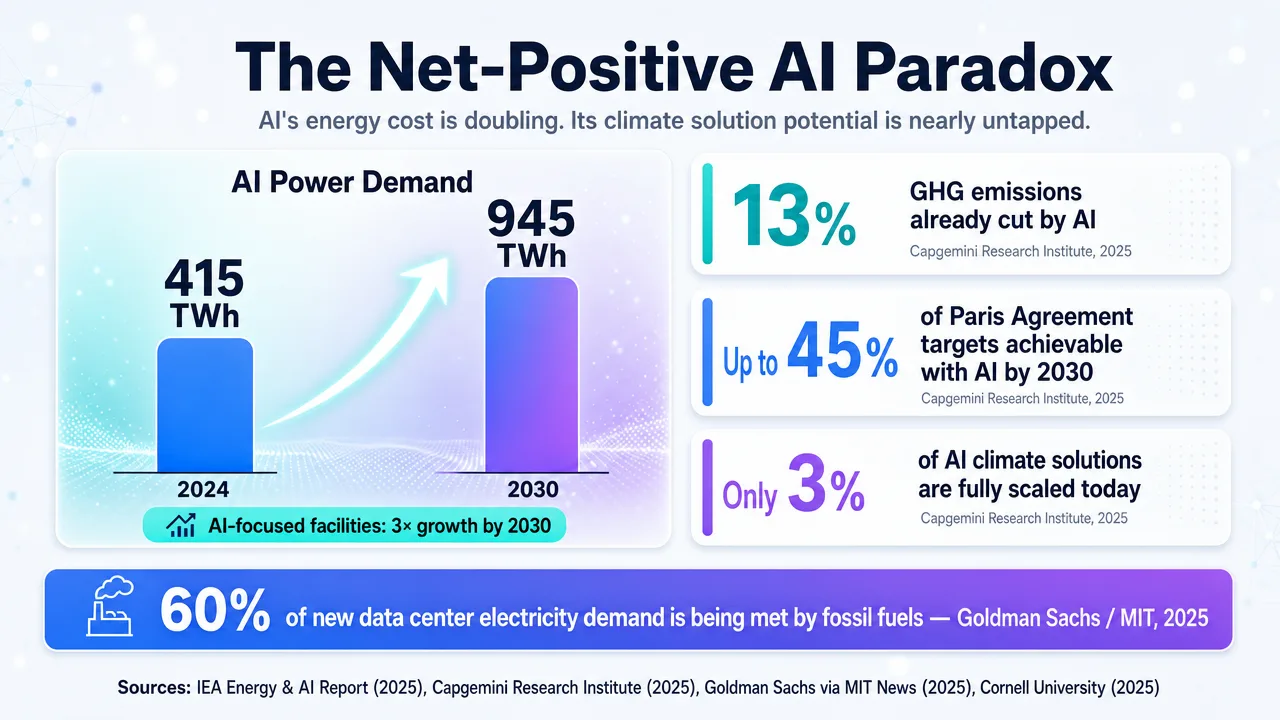
- Why it matters now: As Big Tech races to secure gigawatts of power for massive AI data centers, the intelligence ecosystem is facing intense scrutiny over its environmental footprint. The AICA award sets an official, global benchmark for “net-positive AI” demanding that the computational cost of running a model is aggressively offset by the real-world carbon emissions it helps reduce.
- Who is most affected: Open-source AI developers, climate tech founders, MLOps teams, and academic research labs who now have a direct pathway to global policy validation, provided their systems are fully transparent and accessible.
- The under-reported angle: Most coverage treats this as a standard NGO grant, but it is actually a proxy for global AI governance. By enforcing strict evaluation rubrics around open-source licenses (like Apache-2.0 and MIT) and requiring standardized risk and sustainability reporting, the UN is quietly drafting a regulatory blueprint for how safe, impactful AI should be built and audited.
🧠 Deep Dive
Have you stopped to wonder why so much of the discussion around AI and energy feels one-sided? While the broader tech narrative obsesses over the massive energy demands of AGI training runs and sprawling GPU data centers, the UNFCCC’s AI for Climate Action Award focuses entirely on the inverse: how artificial intelligence can act as a targeted weapon against climate collapse. This award signals a crucial maturity in global policy. The UN isn’t looking for theoretical white papers or closed-API SaaS tools; they are hunting for deployable, open-source AI models that can optimize power grids, predict extreme weather, and manage land-use adaptations in real-time.
From what I’ve seen in similar policy shifts, a close read of the AICA parameters reveals a significant shift in expectations for AI builders. Standard NGO coverage focuses on the basic eligibility and deadlines, completely missing the technical rigor required to win. To succeed, entrants must do more than claim alignment with Sustainable Development Goals (SDGs). They must provide hard artifacts of responsible ML development: comprehensive model cards, clear dataset datasheets, rigid bias evaluations, and explicit open-source licensing declarations (such as Apache-2.0, MIT, or GPL). The UN is effectively using this award to institutionalize best practices for open reproducible research in applied AI.
Crucially, this initiative highlights an escalating tension in the AI infrastructure world: the compute footprint versus impact paradox. The current web discourse leaves a massive gap in how developers quantify the sustainability of their own AI systems. A winning AICA submission won’t just showcase high inference accuracy; it must demonstrate that the energy spent powering its GPUs and data pipelines is justified by the tangible emissions it prevents. This forces developers to master a new skill: proving a net-negative carbon lifecycle for their machine learning architectures.
Ultimately, the AICA sets up a contrast between proprietary intelligence monopolies and distributed, open-source ecology. While frontier model builders gatekeep their weights and obscure their power consumption, the UNFCCC is building a localized, open ecosystem. By prioritizing verifiable climate impact over raw parameter scale, this framework offers a glimpse into how future international AI regulations might treat open-source models as vital public digital infrastructure.
📊 Stakeholders & Impact
| Stakeholder / Aspect | Impact | Insight |
|---|---|---|
| AI / LLM Developers | High | Must adapt to rigorous transparency standards (model cards, datasheets) and strictly open-source methodologies to compete. |
| Open-Source Ecosystems | High | Validates Apache-2.0, MIT, and similar licenses as the preferred default for globally critical digital infrastructure. |
| Hyperscalers & Big Tech | Medium | Highlights the mounting policy pressure to justify massive AI data center energy consumption through quantifiable, net-positive climate use cases. |
| Regulators & Policy Makers | Significant | Provides a tested scorecard for evaluating AI systems not just on safety and bias, but on their net environmental ROI. |
✍️ About the analysis
Researched and written with AI assistance under the editorial responsibility of the i10X News team. The title image is an AI-generated illustration. Read our AI Use Policy. Spotted an error? Request a correction.
This is an independent, research-based analysis synthesizing the evaluation criteria, eligibility gaps, and strategic implications of the UNFCCC AICA Award. It is written for AI founders, MLOps engineers, and CTOs seeking to navigate the rapidly converging landscapes of machine learning performance, open-source licensing, and AI sustainability.
🔭 i10x Perspective
The UN’s AI Climate Award is an early warning signal for the broader AI infrastructure market: the era of deploying power-hungry models without accounting for their carbon ROI is ending. Over the next five to ten years, as generative AI places unprecedented stress on national power grids, demonstrating a verifiable, net-positive climate impact will transition from a PR advantage into a strict license to operate. The criteria the UN is testing today – mandatory model cards, compute-efficiency disclosures, and open weights – will almost certainly evolve into tomorrow’s baseline regulations for global intelligence infrastructure.