Summary
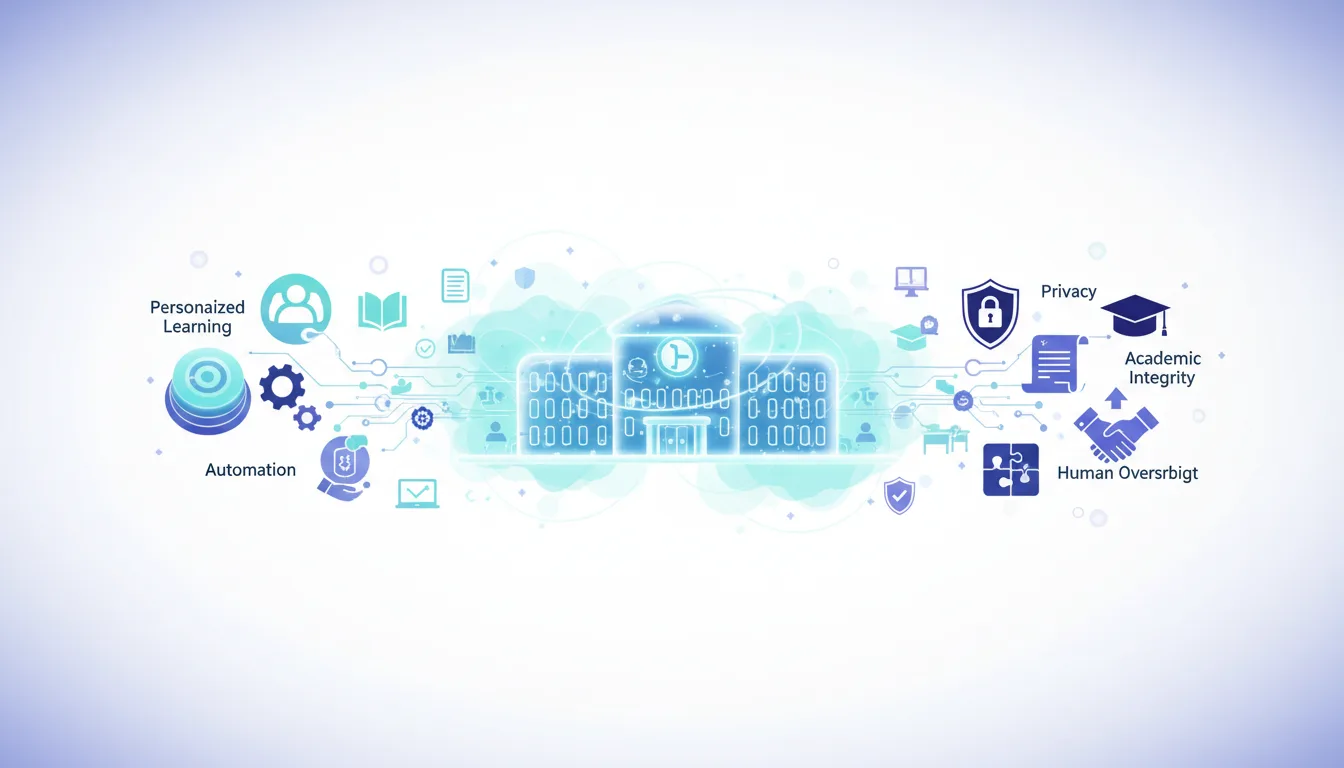
Schools and universities are moving beyond trying to ban generative AI and are now treating it as core institutional infrastructure. This shift demands new governance models that balance academic integrity, student data privacy, and the integration of LLMs into pedagogical workflows.
What happened
Instead of merely reacting to AI-generated essays, educational institutions are being targeted by tech giants and ed-tech vendors aiming to deploy AI-driven instruction, adaptive tutoring, and administrative automation at scale.
Why it matters now
Education is acting as a massive funnel for LLM adoption. How universities and school districts procure, regulate, and deploy these models will establish the baseline for how the next generation interacts with AI, shaping the broader market share for companies like OpenAI, Google, and Anthropic.
Who is most affected
University leadership (CIOs, presidents), educators negotiating their labor rights, ed-tech platform vendors, and students navigating an ambiguous landscape of AI literacy and digital surveillance.
The under-reported angle
The true bottleneck for AI in education isn’t student cheating – it is vendor procurement and data governance. Institutions are struggling to deploy LLMs without inadvertently feeding sensitive student data back into public training loops or violating compliance frameworks.
Deep Dive
Have you ever watched a policy memo gather dust while the technology it describes races ahead? That’s the sense I get watching the narrative around AI in education shift from a localized classroom disruption to a full-blown enterprise infrastructure challenge. When a university or school district adopts an LLM platform, they aren’t just buying a new teaching aid – they are integrating a sophisticated intelligence layer that touches everything from student analytics to administrative automation.
Commercial players like Intel and Google view education through the lens of cloud infrastructure and efficiency, pushing tools that automate routine workflows and deliver real-time curriculum insights. Yet inserting algorithmic agents into the learning process creates a complex web of dependencies that current school policies are vastly unprepared for.
A clear tension has emerged between the developers of AI models and the reality of educational governance. Global policy watchdogs like UNESCO and research bodies like the US Department of Education (IES) are urgently pushing for human-centered, rights-based frameworks. They recognize that if AI deployment is left solely to market forces, it risks exacerbating the digital divide. While affluent institutions can afford bespoke, compliant AI platforms with robust data guardrails, underfunded districts are left vulnerable to unregulated “shadow IT” where students and teachers use consumer-grade LLMs that lack privacy safeguards.
Furthermore, the integration of AI is forcing a systemic redesign of human assessment. The initial instinct of educators to rely on “AI detection” software has proven technically flawed and prone to false positives. Instead, higher education is being forced to pivot toward process-oriented assessment – oral exams, authentic localized projects, and secure sandboxed environments. This isn’t merely an academic shift; it represents an infrastructure challenge. Institutions now require an AI use policy matrix that clearly defines permitted, limited, and prohibited LLM applications, forcing faculty to redesign syllabi to evaluate how a student prompts and iterates with an AI, rather than just grading the final output.
Educators and their unions, such as the NEA, are caught in the middle of this transformation. There is a delicate balance between utilizing AI to alleviate severe administrative burnout – such as automated lesson planning and grading – and protecting the human-led teaching relationship. The push for automated tutoring systems and adaptive learning pathways promises highly personalized education, but it also introduces the risk of over-reliance on algorithms that may hallucinate or exhibit cultural biases.
Ultimately, education is serving as a massive stress-test for enterprise AI governance. Universities are desperately in need of rigorous procurement checklists, vendor due diligence, and risk registers covering everything from model bias to accessibility. To transition from anxiety to responsible adoption, educational leadership must recognize that they are not just managing a new software tool; they are architecting a complex intelligence pipeline. How they balance innovation with academic rigor will provide a blueprint for every other knowledge-based industry grappling with the integration of generative AI.
Stakeholders & Impact
- LLM & Ed-Tech Vendors — Impact: High. Insight: Education is a massive pipeline for user acquisition. Vendors winning institutional procurement contracts lock in long-term enterprise adoption and platform loyalty.
- Institutional Leadership & CIOs — Impact: High. Insight: Must pivot from outright bans to building secure, compliant AI architectures, managing vendor procurement, and enforcing data privacy guardrails.
- Faculty & Educators — Impact: High. Insight: Facing a fundamental redesign of their labor. They must transition from evaluating final outputs to managing AI-assisted workflows while navigating union concerns over automation.
- Regulators & Policy Makers — Impact: Significant. Insight: Forced to draft new definitions of AI literacy, equity, and human-rights protections to prevent algorithms from deepening educational inequalities.
About the analysis
Researched and written with AI assistance under the editorial responsibility of the i10X News team. The title image is an AI-generated illustration. Read our AI Use Policy. Spotted an error? Request a correction.
This independent, research-based analysis synthesizes global policy guidelines, government research taxonomies, and commercial technology frameworks. It is designed for university leadership, ed-tech builders, and AI governance strategists looking to move beyond the superficial debate of academic cheating and focus on institutional AI implementation.
i10x Perspective
The education sector is the ultimate proxy war for the future of enterprise LLM adoption. The platform a student is trained to use today – whether it’s an OpenAI wrapper, a Google Gemini integration, or an Anthropic sandbox – will become their default operating system as they enter the workforce. From what I’ve seen, the structural frameworks universities are currently inventing to assess human-in-the-loop workflows will eventually become the exact models corporations use to evaluate their own employees’ AI-augmented productivity. The institutions that successfully navigate this infrastructure challenge aren’t just saving their academic integrity; they are writing the governance playbook for the next decade of human-machine collaboration.