
Quick Take
- The finding: In 50,000 U.S. job postings from 33 large firms, the share mentioning AI rose 66% between 2023 and 2025, from 5.3% to 8.8%. Only 31% of AI-related sentences described the job’s actual responsibilities.
- Exposed tasks fade slightly: Work activities that people often do with Copilot or Claude show up in fewer postings. The shift in the mix of responsibilities is small, though, and partly reflects shorter, rewritten templates.
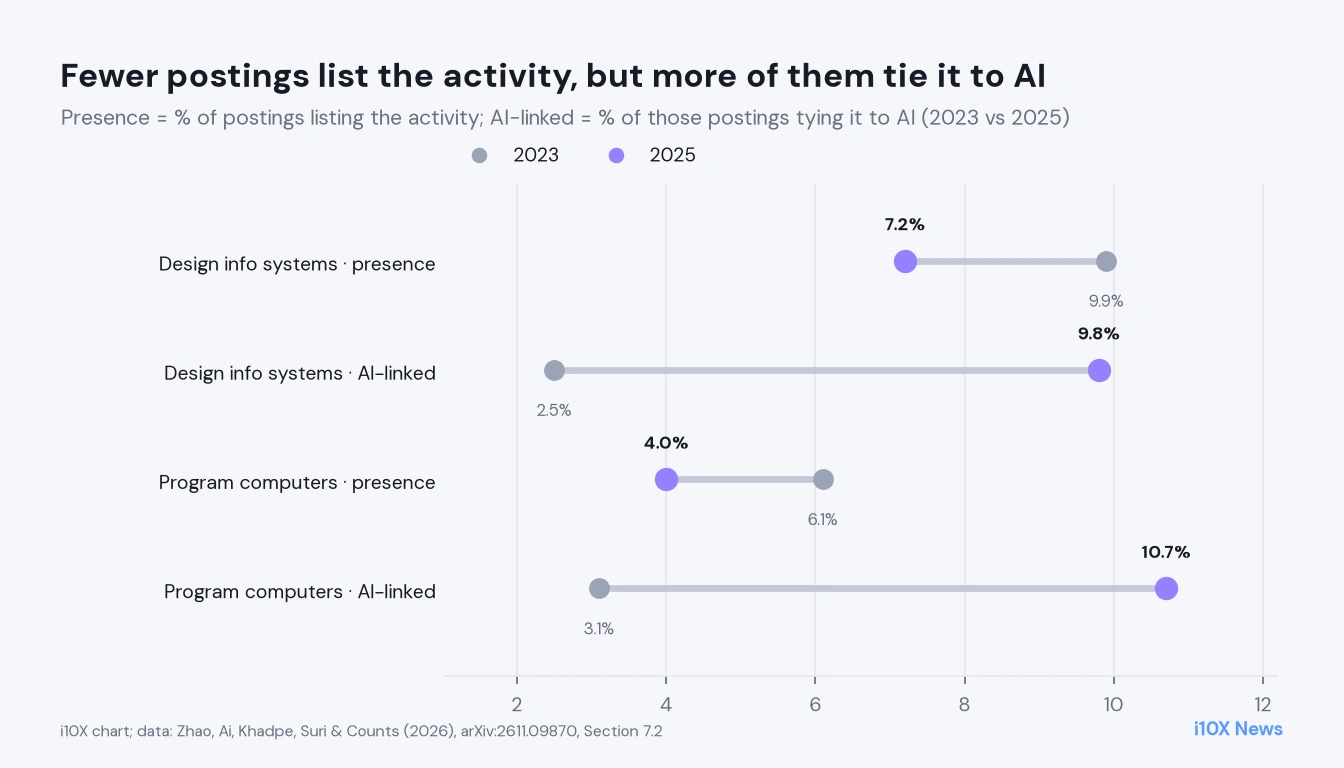
- What it means: When employers do list AI-exposed activities, they increasingly tie them to AI. In 55 of 57 activities that appeared less often, the number of AI-linked postings still went up.
Most evidence on AI and work comes from the supply side: what people use chatbots for. A new preprint by Dora Zhao (Stanford, written during an internship at Microsoft), Lin Ai, Pranav Khadpe, Siddharth Suri and Scott Counts (Microsoft and Microsoft Research), “AI Exposure and the Changing Responsibilities in Job Postings,” looks at the demand side instead. It asks what employers say they want, and how that is changing for tasks that AI already handles.
What the study shows
The team mapped each posting’s responsibilities onto 332 standardized work activities from the U.S. Department of Labor’s O*NET taxonomy. They then compared 2023 with 2025, using two measures of how exposed each activity is to AI: the share of an activity Microsoft Copilot performs, and the share of Claude conversations about it.
- AI is more visible: Postings mentioning AI rose from 5.3% to 8.8% (+66.0%), or 2.37 percentage points a year within firms and occupation groups. Generative AI mentions grew 278%, from 0.9% to 3.4%.
- Much of it is branding: AI sentences more than doubled, from 2,043 to 4,792. But 29% were in qualifications, 28% in summaries and 12% in company self-descriptions, against 31% in responsibilities.
- Exposed activities decline a little: A one-standard-deviation increase in exposure was associated with a 0.19-point (Copilot) and 0.24-point (Claude) larger fall in how often an activity appears (both p < .001). As a share of all listed responsibilities, the effect was only significant for Claude (β = −0.024, p = .03).
- Templates shrank: The average number of responsibilities per posting fell from 12.0 to 10.5. An audit of matched postings suggests much of this comes from rewritten templates rather than changed work.
- AI moves inside the job: In 2025, activities in the top exposure quartile were AI-linked in 1.31% of postings that listed them, against 0.07% in the bottom quartile. That share grew faster for exposed activities (β = 0.28, p = .001).
| Outcome measure | Copilot exposure | Claude exposure |
|---|---|---|
| Change in presence (pp per SD) | −0.19 (p < .001) | −0.24 (p < .001) |
| Log ratio | −0.040 (p = .03) | −0.036 (p = .06) |
| Mention share | −0.010 (p = .16) | −0.024 (p = .03) |
Why it matters: tasks inside jobs, not just keyword counts
Counting “AI” keywords tells you little about the work itself. This pipeline turns free-text postings into a standard set of activities, so firms and years can be compared. It was validated by hand: precision of 0.91 against majority-vote labels from three authors. Boilerplate AI slogans repeated across a firm’s postings are removed. Two independent exposure measures, from two different AI products, point the same way. The authors also report three different prevalence measures rather than picking the most dramatic one.
Method in brief
- Data: 575,686 postings from 33 firms in ten sectors, via the TheirStack job-posting API. Of these, 341,220 were U.S. postings with dates, and 50,000 were sampled by firm and half-year (2023 Q1 to 2025 Q4). The prevalence analysis covers the 20 firms with at least 200 postings in each year (22,963 postings).
- Pipeline: GPT-5.1 extracts and splits responsibilities into smaller tasks; text-embedding-3-large matches them to O*NET 30.2 activities; GPT-6 Luna checks each match against the posting text.
- Exposure: Copilot usage share (Tomlinson et al., 2025) and Claude conversation share (Massenkoff et al., 2026), log-transformed and normalised.
- Statistics: Linear mixed-effects models with firm-level random slopes, per-firm regressions with Benjamini–Hochberg correction, and firm-level bootstrap confidence intervals.
What remains open
- Correlation, not causation: Hiring priorities, firm strategy and the economy also changed over the period.
- Postings are not jobs: Postings show what employers advertise, not who gets hired or what people actually do. The authors warn explicitly against reading the results as evidence of displacement.
- Narrow exposure measure: Copilot and Claude chat usage does not capture coding agents, robots or AI built into industry software.
- Sample: Large U.S. firms (smallest about 1,400 employees), weighted toward knowledge work: 16.4% computer and math, 16.1% management.
- Imperfect mapping: Recall of the activity matching was 0.62. No code or data release is mentioned.
Context: the demand side of AI exposure
Classic exposure studies (Webb, 2019; Felten et al., 2019; Eloundou et al., 2024) ranked occupations by how much AI could do. Usage reports from Microsoft and Anthropic then showed what people actually do with chatbots. Recent work found that firms adapt partly by changing whom they hire, which we covered in “Firms Adapt to AI by Changing Whom They Hire First”. This paper adds a finer view: the same activity label can quietly change meaning as AI becomes part of it. See also our analysis of augmentation vs. exposure.
What it means for employers and job seekers
- Read past the buzzwords: Most new AI language in postings is about qualifications or employer branding. The concrete AI duties sit in a minority of sentences.
- Expect AI in old job titles: Designing systems or programming still appear, but more often with AI attached. Being able to do the same work with AI is becoming part of the job description.
- For HR teams: Taxonomies like O*NET lag behind. Track what responsibilities actually say, not just category counts.
- For workforce planning: A modest drop in exposed activities is not proof of job cuts. Treat it as an early signal to watch.
More on our Society & Economy studies page and in Microsoft and Anthropic coverage.
About the analysis
Researched and written with AI assistance under the editorial responsibility of the i10X News team. The title image is an AI-generated illustration. Read our AI Use Policy. Spotted an error? Request a correction.
This article is based on the full text of Zhao, Ai, Khadpe, Suri and Counts (2026), “AI Exposure and the Changing Responsibilities in Job Postings,” arXiv:2611.09870v1 (cs.CY, submitted November 6, 2026), including the methods, results, limitations and ethics sections. All numbers come from the paper. The paper is licensed CC BY-NC-SA 4.0, so i10X did not reuse its figures; the chart was redrawn from numbers in Section 7.2. Four authors are affiliated with Microsoft or Microsoft Research, whose Copilot usage data feeds one of the exposure measures; no separate funding or conflict-of-interest statement is given. AI tools assisted with research and drafting; selection, fact-checking and final editing were done by the i10X editorial team.
i10x Perspective
The “AI is taking tasks” story and the “AI is everywhere in job ads” story are both partly true, and both partly hype. This study’s most useful point is the quiet one: jobs keep their old labels while their content changes. For workers, the practical takeaway is not to abandon AI-exposed skills but to learn to do them with AI, because that is increasingly what the posting asks for.