
Quick Take
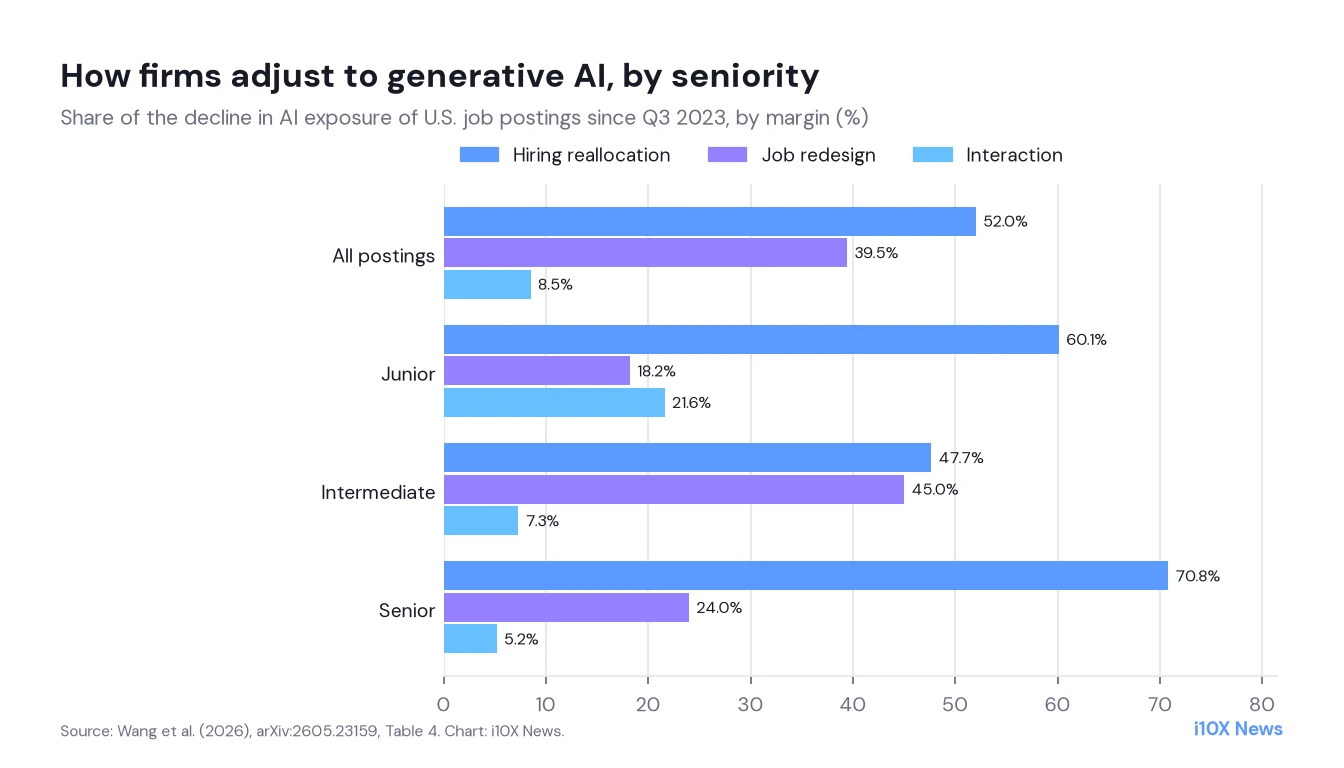
- The finding: From the third quarter of 2023, average generative AI exposure in U.S. job postings declined. Hiring reallocation, meaning firms posting different kinds of jobs, explains 52% of that decline, and redesigning tasks within comparable jobs explains 39.5%.
- The job ladder differs: Senior jobs adjusted earlier and mostly by reallocation (70.8%). Junior jobs adjusted through a broader mix, with the interaction of reallocation and redesign contributing 21.6%.
- What it means: AI exposure is not a fixed property of an occupation. Employers are rewriting job content, which static exposure scores cannot see.
Most research on AI and jobs asks which occupations are exposed and whether exposed jobs decline. Researchers at Purdue University’s Mitch Daniels School of Business ask a different question: how do firms reorganize labor demand as generative AI spreads? Do they change where they hire, what jobs contain, or both? To answer it, they built a posting-level exposure measure for a nationwide sample of U.S. job ads from January 2021 to June 2025.
What the study shows
The data come from Lightcast, which aggregates postings from more than 220,000 websites; the study period contains more than 188 million postings, from which the authors draw a stratified 5% sample of more than nine million. A two-stage LLM pipeline first extracts 3 to 10 tasks from each posting, then classifies each task as not exposed, directly exposed or indirectly exposed to generative AI, using the standard threshold of at least 50% time savings at equal quality. The main measure counts direct exposure fully and indirect exposure at half weight.
| Share of decline since Q3 2023 | All | Junior | Intermediate | Senior |
|---|---|---|---|---|
| Hiring reallocation (composition) | 52.0% | 60.2% | 47.7% | 70.8% |
| Job redesign (within-cell) | 39.5% | 18.2% | 45.0% | 24.0% |
| Interaction | 8.5% | 21.6% | 7.3% | 5.2% |
- Exposure moves over time: Aggregate exposure rose relative to the 2021 baseline through early 2023, then turned negative from Q3 2023 and kept declining through the end of the sample.
- Half of the tasks are exposed in some way: Across postings, 28.2% of task weight is directly exposed and 22.9% indirectly exposed, leaving 48.9% unexposed. The main exposure index averages 0.396.
- Occupations drive the explained part: An Oaxaca–Blinder decomposition explains roughly two-thirds of the decline with observable job characteristics, and shifts in occupational composition account for about 90% of that explained part.
- Senior first, juniors more complex: Senior postings adjusted earlier and mostly through reallocation. For junior postings, redesign and the joint movement of both margins matter much more.
Why it matters: exposure is not destiny
Influential exposure scores assign one number to each occupation. This study shows that the same occupation can carry very different AI exposure across postings, industries and seniority levels, and that employers revise job content over time. A static score misses almost 40% of the adjustment.
The job-ladder pattern also matters for the debate about entry-level work. Junior roles are not only being hired less; their task content is being rearranged, which changes how workers enter careers and build expertise.
Method in brief
The pipeline uses Llama-3.1-8b-instant from Meta for task extraction and OpenAI‘s GPT-5-nano for exposure classification, following the rubric of Eloundou et al. Specialized skills get double weight. Changes in mean exposure relative to 2021 are split with a three-fold Kitagawa decomposition across occupation × seniority × industry cells into composition, within-cell and interaction effects, complemented by an Oaxaca–Blinder decomposition of the pre- versus post-GPT gap.
What remains open
- Postings are not employment: Job ads show demand, not who is actually hired, paid or let go.
- LLMs labeling LLM exposure: Exposure scores come from small language models applying a rubric. Errors in task extraction or classification flow into every number.
- Association, not causation: The decomposition describes how exposure changed. It does not prove that generative AI caused the shifts, which coincide with other labor-market changes after 2022.
- Sample ends mid-2025: The data stop in June 2025, before many agentic tools spread inside firms.
Context
The paper complements evidence such as Brynjolfsson et al.’s finding of a 16% relative employment decline among workers aged 22–25 in the most AI-exposed occupations. Rather than counting jobs, it shows how the content of demand is reorganized. More labor research is in our Society & Economy section.
What it means for HR and workforce planning
- Audit job descriptions, not titles: Exposure varies within occupations. Review the actual task mix in your postings.
- Redesign entry roles deliberately: Junior roles are being reshaped on several margins at once. Make sure they still teach the skills people need to advance.
- Re-measure regularly: Exposure changed substantially between 2021 and 2025. Workforce plans built on one-off scores age quickly.
About the analysis
Researched and written with AI assistance under the editorial responsibility of the i10X News team. The title image is an AI-generated illustration. Read our AI Use Policy. Spotted an error? Request a correction.
This article is based on the full text of the preprint “Generative AI and the Reorganization of Labor Demand” (arXiv:2605.23159v1, submitted May 22, 2026). All numbers are taken from the paper’s text, tables and figures; i10X did not rerun the experiments. The chart was redrawn by i10X from Table 4 of the paper, which is published under a CC BY 4.0 license.
i10x Perspective
The headline here is subtle but important: companies do not just stop hiring AI-exposed roles, they rewrite them. Nearly 40% of the measured adjustment happens inside jobs that keep their titles. For policymakers and workforce planners, that is a warning against relying on static occupation lists to predict disruption. For employers, it is a reminder that the most consequential AI decision may not be whom to hire, but what the job description says.