AI Task Exposure: Why Generative Models Won't Trigger Mass Layoffs

The mainstream panic over an impending AI-driven mass automation event - often called the "Jobapocalypse" - keeps running into hard macroeconomic data that point more toward massive task restructuring than outright job destruction. Recent labor reports from places like Goldman Sachs, the ILO, WEF, and the OECD have tried to size up AI's footprint on employment, yet the numbers often get twisted in translation. "task exposure" gets read as immediate layoffs when the studies themselves draw a narrower line.
Right now that misreading matters because models such as GPT-4o and Claude 3.5 Sonnet are moving from pilot programs into everyday workflows. When CIOs and policymakers treat those exposure figures as headcount forecasts, resources get pointed in the wrong directions and regulations start chasing ghosts instead of real frictions.
The people feeling this most are enterprise leaders mapping workforce scenarios, knowledge workers being handed new tools at speed, and regulators trying to shape active labor market policies while the ground is still shifting.
The piece that rarely gets airtime is the gap between what today's models can technically do and what organizations can actually absorb. Enterprise adoption moves slowly, compute remains constrained, and the Productivity J-curve still applies: companies sink time and budget into redesign before any sustained drop in headcount shows up.
🧠 Deep Dive
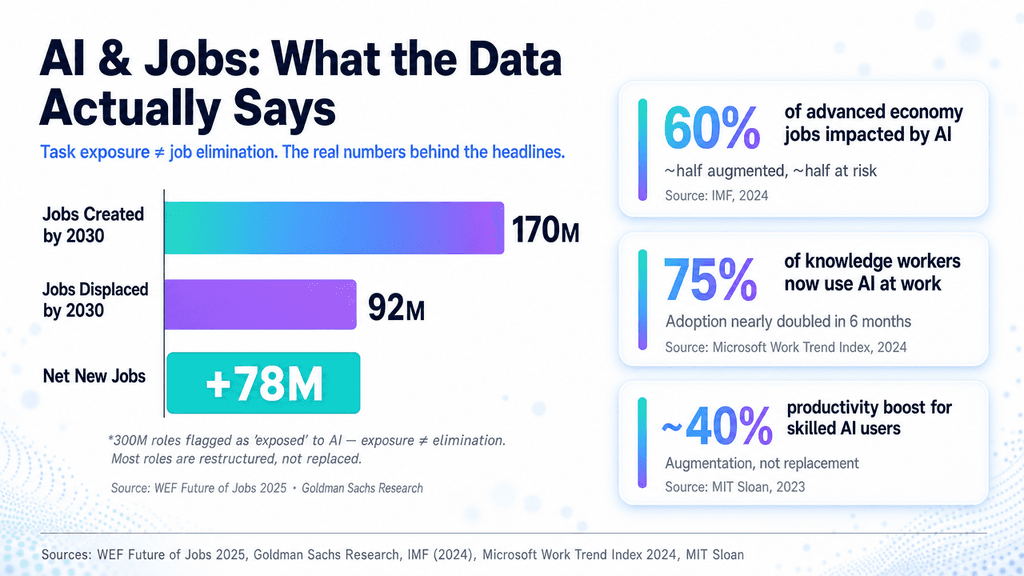
Have you ever watched a single headline turn a measured estimate into a foregone conclusion? That pattern has locked the AI-and-labor debate into a simple binary: either tools raise everyone’s output or they wipe out entire professions. Start with the Goldman Sachs figure that generative AI could touch 300 million full-time roles. The public takeaway became three hundred million jobs gone. Cross-check the same data through the ILO and OECD lens, though, and the picture changes. Task-level exposure rarely equals wholesale occupational replacement.
Break an occupation down into its actual pieces and the difference becomes clearer. An LLM does not step in for the full financial analyst or software engineer. It takes over slices - condensing earnings calls, generating routine test scripts, that sort of thing. When roughly 30 percent of someone’s daily work shifts to the model, firms almost never cut 30 percent of the headcount. They re-bundle the role instead, nudging the person toward higher-value judgment calls, client work, and the messy exceptions that still need a human.
At the same time, forecasts of mass displacement tend to glide past infrastructure limits and the well-documented J-curve. Building agentic systems that run entire back-office functions still demands heavy integration work, stable APIs, and access to enough GPUs. Data-center buildouts, power constraints, and silicon lead times act as a natural brake. Most organizations are still in the early, high-friction part of that curve - investing without yet seeing the labor displacement that only comes after processes are fully rewritten.
What also tends to get lost is the question of job quality. OECD and WEF work points to wage pressure and tighter algorithmic oversight rather than sudden unemployment. As routine cognitive tasks move to machines, some roles risk becoming oversight positions with less negotiating room on pay. Developers and senior leaders who shape the systems may see gains, while mid-level knowledge work feels the squeeze.
From what I've seen, the old "skills mismatch" framing no longer fits what is unfolding. Policymakers would do better to focus on targeted wage supports and active labor market policies that cushion workers during the adjustment rather than assume everyone simply needs another certificate. The real test for any organization is whether it is tracking task shifts, not chasing headline job-loss numbers.
📊 Stakeholders & Impact
Stakeholder / Aspect | Impact | Insight |
|---|---|---|
Enterprise Leaders (CIO / CHRO) | High | They face the practical puzzle of moving from headcount planning to task-based capability mapping while LLMs are still being woven into live operations. |
AI / LLM Providers | Medium | Adoption speed hinges on how cleanly teams can redesign workflows around new APIs without breaking day-to-day reliability. |
Knowledge Workers | High | Full unemployment remains unlikely, yet exposure to wage compression, rapid upskilling demands, and loss of task autonomy is real and immediate. |
Policymakers & Labor Regulators | Significant | The priority is building focused transition supports and safety nets instead of reacting to broad unemployment forecasts that the data do not support. |
✍️ About the analysis
This independent review pulls together labor-market data and forecasts from the ILO, WEF, OECD, and Goldman Sachs. It strips away the hype to show the structural timeline and mechanics behind AI-driven workforce changes, aimed at technical leaders and policy watchers who need more than headlines.
🔭 i10x Perspective
The "Jobapocalypse" story keeps pulling attention away from what is actually happening: routine cognitive work is becoming cheaper and more abundant while the value of orchestration rises. Inference costs will keep falling and data centers will keep scaling. That combination will separate biological labor from many tasks that can now be handled by compute-backed routing. Offices will not empty out, but the distribution of opportunity will sharpen.
People who learn to direct fleets of AI agents will multiply what they can deliver; those anchored to older workflows will find ground shifting under them. Watching how the major labs assemble agent frameworks today gives the clearest preview of the enterprise roles that will emerge next.
Related News

LLM Medical Prognosis Limits: Why Models Fail Survival Forecasts
Benchmarks show LLMs excel at extracting data from records but struggle with calibrated long-term risk estimates. Discover why prediction drift blocks clinical use and how hybrid pipelines are emerging. Explore the guide.

Shadow AI Risks: Securing Developer Endpoints in LLM Workflows
Enterprises secure production AI but overlook Shadow AI risks from unvetted developer tools and personal LLM keys. Discover how AI Bills of Materials and full-lifecycle controls close the gap.

Grok for Startups: xAI Credit Program for Founders
xAI launches Grok for Startups with 6-12 months of unified credits for Grok, API, Build and Bot. Discover the 20/80 staged release to cut early burn rates and secure ecosystem access.