
Agent ResearchAnthropic
Evidence check
  • Preprint
  • No code released
  • Not independently replicated

Agent “Skills” Mostly Anchor Procedures, Not Inject Knowledge — and Retrieval Breaks Them

Skills beat workflow memory by 6.06 points, but 65.7% of their benefit is procedural anchoring. As skill pools grow from 5 to 100, actual-use precision falls from 29.6% to 3.3%.

Christopher Ort
By Christopher Ort · 2 min read
Share
AI agent's procedural skills being disrupted by external information retrieval, showing broken connections.
Illustration: i10X
On this page
  1. Quick Take
  2. What the study shows
  3. Why it matters: skills are not a knowledge base
  4. Method in brief
  5. What remains open
  6. Context
  7. What it means for skill libraries
  8. About the analysis
  9. i10x Perspective
i10X Quick Take

Quick Take

  1. The finding: Skill-augmented agents beat workflow memory by 6.06 points (95% CI +0.76 to +11.36).
  2. Why they work: Procedural anchoring explains 65.7% of skill cases; explicit knowledge injection only 4.5%.
  3. Why they fail: As skill pools grow from 5 to 100, actual-use precision falls from 29.6% to 3.3% — retrieval becomes the bottleneck.

Agent systems increasingly store reusable “skills”: compact descriptions of what to do, check and avoid. Princeton, UCSD, Stanford, USC and Johns Hopkins researchers ask not whether skills raise success, but why they work — and when they stop.
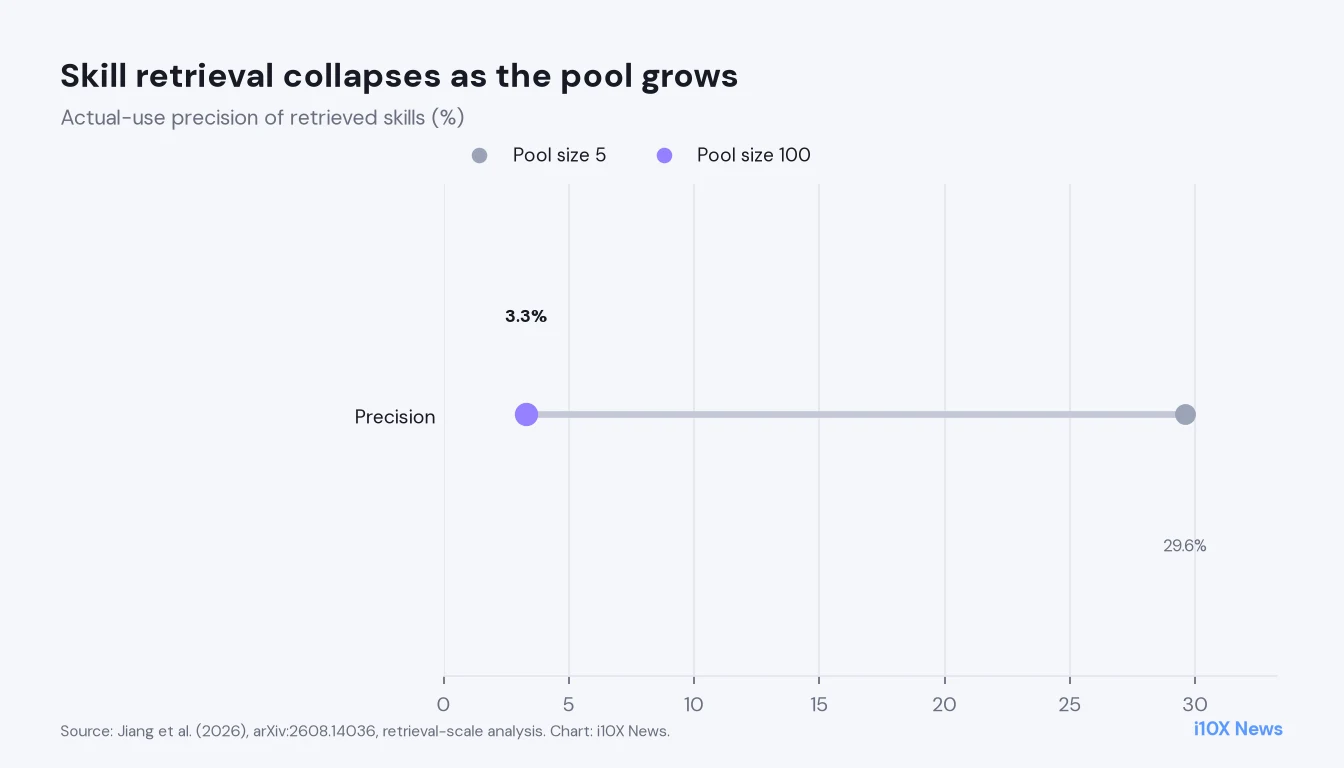
Dumbbell: skill actual-use precision falls from 29.6 percent at pool size 5 to 3.3 percent at pool size 100.
i10X chart based on data from Jiang et al. (2026), arXiv:2608.14036, retrieval-scale analysis (arXiv non-exclusive license).

What the study shows

Matched comparisons against raw baselines and workflow memory, with a human-validated mechanism taxonomy (95.8% agreement, Cohen’s κ = 0.952).

  • Skills stabilize action: They encode procedures more than missing facts.
  • Success composition: Skill-guided success accounts for 61.6% of skill-arm cases vs 54.5% workflow-guided success in the workflow arm.
  • Taxonomy mode: Skills fall into successful-procedure class in 61.7% of cases vs 59.1% raw and 55.7% workflow memory.

Why it matters: skills are not a knowledge base

If skills mainly anchor procedures, bloating a skill library with facts will not help — and poor retrieval will erase the gains.

Method in brief

Trajectory grounding with 714 checks; taxonomy aggregation validated by humans.

What remains open

  • Setting-specific: Results depend on the skill format and domains tested.
  • Retrieval methods: Better retrievers might slow the precision drop.

Context

Related to Anthropic-style skills and agent memory. See Agents.

What it means for skill libraries

  • Keep pools small or curated: Precision collapses at scale.
  • Write procedural skills: Checklists and pitfalls beat trivia.
  • Measure actual use: Retrieval hit rate alone is insufficient.

About the analysis

Researched and written with AI assistance under the editorial responsibility of the i10X News team. The title image is an AI-generated illustration. Read our AI Use Policy. Spotted an error? Request a correction.

This article is based on the full text of the preprint “Demystifying Agent Skills: Why They Work-Until They Don’t” (arXiv:2608.14036v1, submitted August 14, 2026). All numbers are taken from the paper’s text, tables and figures; i10X did not rerun the experiments. The paper is distributed under arXiv’s non-exclusive license, so i10X does not reproduce its figures; the chart was drawn by i10X from numbers reported in retrieval-scale analysis.

i10x Perspective

Skills looked like a way to give agents lasting know-how. This paper says most of the win is reminding the agent how to act, and that win dies when the library gets noisy. The product lesson is ruthless curation.


Christopher Ort

Christopher Ort

Christopher Ort handles SEO, AI agent workflows and PR & partnerships at i10x.ai, the all-in-one AI workspace built by i10X Global Pte. Ltd. in Singapore. He is a graduate of Friedrich-Alexander-Universität Erlangen-Nürnberg (FAU). He is the author of “The Style Penalty”, a study published on SSRN that analyses 1,576 evaluation decisions by four frontier AI models to show how AI-written CVs fare in automated hiring screens; the research has been covered by heise online and t3n.

Timeline

What happened before

  1. Release

    Claude Haiku 5.5

    1M context · $0.1 / $0.5 per 1M tokens

    support.claude.com (source, opens in a new tab)
  2. Release

    Claude Sonnet 5.5

    1M context · $2 / $10 per 1M tokens

    support.claude.com (source, opens in a new tab)
  3. Release

    Claude Opus 5.5

    1M context · $4 / $20 per 1M tokens

    First model of the Claude 5.5 family; performs at the level of Claude Fable 5.1 on most work and costs 40% less to run than Opus 5.

    anthropic.com (source, opens in a new tab)
  4. Partnership

    Accenture partnership on independent frontier-AI evaluation (≥$1B each over five years)

    With Accenture · Research

    anthropic.com (source, opens in a new tab)
  5. Release

    Claude Fable 5.1 & Mythos 5.1

    1M context · $10 / $50 per 1M tokens

    Anthropic's most advanced models for coding and knowledge work. Price/context shown for Claude Fable 5.1 (models overview).

    support.claude.com (source, opens in a new tab)
Full Anthropic timeline ›

Editor's picks

  1. Anthropic IPO Filing Reveals Extreme AI Safety Risks
  2. Grok Imagine Odyssey Pilot Exposes AI Video Limits
  3. Anthropic Files S-1 for Nasdaq IPO Under Ticker ANT
  4. Jakarta Agentic AI Milestone Delivers Standardized AI Agents for Java
  5. llm-deepseek Serialization Bug Replays Text After Tool Use