
Google’s Gemini 1.5 Pro: Bundling, Governance, and the Multimodal Context War
Google is aggressively deploying its flagship Gemini 1.5 Pro model across a fragmented product matrix, leveraging ecosystem bundling to capture everyday consumers while enforcing strict platform governance for enterprise developers via Vertex AI. What happened is straightforward enough on the surface: Google has split access paths for Gemini 1.5 Pro. Consumers get it through hybrid bundles like Google One AI Premium, while developers reach it via direct APIs or Vertex AI. The result is a fair bit of market confusion over where the actual models (Pro, Flash, Nano) end and the product wrappers begin.
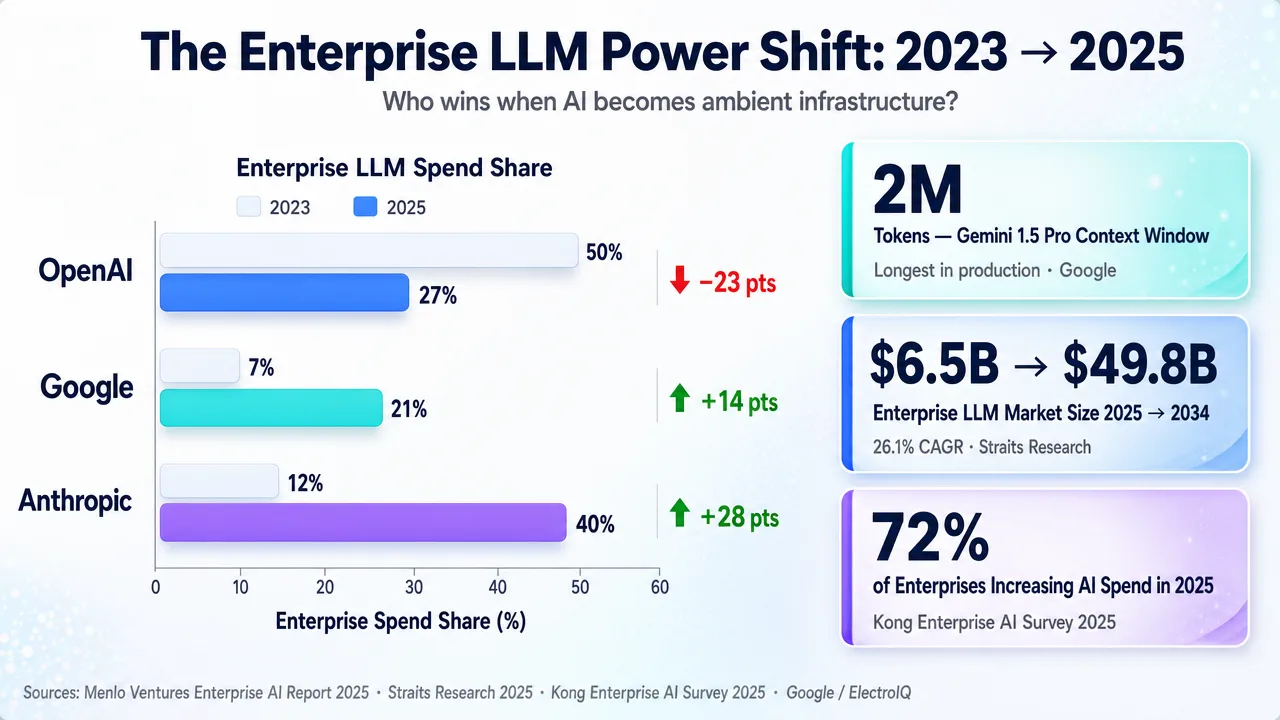
Why it matters now comes down to a shift in the LLM race. Raw intelligence benchmarks matter less than distribution and context mechanics. By routing a model built for massive context windows—multimodal video, code, and text—through channels people already use, Google is testing whether its moats can blunt OpenAI’s brand lead. From what I’ve seen, that bet hinges less on technical superiority and more on habit.
CTOs, platform engineers, and regular users all feel the pinch. They’re weighing cost-subsidized consumer plans against the compliance overhead of enterprise infrastructure, and the trade-offs aren’t always obvious at first glance. The under-reported angle is data sovereignty and naming: most people don’t realize consumer-grade Gemini sessions feed different retention pipelines than the SOC2-compliant, IAM-gated setups required for Vertex AI.
🧠 Deep Dive
Google’s rollout of Gemini Pro—specifically Gemini 1.5 Pro—has created a nomenclature headache that’s larger than the company probably intended. Spend time with the docs and coverage and the split becomes clear: the intelligence engine (the model itself) is being sold inside very different commercial chassis, from Gemini Advanced to Workspace to Vertex AI. That gap isn’t just confusing; it obscures the dual strategy of owning both household and enterprise ground.
On the technical side, Gemini 1.5 Pro still stands out for its context window and native multimodal training. It wasn’t a text model with vision bolted on later; it was built to handle video, audio, and large codebases at once. For engineers the day-to-day issues are usually latency and rate limits, which pushes many toward Gemini Flash for volume work and 1.5 Pro when the reasoning needs to span modalities.
Consumer messaging, though, tells a different story. Google has tucked the heavier model inside the Google One AI Premium tier, so users effectively subsidize inference costs with YouTube Premium and extra storage. It’s a quiet infrastructure play—AI becomes another ambient feature rather than something you buy on its own.
The collision shows up most for businesses. A product manager experimenting with Gemini Advanced on a corporate account is often outside the data-residency and compliance guarantees Vertex AI provides. Enterprise docs stress IAM controls, HIPAA alignment, and evaluation testing; consumer paths do not. That distinction matters more than most coverage admits.
In the end, the Gemini Pro rollout captures where the sector is heading. As base models converge, advantage shifts to whoever can route a million-token context window through the right pricing, compliance, and latency rules for each use case.
📊 Stakeholders & Impact
AI / LLM Providers
Impact: High. Insight: Google is pushing competitors like OpenAI and Anthropic to compete on bundling (Workspace, YouTube, Cloud) as much as reasoning.
Enterprise IT & DevOps
Impact: Significant. Insight: Teams have to keep consumer Gemini tiers from becoming shadow IT and migrate workflows into governed Vertex AI environments to maintain compliance and data controls.
Consumers & Freelancers
Impact: Medium. Insight: Subscription decisions now involve real ROI trade-offs against bundled storage and media perks, not just per-inference pricing or model capability.
AI Infrastructure & Cloud
Impact: High. Insight: The large context window is reshaping data-center priorities toward sustained multimodal workloads and long-lived inference sessions.
✍️ About the analysis
Researched and written with AI assistance under the editorial responsibility of the i10X News team. The title image is an AI-generated illustration. Read our AI Use Policy. Spotted an error? Request a correction.
This independent analysis draws on technical model documentation, cloud deployment guides, and consumer pricing details. It is meant for CTOs, product managers, and developers who need to separate the model from the commercial layers.
🔭 i10x Perspective
The fragmentation around Gemini Pro marks a broader turn. The era of the “naked LLM” is closing. Google is leaning on Android, Workspace, and its TPU stack to make the AI layer feel like basic infrastructure rather than a separate product. Over the next few years the real test will be whether OpenAI’s speed or Google’s ambient presence wins out—
Conclusion
The company that makes its multimodal context window the least noticeable part of daily work will likely come out ahead. Whoever makes the multimodal context window the least noticeable part of daily work will likely come out ahead.