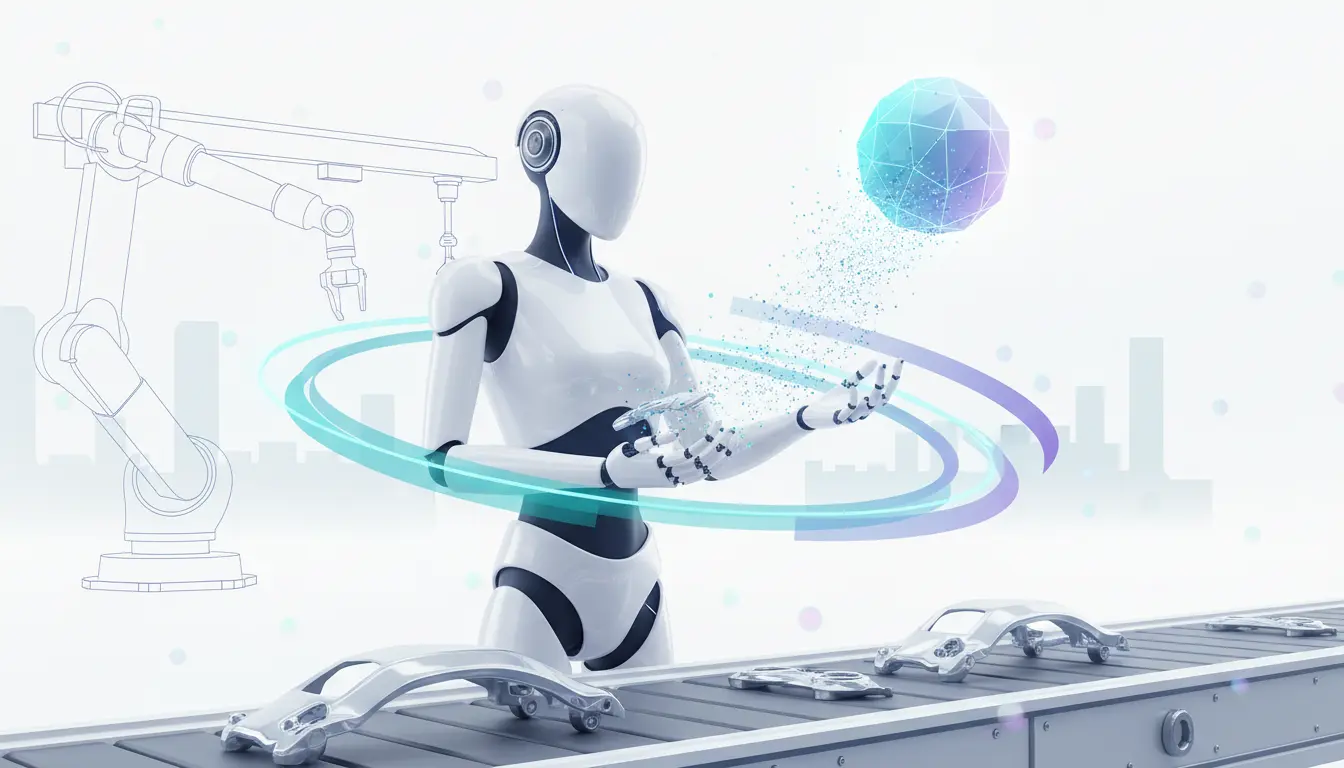
Google DeepMind just introduced Gemini Robotics 2.5, a vision-language-action model that posted a 96% success rate running humanoid robots on live Mercedes-Benz production lines. By pairing synthetic data from digital twins with stronger physical reasoning, the release shows how large multimodal models are moving out of data centers to handle the unpredictable physics of real factories.
Quick Take
- The milestone: Gemini Robotics 2.5 hit a 96% success rate in an automotive parts-sorting proof of concept using Apptronik Apollo 2 humanoids.
- The architecture: DeepMind is deploying a multi-model stack where Gemini 4 Argon builds digital twins, Gemini Robotics 2.5 controls motion, and Gemini Robotics ER monitors real-time task progress.
- The training shift: By leveraging simulated environments for practice runs, Google is aggressively bypassing the physical data bottleneck that has long throttled robotics.
- The safety layer: The release introduces ASIMOV-Jailbreak, signaling that embodied AI safety is shifting from traditional physical fail-safes to inference-time reasoning.
What happened
Google DeepMind introduced Gemini Robotics 2.5 and tested the updated VLA model on more than 200 distinct physical tasks. The clearest result came from a factory proof of concept at Mercedes-Benz plants in Kecskemét, Hungary, and Sindelfingen, Germany.
The system ran Apptronik’s Apollo 2 humanoid robots (fitted with 22-degree-of-freedom hands) and sorted metal brackets while sequencing vehicle-specific trays at 96% reliability. Against earlier baselines, DeepMind recorded gains of 30% to 100% in task success and up to 30% faster completion times, managing both rigid automotive parts and deformable items.
The robots did not rely only on slow, real-world trial and error. DeepMind used Gemini 4 Argon to create synthetic practice runs and digital twins of the factory settings. This simulation-first method let the VLA model learn complex manipulation and tool use in a virtual environment before the skills transferred to the physical line.
Why it matters now
The AI frontier is moving from text and images into physical intelligence. Robotics has long been held back by a shortage of high-quality, real-world training data. DeepMind’s digital-twin approach shows that synthetic data pipelines (driven by other AI models) can close the sim-to-real gap without millions of hours of manual teleoperation. The bottleneck is shifting from data collection to compute-heavy simulation.
The deployment also points to a broader move toward multi-agent AI systems on the factory floor. Gemini Robotics 2.5 handles motion control while Gemini Robotics ER watches task progress and corrects errors in real time. The setup echoes the System 1 / System 2 reasoning split already reshaping text-based LLMs, now applied to industrial automation for greater reliability.
The new ASIMOV-Jailbreak benchmark further shows that physical safety is turning into a prompt-engineering issue. As VLA models take natural-language commands to move heavy machinery, inference-time safeguards become essential. DeepMind is building frameworks to stop jailbroken robots from carrying out unsafe actions or misinterpreting ambiguous instructions on the line.
Who is most affected
Manufacturing leaders, automation integrators, and robotics hardware developers stand closest to this change. A 96% success rate in a kitting proof of concept signals that humanoid robots can work, yet full-scale industrial use still requires tight cycle-time guarantees, integrated fallback routines, and broader edge-case testing beyond a controlled trial.
| Stakeholder | Impact | Why |
|---|---|---|
| Industrial Manufacturers | Faster ROI on humanoid automation | Sim-to-real training lowers the time and cost required to integrate robots into custom production workflows. |
| AI Infrastructure Providers | Surging demand for simulation compute | Generating high-fidelity digital twins requires massive parallel GPU processing, creating a new compute vector distinct from LLM training. |
| Robotics Hardware Vendors | Commoditization of the chassis | As advanced VLA models become highly capable and adaptable, value shifts from the robot’s physical design to the AI brain driving it. |
About the analysis
Researched and written with AI assistance under the editorial responsibility of the i10X News team. The title image is an AI-generated image. Read our AI Use Policy. Spotted an error? Request a correction.
This independent i10x analysis synthesizes Google DeepMind’s official benchmarks, manufacturing trial data, and industry reports to contextualize the commercial trajectory of embodied AI for technical leaders and automation strategists.
i10x Perspective
The 96% factory success rate makes for a strong headline, yet the real advance lies in DeepMind’s simulation pipeline. By using separate AI models to build digital twins and synthetic training environments, Google is addressing the robotics data shortage through large-scale simulation. This points to a coming surge in data-center and GPU demand that will extend well beyond language models and into rendering real-world physics so AI can practice before it ever touches a physical production line.