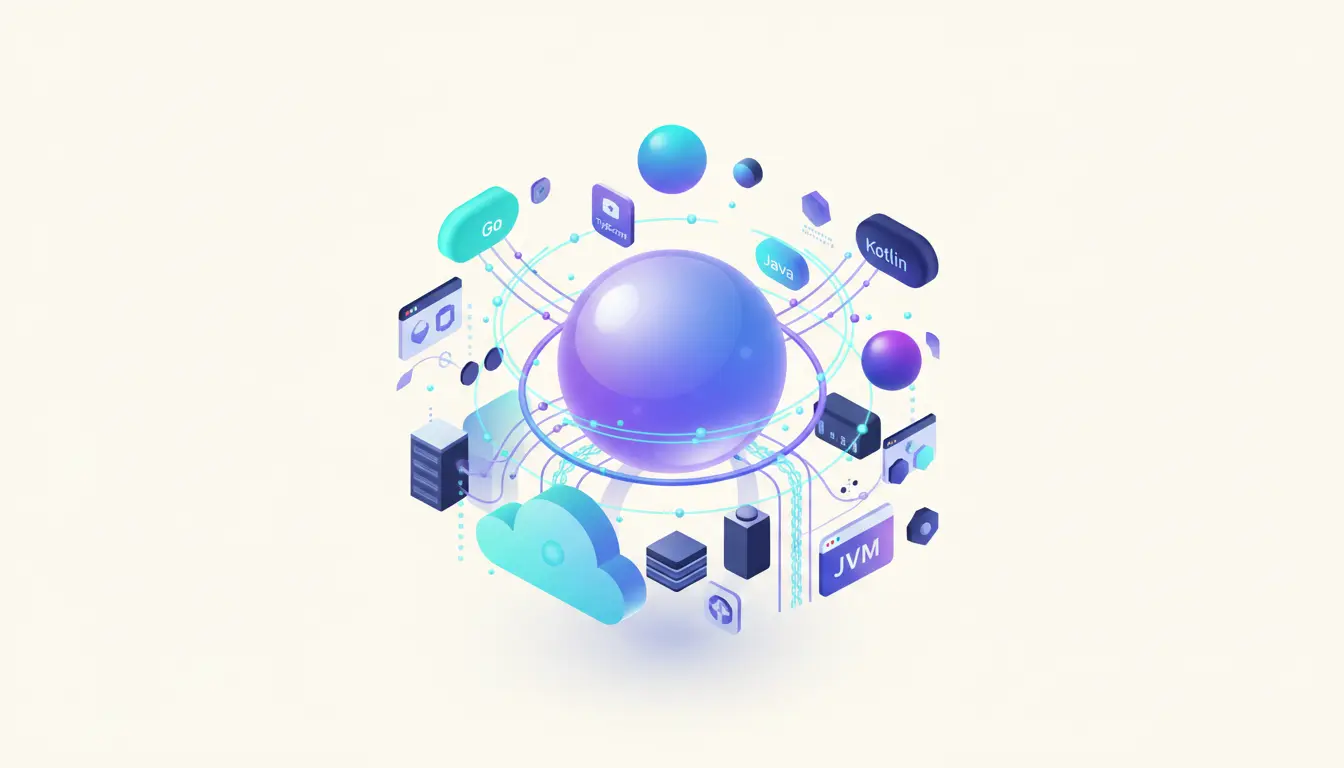
Google has expanded its open-source Agent Development Kit (ADK) with native support for Go, TypeScript, Java, and Kotlin on top of the original Python base. The move pulls AI agent work out of isolated data-science environments and places it inside the languages and runtimes that already power enterprise systems.
Quick Take
- The news: Google’s ADK now natively supports five programming languages, breaking the traditional Python monopoly in generative AI development.
- The infrastructure shift: Enterprise AI is moving from isolated prototypes to distributed, multi-agent systems capable of running across web browsers, JVM applications, and Kubernetes clusters.
- The protocol power play: The expansion heavily leverages the Agent2Agent (A2A) protocol and Model Context Protocol (MCP) to ensure agents built in different languages can seamlessly discover each other, delegate tasks, and access enterprise databases.
- The competitive edge: By accommodating the tools developers already use, Google is positioning the Gemini Enterprise Agent Platform and Vertex AI as the unified orchestration layers for the next generation of multi-agent workloads.
What happened
Google has upgraded its open-source Agent Development Kit, rolling out native compatibility for Go, TypeScript, Java, and Kotlin. This expansion allows software teams to build AI agents using the languages native to their existing backend services, web applications, and Android environments, eliminating the need to force-fit Python into varied enterprise architectures.
The toolkit is deeply integrated with the Gemini Enterprise Agent Platform and Vertex AI Agent Engine. It provides the necessary command-line tooling, project scaffolding, and deployment configurations to push AI agents directly into diverse runtime environments. This includes local execution, Google Kubernetes Engine (GKE), and Cloud Run.
Beyond just language syntax, the update is designed around open interoperability. It packages native support for standardized communication protocols, enabling developers to stitch together complex, distributed agent networks rather than building monolithic AI applications.
Why it matters now
The AI industry has a deployment bottleneck: powerful LLMs are often trapped in Python-heavy prototype wrappers that struggle to mesh natively with existing Java or Go-based enterprise infrastructure. By democratizing the language requirements, Google is eliminating the friction between AI engineering and traditional software development. An organization can now deploy a frontend TypeScript agent for user interaction that seamlessly hands off complex backend processing to a high-performance Go agent.
This cross-runtime collaboration is supercharged by two critical interoperability frameworks. The Model Context Protocol (MCP) acts as a standardized bridge, securely connecting these diverse agents to external tools, APIs, and proprietary enterprise data. Simultaneously, the Agent2Agent (A2A) protocol allows agents-even those built in non-Google frameworks like LangGraph or CrewAI-to discover capabilities and delegate tasks to one another.
Strategically, this is Google maneuvering to own the multi-agent orchestration layer. By providing the tools to build, govern, and deploy a multi-language swarm of agents, Google Cloud is cementing Vertex AI as the ambient event mesh for enterprise intelligence, targeting CTOs who are weary of fragmented AI tooling.
Who is most affected
The immediate beneficiaries are enterprise platform engineering teams and traditional software developers who have historically been sidelined by the Python-centric nature of the generative AI boom. Organizations heavily invested in JVM or Go architectures can now integrate LLM-driven intelligence natively without maintaining parallel tech stacks, bridging disparate runtimes, or entirely retraining their engineering workforce.
| Stakeholder | Impact | Why |
|---|---|---|
| Enterprise CTOs | Unified AI infrastructure | They can govern, monitor, and scale AI agents within their existing security perimeters and cloud deployments. |
| Software Developers | Native AI integration | They are no longer required to learn Python to build, debug, and orchestrate production-grade AI agents. |
| AI Platform Teams | Simplified orchestration | Standardized A2A and MCP protocols allow agents from different internal teams or external vendors to collaborate securely. |
The governance and scaling angle
Moving beyond language diversity, this expansion signals a maturation in how multi-system agents are governed in production. When agents communicate across languages using A2A via the Vertex AI Agent Engine, enterprises gain access to centralized observability tools like the Agent Registry and Agent Gallery. This means a sprawling corporate network of diverse, autonomous agents can finally be monitored for context management, session security, and evaluation metrics as a cohesive production unit, rather than a fractured set of API calls.
About the analysis
Researched and written with AI assistance under the editorial responsibility of the i10X News team. The title image is an AI-generated illustration. Read our AI Use Policy. Spotted an error? Request a correction.
This is an independent i10x analysis based on official product documentation, developer guidelines, and industry reporting, curated to help technical leaders, CTOs, and platform engineers navigate the evolving AI infrastructure landscape.
- Google expands AI agent kit to five languages (IT Brief)
- Google expands AI agent kit to five languages (Channel Life)
- Five guides to building and scaling production-ready AI agents
- Build and manage multi-system agents with Vertex AI
- Agent Development Kit | Gemini Enterprise Agent Platform
- Gemini Enterprise Agent Platform | Google Cloud Documentation
i10x Perspective
The era of the monolithic, Python-exclusive AI agent is effectively over. Google’s expansion of the ADK reflects a critical market reality: for AI to truly infiltrate the enterprise, it must conform to the infrastructure that already runs the world, not the other way around. As protocols like A2A and MCP standardize how intelligence communicates across language barriers, the next major AI frontier won’t be about who builds the smartest single model, but who can orchestrate the most resilient, multi-lingual swarm of agents.