Google Health Agents: Analysis
⚡ Quick Take
“Healthcare isn’t a single prompt; it’s a multi-year context window. Google’s new Health Agents framework signals the shift from stateless AI chatbots to stateful, autonomous systems capable of temporal reasoning.”
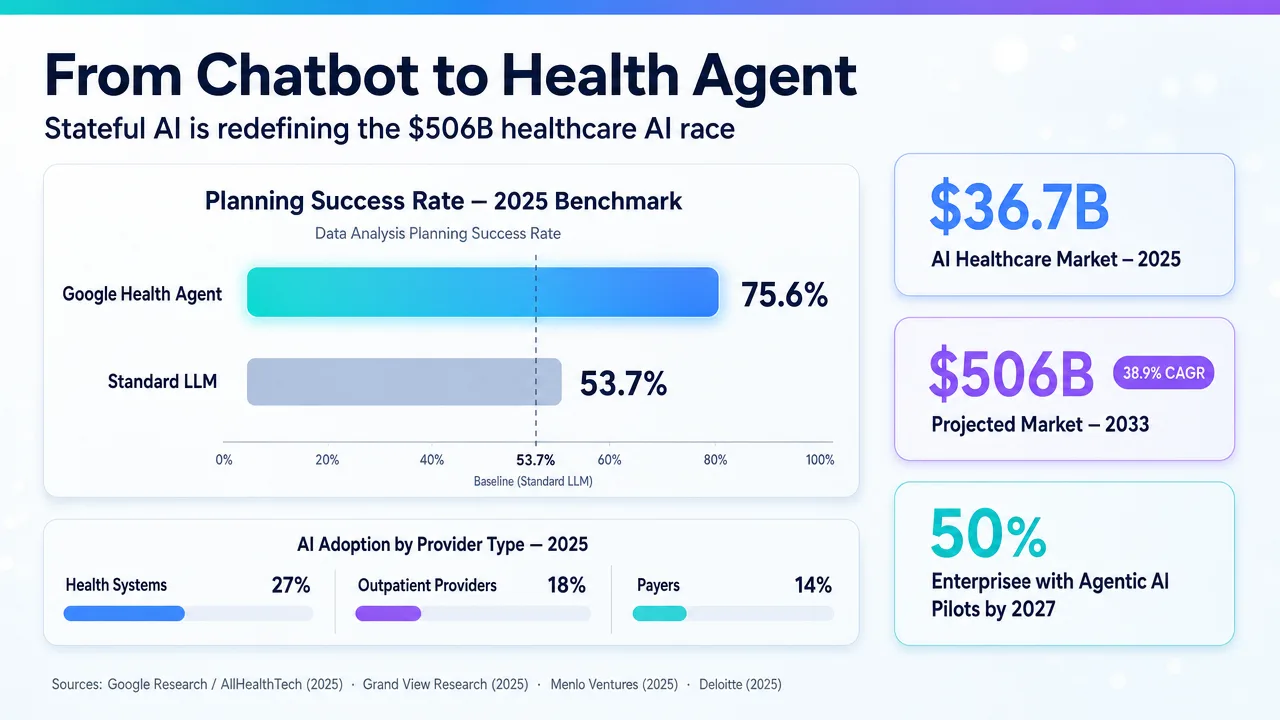
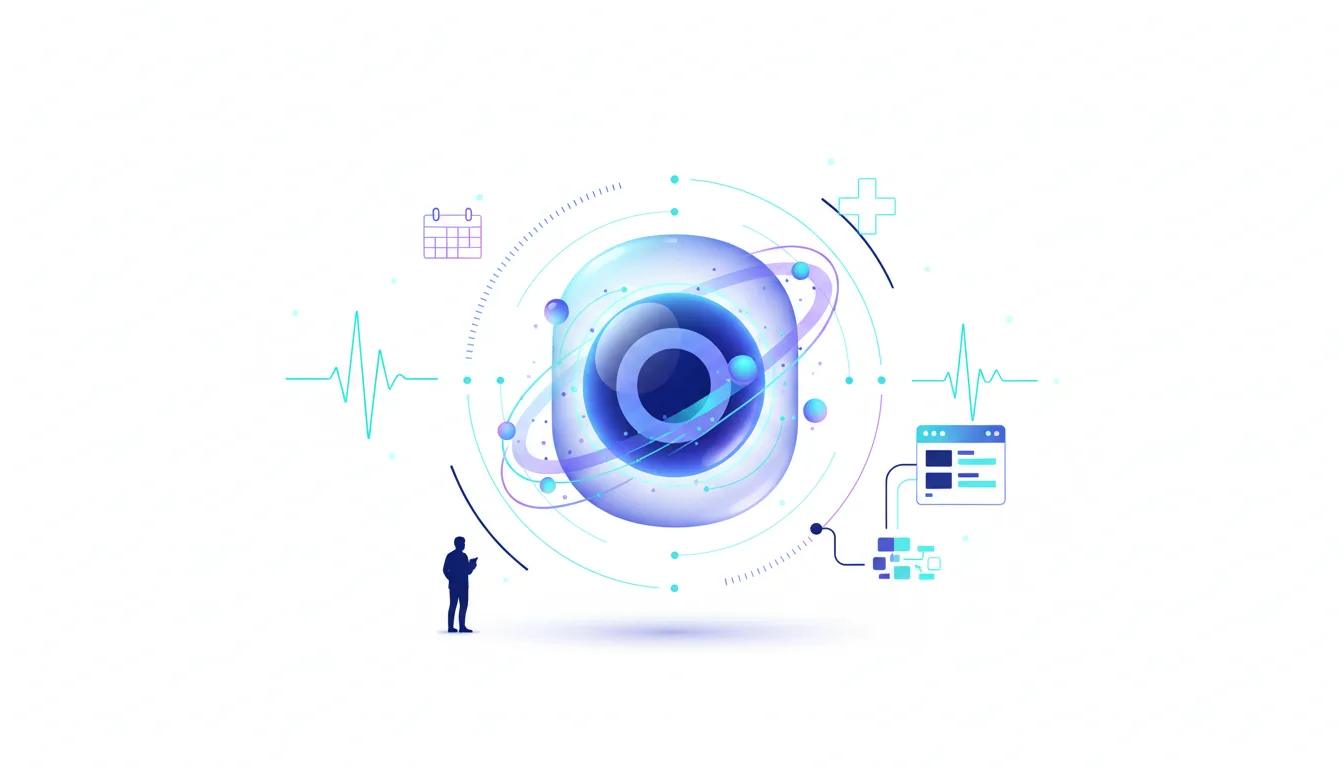
Summary: Google researchers have published a comprehensive framework in Nature defining and evaluating AI Health Agents, moving the industry’s focus from episodic generative Q&A toward long-horizon, autonomous healthcare assistance.
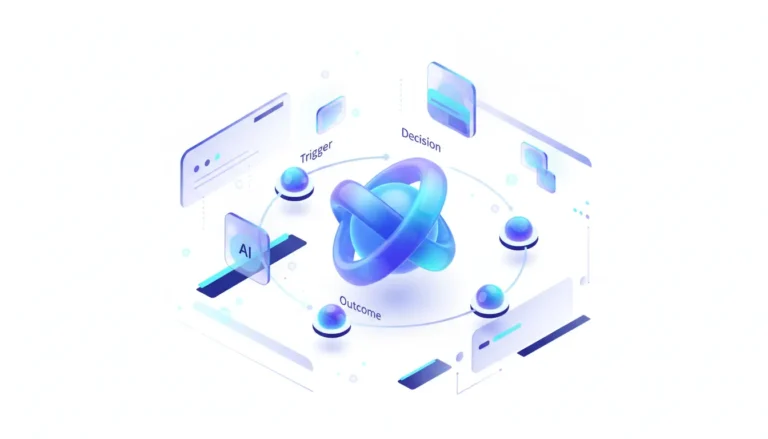
What happened: The team laid out both a benchmark and an architectural blueprint for agents that draw on persistent memory, planner-executor loops, and specialized tool use. Their aim is to handle longitudinal tasks such as chronic symptom tracking and medication adherence over weeks or months.
Why it matters now: Most LLMs remain essentially amnesiac, tuned for one-off or few-shot exchanges inside a single session. This work spells out the technical and safety requirements needed to keep an agent’s decisions coherent across extended time horizons, testing everything from context-window management to temporal credit assignment.
Who is most affected: Digital health product teams, clinical informaticists, AI infrastructure groups building stateful memory systems, and compliance officers aligning capabilities with Software as a Medical Device (SaMD) rules.
The under-reported angle: While headlines often spotlight consumer-facing “app tracking,” the tougher problem sits in the plumbing. Teams must map agentic planner-executor loops into heavily regulated EHR/PHR environments using FHIR while putting reliable Human-in-the-Loop (HITL) escalation paths in place.
🧠 Deep Dive
Have you ever noticed how a standard health chatbot treats today’s question about insulin levels as if it has no connection to a remark you made weeks earlier about skipped meals? That disconnect is exactly what Google’s Health Agents framework, detailed in Nature, sets out to fix. The approach introduces persistent episodic and semantic memory, planner-executor loops, and deeper tool integration. From what I’ve seen, this is less a UI refresh and more a fundamental change in how models handle time and state.
The research also zeroes in on evaluation, which remains a stubborn bottleneck. Static benchmarks such as MMLU or MedQA work fine for one-shot answers, yet they fall short when the task involves guiding a patient across a six-month trajectory. The Nature paper proposes new longitudinal benchmarks that fold clinician review directly into failure analysis, recognizing that risk in these systems often surfaces as gradual drift in planning logic rather than dramatic one-off hallucinations.
That said, a practical gap still separates these academic designs from production use. Integrating agent memory with live EHR/PHR data through FHIR and CDS Hooks is anything but straightforward. Privacy-preserving state management, possibly via edge inference or federated learning, will be essential before these agents can safely maintain the long-term context their architecture requires.
Regulatory and economic realities will shape deployment even more than the tech itself. An agent that merely logs readings may qualify as a low-risk consumer tool, but one that autonomously adjusts care pathways runs straight into FDA SaMD classifications. Product teams will need tightly designed HITL workflows so an agent’s reasoning stays visible and control can shift to clinicians before any safety threshold is crossed.
At its core, the Health Agents story is about infrastructure. It pushes AI providers to re-think how they store and retrieve long-horizon context at scale, with continuous low-latency links between wearable streams and an LLM’s reasoning engine. The organizations that come out ahead will likely be those that master stateful memory orchestration, precise tool use, and airtight compliance rather than those with the flashiest base model.
📊 Stakeholders & Impact
| Stakeholder / Aspect | Impact | Insight |
|---|---|---|
| AI / LLM Providers | High | Demands an architectural shift toward continuous state management, memory retrieval systems (RAG/Agentic mapping), and low-latency tool execution. |
| Digital Health Developers | High | Forces a transition from basic conversational UIs to building SaMD-compliant planner architectures with strict FHIR API integrations. |
| Healthcare Providers | Medium–High | Promises massive reductions in administrative follow-up and basic triage, provided the HITL escalation economics don’t cannibalize the ROI. |
| Regulators (FDA, MDR) | Significant | Accelerates the need for dynamic testing harnesses and updated safety frameworks for AI models capable of autonomous, long-term planning. |
✍️ About the analysis
Researched and written with AI assistance under the editorial responsibility of the i10X News team. The title image is an AI-generated illustration. Read our AI Use Policy. Spotted an error? Request a correction.
This independent, research-driven analysis contextualizes the latest academic and corporate frameworks (including Nature publications and Google AI research) on AI health agents. Designed for technical founders, digital health EMs, and CTOs, it bridges the gap between foundational LLM research, infrastructure planning, and regulatory realities.
🔭 i10x Perspective
The move toward continuous Health Agents previews a larger change in global AI infrastructure: the rise of “ambient intelligence.” We are leaving the period when AI lives inside a deliberate chat window and entering one where models run as quiet background processes, watching, planning, and calling tools without constant user direction. This shift naturally advantages closed-ecosystem players such as Apple and Google, who already control both edge sensors and the cloud resources needed for hybrid setups.
For anyone tracking the AI race over the next five years, the real test will be whether these regulated, context-heavy agents can scale without burying providers under compliance and liability costs.