How AI Creates New Entry-Level Jobs: MIT & NBER Evidence
⚡ Quick Take
The common story these days is that generative AI will wipe out entry-level roles, yet fresh economic research points the other way. Past technological leaps have tended to work as powerful engines for creating new tasks - ones that younger, skilled workers often step into first.
Recent analyses from MIT and NBER working papers show how general-purpose technologies have usually led to net job gains for early-career talent by spawning roles that simply didn't exist before. With that in mind, business leaders and policymakers now face the practical question of how quickly LLMs will spread - and how to shape the kinds of apprenticeships that will matter in an intelligence-driven economy.
Economists have pored over postwar U.S. records to separate simple exposure to automation from outright displacement. The pattern is consistent: while older tasks get automated away, new technologies open up fresh categories of work, and history shows younger workers tend to fill them because they aren't carrying outdated habits.
What stands out now is that the AI conversation stays fixated on compute power and scaling. Once these models move into real enterprise use, though, a quieter shortage appears - the people needed to guide, test, and weave them into daily operations. If the pattern holds, demand should rise fastest for specialized entry-level work that barely existed a year or two ago.
Early-career professionals, HR teams rethinking roles, and policymakers trying to match skills to regional economies all feel the shift most directly. The real constraint isn't whether AI will take over coding or writing; it's the shortage of clear routes - apprenticeships, micro-credentials, and the like - to steer young talent into the tasks that today's AI systems are already generating.
🧠 Deep Dive
Have you ever wondered why AI discussions keep circling back to job loss, even as evidence from earlier tech shifts suggests something more layered? A quick look at Google's search results today shows AI Overviews sitting right above job listings, which keeps the tension high. For the past couple of years the talk has split between full replacement and basic support. Work from MIT and NBER, however, highlights a steadier thread: technology creates as much as it removes.
Executives often read "AI exposure" as shorthand for cuts, but the record from earlier general-purpose tools tells a different tale. Automation trims costs and eventually triggers a productivity upswing - the familiar J-curve. That surge tends to generate brand-new tasks, which younger workers with fewer legacy routines pick up more readily.
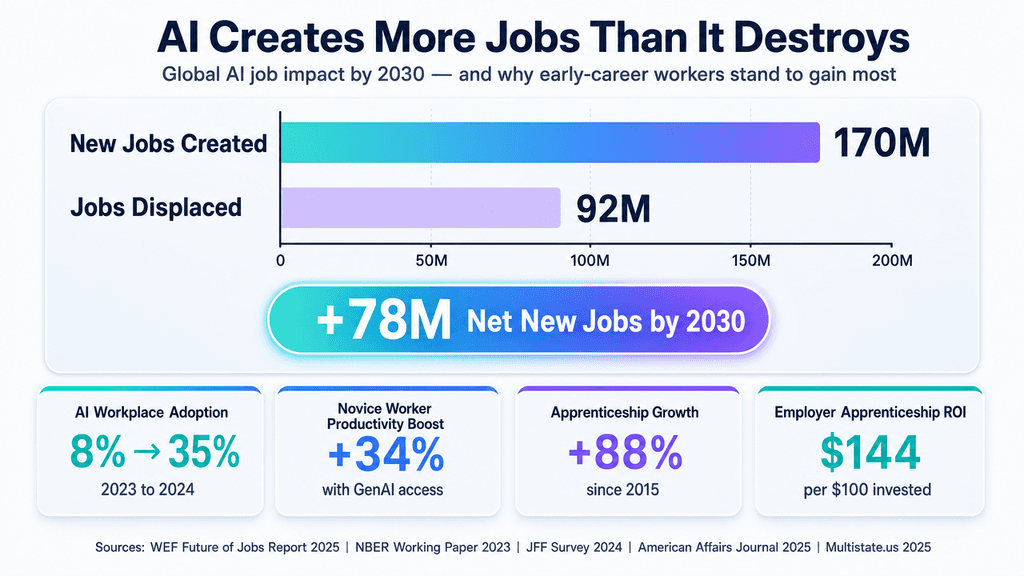
So instead of focusing only on how many junior coders might lose ground to Copilot, it makes sense to map what fresh work will actually appear around these systems. As tools from OpenAI, Google, and Anthropic grow more multi-modal and agentic, roles in model evaluation, prompt-pipeline upkeep, data alignment, and governance are already forming.
A gap still sits in the middle. Research confirms that tech waves eventually favor newer cohorts, and groups like Brookings push for broad retraining. Yet few organizations are connecting those new tasks to actual job codes or entry-level tracks. Companies aren't mainly dealing with layoffs right now; they're figuring out how to build internal ladders into work that didn't exist eighteen months ago.
This same pressure shows up in the infrastructure build-out. Just as data centers test power grids, large-scale model deployment will test the supply of people who can adapt, secure, and watch over them once they're in place. Realizing the expected returns on heavy GPU investments will depend first on closing that entry-level gap.
📊 Stakeholders & Impact
- AI / LLM Providers
Impact: Medium
Insight: User adoption and enterprise scale depend heavily on a workforce capable of managing and orchestrating new models. - Enterprise Leaders & HR
Impact: High
Insight: Must pivot from "automation defense" to "task creation offensive," redesigning junior job architectures to capture the productivity J-curve. - Early-Career Workforce
Impact: High
Insight: Maximum leverage. Young workers have the highest capacity to capture net-new roles, provided they position themselves toward emerging AI-native tasks. - Regulators & Policy
Impact: Significant
Insight: Need to shift focus from protective wage insurance to aggressive funding for AI apprenticeships and credentialing programs.
✍️ About the analysis
This independent look draws on economic working papers from MIT and NBER, enterprise surveys from WEF and HBR, and policy briefs from various think tanks. It is meant for CTOs, HR leaders, and policymakers who want to move past simple automation headlines and start shaping the next layer of intelligence-driven work.
🔭 i10x Perspective
The idea that "AI eats the young" misses the historical pattern. General-purpose technologies have usually found their footing through early-career talent. Over the next five to ten years, as models shift from chat interfaces toward autonomous agents, the real edge for companies will come from spotting those newly created tasks early and building clear paths for younger workers to take them on. The forward-looking organizations will likely move away from stockpiling senior prompt engineers and instead invest in sizable, in-house apprenticeship structures tailored to the work AI is now making possible.
Investing in clear, scalable apprenticeship pathways is the single most important action organizations can take to capture the productivity gains of AI while enabling early-career workers to lead on net-new tasks.
Related News

Mistral Large 4: Europe's Top Open-Weight Model
Mistral Large 4 launches as a 1T-parameter MoE model optimized for enterprise coding and cybersecurity. See how it compares to leading Chinese open-weight models and why it matters for buyers. Explore the guide.

AI Agent Videos: The Operator-First Education Gap
Enterprise searches for AI agent videos reveal a split between technical tutorials and hype. Discover why operator-first, no-code resources are essential for non-technical teams to deploy LLM agents effectively. Explore the analysis.

AI Leadership: Why Human EQ Now Outweighs Expertise
Frontier LLMs are automating leadership tasks, raising the stakes for human emotional intelligence and accountability. Learn how organizations can protect core leadership skills while integrating AI.